Lisa Su: “We’ll invest in Korean AI” ... Government seeks cooperation with AMD on three major projects
- Input
- 2026-10-07 13:59:07
- Updated
- 2026-10-07 13:59:07
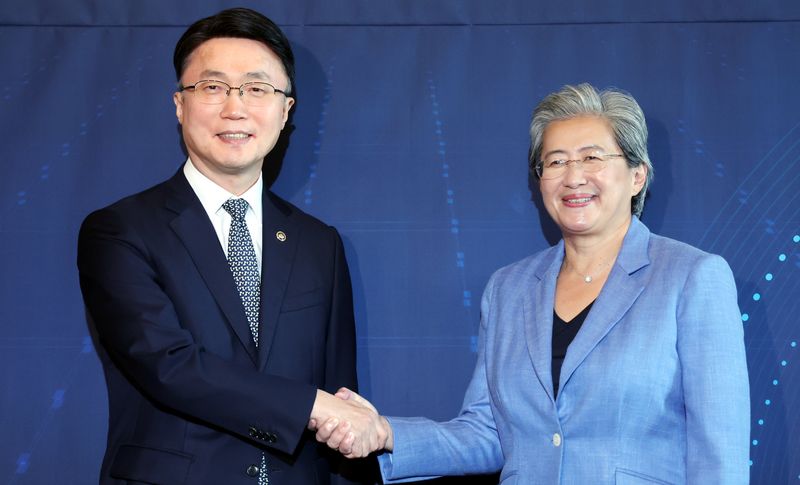
The government is pursuing the development of computing infrastructure combining AMD central processing units (CPUs) and graphics processing units (GPUs) with domestically developed AI semiconductors. Its plan is to develop a model that can be used in global markets following domestic testing, and expand cooperation through “three mega-projects” in semiconductors, AI data centers and physical AI. Lisa Su, AMD chair and chief executive officer (CEO), called the government’s proposal “the right direction and an ambitious vision” and expressed her willingness to participate actively.
Korean AI research hub planned ... cooperation to extend to physical AI
Su met Ryu Je-myeong, second vice minister of science and ICT, at the Four Seasons Hotel in Seoul on the 7th. “I know there is strong demand for AI computing resources in Korea,” she said, adding, “We plan to spare no investment in expanding computing capacity so AI startups and users can easily make use of AI.”The meeting followed a memorandum of understanding (MOU) signed by the Ministry of Science and ICT and AMD last July. The two sides fleshed out cooperation plans, including establishing the AMD AI Center (AI Center of Excellence, or AI CoE) within the year, developing talent and building heterogeneous AI computing infrastructure.
Su personally outlined plans to establish a research hub in Korea and recruit a large number of staff. “We are working to establish an AI research center, ‘CoE,’ to expand Korea’s AI ecosystem,” she said. “We plan to bring several hundred outstanding AI research talents together at the center.” The center is slated to be established within the year, while recruitment is planned over the next several years.
The government also discussed ways to link this effort to joint research in physical AI. Lee Do-gyu, director general of Information and Communications Policy at the Ministry of Science and ICT, said at a background briefing after the meeting that Vice Minister Ryu had proposed partnerships with AMD on three mega-projects: semiconductors, AI data centers and physical AI. Su reportedly called the proposal “the right direction and an ambitious vision” and expressed her willingness to participate actively.
Su also said some of World Labs’ models could be released as open source and developed into a field of joint research at CoE. She said physical AI would become a very important field over the next 3–5 years, and explained that reference designs spanning hardware and solutions would make it easier for customers to use the technology.
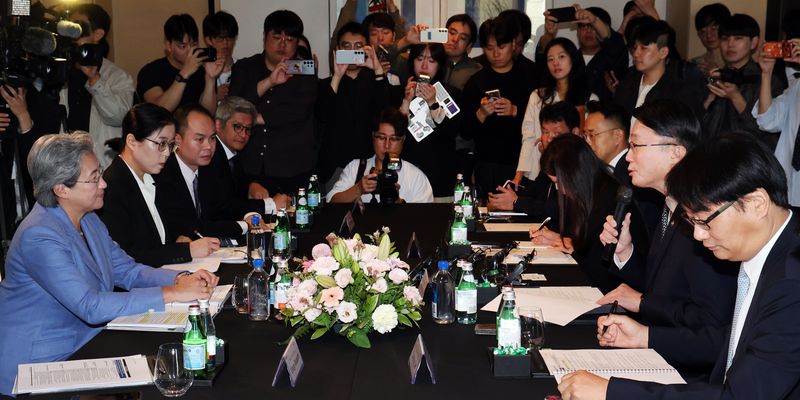
Connecting domestic NPUs with AMD ... Companies propose direct collaboration
Another key agenda item that day was heterogeneous AI computing infrastructure combining different semiconductors and software. The view was that as the AI market expands from training to inference, the ability to use computing resources according to service needs while reducing costs and power consumption has become increasingly important.The two sides agreed to connect AMD CPUs and GPUs with domestically developed neural processing units (NPUs) in a single system and develop it into a reference model that could be used in global markets after domestic testing. “I hope AMD will actively work with Korean NPU startups and help expand the global AI ecosystem together,” Vice Minister Ryu said.
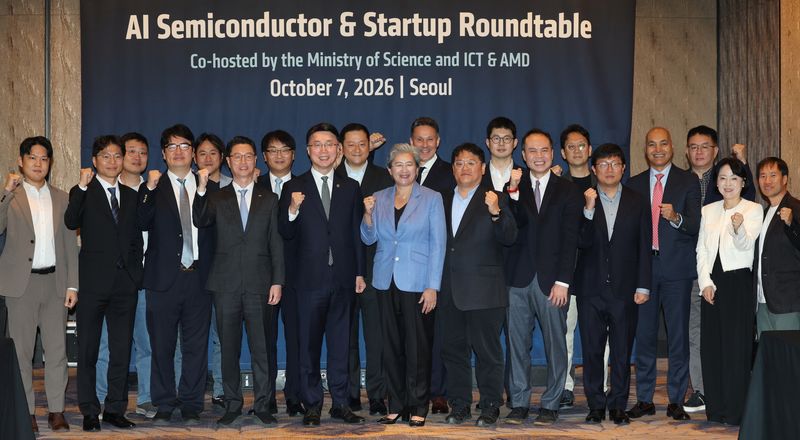
At a closed-door roundtable that followed, Korean companies proposed specific ways to work with AMD executives. Su emphasized an open AI ecosystem and diverse partnerships, saying, “I’d like to express my thanks, as we are already working with companies represented here.”
NPU companies including FuriosaAI, HyperExcel and Mobilint asked how they could participate in the open ecosystem. Su replied that AMD’s philosophy is to make it easy for users to choose the hardware they want, and that the company is open to working with others to connect CPUs with a range of accelerators.
Lablup Inc. proposed integrated CPU-GPU optimization, while Elice Group proposed quickly introducing AMD’s latest systems in modular data centers. HyperExcel presented sovereign AI infrastructure combining the technologies of Korean companies with AMD CPUs and GPUs for AI training. AMD also expressed agreement and a willingness to cooperate.
Cloud and university partnerships have already begun. Su said, “As a first step, we have begun working with MangoBoost on cloud infrastructure,” and also noted that AMD had recently signed an MOU with Seoul National University’s AI Institute.
Lee said the discussion “is significant because it laid the groundwork for cooperation that goes beyond individual companies’ technologies to connect technologies from different fields and expand them into real-world AI services and global markets.”
[email protected] Yoon Hong-jip Reporter