Wi Seong-gon's First 100 Days as Jeju Governor: “Now I'll Deliver Results”; Jeju Second Airport and Economic Policy Put to the Test
- Input
- 2026-10-07 13:37:15
- Updated
- 2026-10-07 13:37:15
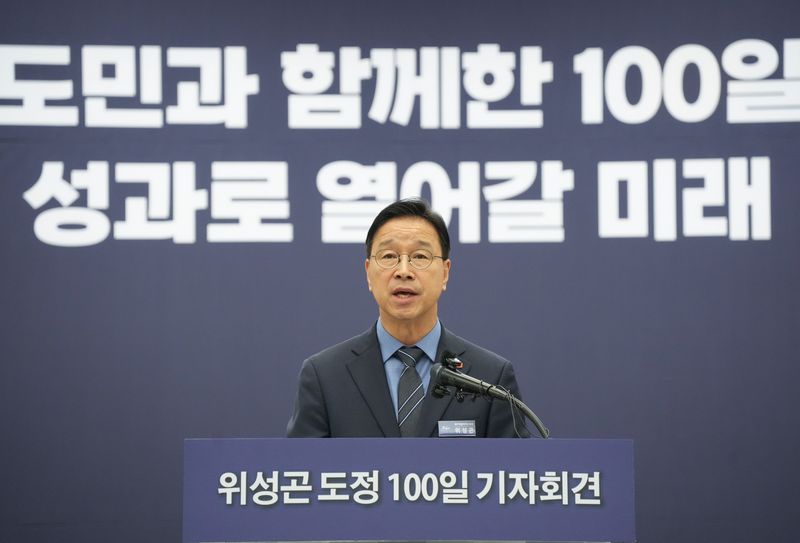
【Financial News Jeju—Reporter Jeong Yong-bok】 The process of gathering residents’ opinions on the Jeju Second Airport will be completed by the first half of next year, and a 2027 comprehensive economic revitalization plan aimed at restoring livelihoods and transforming the industrial structure will be drawn up. Marking his 100th day in office, Jeju Governor Wi Seong-gon outlined plans to shift the focus from the early phase of provincial administration, centered on policy planning and organizational restructuring, to implementation and tangible results.
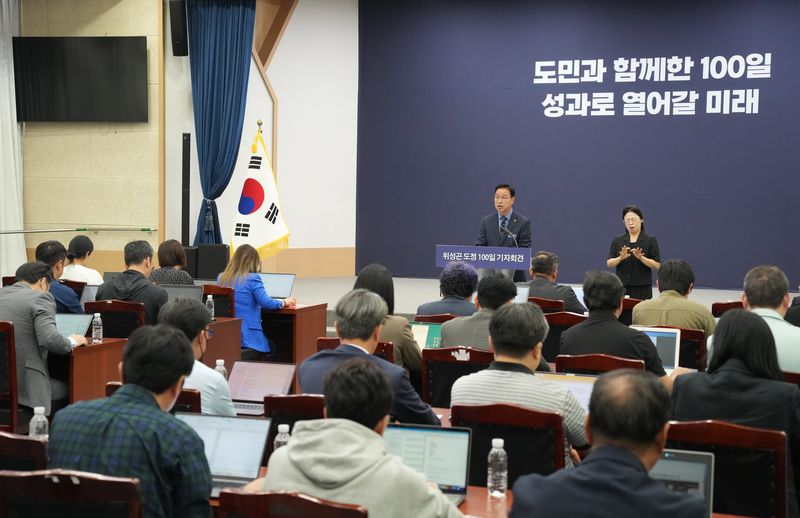
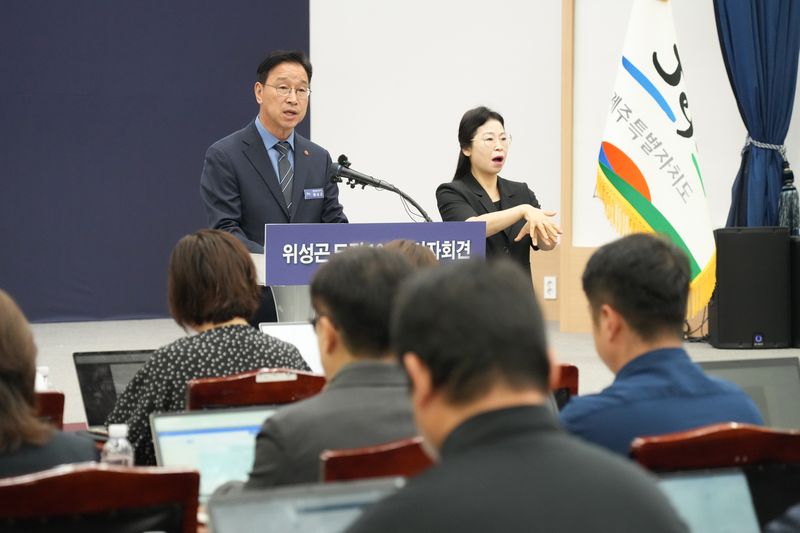
According to Jeju Special Self-Governing Province, Governor Wi held a press conference at Tamna Hall in the provincial government complex on the 7th to mark 100 days since the launch of the ninth popularly elected administration, outlining key policies from the past 100 days and the direction of the provincial administration going forward.
Since taking office, Governor Wi has made restoring the livelihoods economy a top priority. His first administrative order established the Livelihood Economy Situation Room, and just 10 days after taking office he drew up a supplementary budget of 461.5 billion won for livelihood recovery. Funding was focused on reducing the operating burdens of small businesses, farmers and fishers, and supporting the local construction market.
Governor Wi said, “Some indicators, including tourist spending and consumer sentiment, are showing signs of recovery, but it is difficult to regard this as an economic recovery that residents can immediately feel.” That is also why Jeju Province plans to draw up a separate comprehensive economic revitalization plan for 2027.
One pillar of the economic policy is to rebuild existing key industries. In the primary sector, the focus is on overhauling distribution, logistics, and supply-and-demand structures so that agricultural and fishery products can fetch fair prices, rather than simply increasing production. The aim is to improve the sustainability of agriculture and fisheries while addressing an aging population, climate change, and energy costs.
Tourism policy emphasized spending that stays in the local economy rather than the number of visitors. Governor Wi said, “We will upgrade our policies to ensure that what tourists spend in Jeju translates into real income for neighborhood businesses and small-business owners.”
The administration will also pursue an AI transformation of the tourism industry. It plans to establish a system in which the governor personally chairs the Jeju Tourism Strategy Meeting and coordinates issues with tourism agencies and organizations.
The governor also made clear that Jeju’s economy cannot be revived through existing industries alone. The province will develop renewable energy, AI, space, and biotechnology as future growth engines, and work to establish green AI data centers powered by renewable energy and an ecosystem for artificial intelligence transformation (AX).
The administration plans to redesign wind-power benefit sharing so residents can feel its effects in practice. While taking power producers’ financial circumstances into account, it is considering ways for residents who cannot afford to invest directly, as well as future generations, to share in development profits.
As his guiding principle in addressing contentious issues, Governor Wi put “the interests of residents” first. He said, “There is only one principle engraved in my heart when dealing with issues: ‘the interests of residents,’” adding, “I will resolve them in a principled manner, in accordance with residents’ wishes.”
The Jeju Second Airport, the biggest pending issue, will complete the process of gathering residents’ opinions by the first half of 2027. The governor reaffirmed the existing position: disclose sufficient information, gather opinions, and then decide how to proceed.
The same standard will apply to controversial policies, including the bus rapid transit (BRT) system, center-island bus stops, an international cargo route between Jeju and Qingdao, and the recycling-disposal system. The administration says it will weigh the burdens on residents and the expected benefits of implementing each policy, then decide how to proceed after gathering sufficient public input.
The nationwide competition to attract major events has also become a challenge that could determine the ninth administration’s success. Jeju Province plans to highlight its experience hosting international meetings at the leaders’ level, its conference facilities, and the safety of an island setting in its bid to host the 2028 G20 summit.
For the second round of public institution relocations, the province will strengthen its case by linking the functions of relocating institutions to Jeju’s industrial ecosystem, rather than simply listing the institutions it wants. It plans to respond to the government’s relocation plans with a focus on the major institutions it has already targeted.
Changes within the administration were also announced. Jeju Province, Jeju City, and Seogwipo City will hold regular meetings to address issues together, and policy implementation agreements between the governor and the administrative city heads will be introduced to clarify accountability for carrying out policies.
At the press conference marking his 100th day in office, Governor Wi’s message centered on the idea that “preparations are complete.” Going forward, the administration will be judged less on how many new policies it announces than on whether it delivers tangible results on issues such as the Jeju Second Airport, the livelihoods economy, tourism, primary industries, and new industries.
Governor Wi said, “If the past 100 days were about setting the direction, from now on I will deliver results,” adding, “I will upgrade primary industries and tourism while developing new growth engines, enriching residents’ lives and getting Jeju’s economy moving again.”
[email protected] Jeong Yong-bok Reporter