Education Ministry audit sees ruling and opposition parties clash over early-admissions 'system outage'
- Input
- 2026-10-07 13:15:43
- Updated
- 2026-10-07 13:15:43
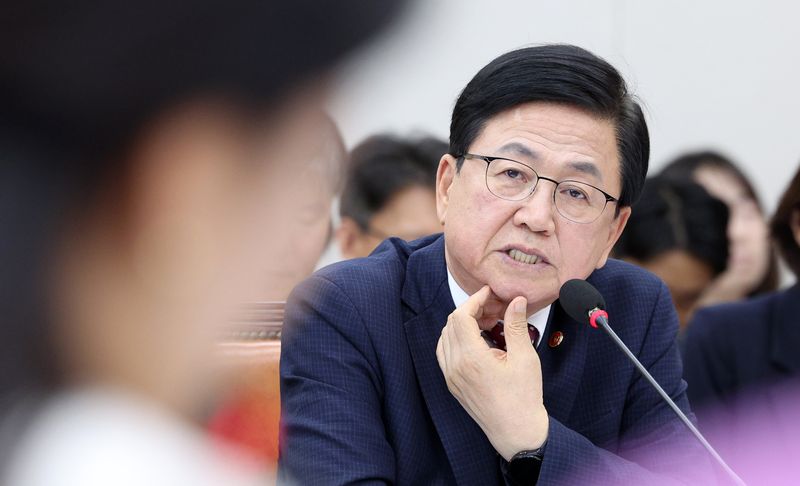
[Financial News] At a National Assembly Education Committee audit held on the 7th, sharp criticism poured in from both ruling and opposition parties over the "college early-admissions application system outage"—the recent disruption that threw applicants and their parents into confusion. Heated exchanges also took place between the National Assembly and the Education Ministry and National Education Commission, the agencies under audit, over key education issues, including the controversy surrounding the film Assassins and its alleged historical bias, measures to prevent cheating with advanced AI glasses that threaten fairness on the College Scholastic Ability Test (CSAT), the National Education Commission's inadequate reporting and policy confusion between government agencies.
■ “The first experience for underage test-takers was a system outage” ... Barrage of criticism over early-admissions disruption
As soon as the audit began, questions of accountability over the early-admissions application disruption were leveled at education authorities appearing before the committee as agencies under audit.
Lee Ju-young of the Reform Party said, “A system failure occurred in a national system that students encounter for the first time as they enter society, causing them psychological and practical harm,” and pointed to indications that final competition rates at individual universities had been leaked and shared through online communities, social media and random number generation during the application extension period. Seo Beom-soo of the People Power Party also criticized the roughly 50 minutes it took for the minister to be briefed after the system failure and the lack of an emergency manual. He pressed the ministry, saying, “If you rely only on the contractor’s claim of ‘force majeure’ and the same thing happens in the upcoming regular admissions round, what will you do?”
Education Minister Choi Kyo-jin bowed his head, saying, “I feel a heavy sense of responsibility.” He promised, “We will mobilize experts to conduct a full reanalysis of the cause and thoroughly overhaul our response manual—including changing how competition rates are disclosed by time slot and revising the random-number system for regular admissions—to prevent a recurrence.”
■ From the historical-distortion controversy over the film Assassins to ‘AI glasses’ threatening the CSAT
Beyond the early-admissions disruption, lawmakers continued to raise pointed questions about major issues facing the education sector.
First, People Power Party lawmakers Jeong Seong-guk and Park Jeong-hun raised concerns about plans for group screenings of the film Assassins at high schools. The film deals with a conspiracy theory that the assassination of Yuk Young-soo was staged. They criticized the screenings, saying, “It could instill a distorted view of history in young people.” Park also pointed to historical bias, citing past remarks by Education Minister Choi Kyo-jin.
Ruling Democratic Party of Korea lawmaker Baek Seung-a countered, saying, “Watching a film can be an opportunity to develop critical thinking skills,” while the Education Ministry said it would strengthen media literacy education for students.
Democratic Party of Korea lawmaker Kim Moon-soo also put on AI glasses at the audit and demonstrated solving CSAT English and math questions in real time. He warned that the rapid spread of AI glasses threatened fairness in the college entrance exam. The Education Ministry said it would introduce strict countermeasures, including a dedicated detection manual and strong penalties such as revoking test-takers' eligibility to sit the exam.
The National Education Commission's inadequate reporting and policy confusion also drew criticism. Lawmakers from both parties, including People Power Party lawmaker Jeong Seong-guk and Democratic Party of Korea lawmakers Kim Jun-hyeok and Park Beom-gye, criticized the commission for submitting an inadequate work report of just three pages despite addressing major issues such as a 3 p.m. dismissal policy for lower-grade elementary school students and expanding descriptive and essay-type assessments on the CSAT. Seo Beom-soo said, “Conflicting policy messages from the Education Ministry and the National Education Commission are causing confusion in the field.” Commission Chair Cha Jeong-in responded, “We will treat descriptive and essay-type assessments as a long-term task and move forward after establishing a framework to prepare public education.”
■ Mounting issues, including AI textbook compensation lawsuits and personal information leaks
Meanwhile, Democratic Party of Korea lawmaker Baek Seung-a pointed to the low utilization rate (5%) of the AI Digital Textbook (AIDT) project launched by the previous administration and publishers' lawsuits seeking around 226 billion won in state compensation, and called for a review of the right to seek recourse over procedural illegality. Kang Kyeong-sook of the Rebuilding Korea Party criticized the data-sovereignty concerns arising from the leak of 75,000 Google accounts at the Daejeon Office of Education, as well as allegations of ties between the chair of the Teachers' Appeals Commission—currently relieved of duty—and associates of a former minister, and of preferential treatment in promotion.
[email protected] Kim Man-gi Reporter