Nuri (KSLV-II)’s Fifth Launch Succeeds... All Five Constellation Satellites Deployed
- Input
- 2026-10-07 15:22:46
- Updated
- 2026-10-07 15:22:46
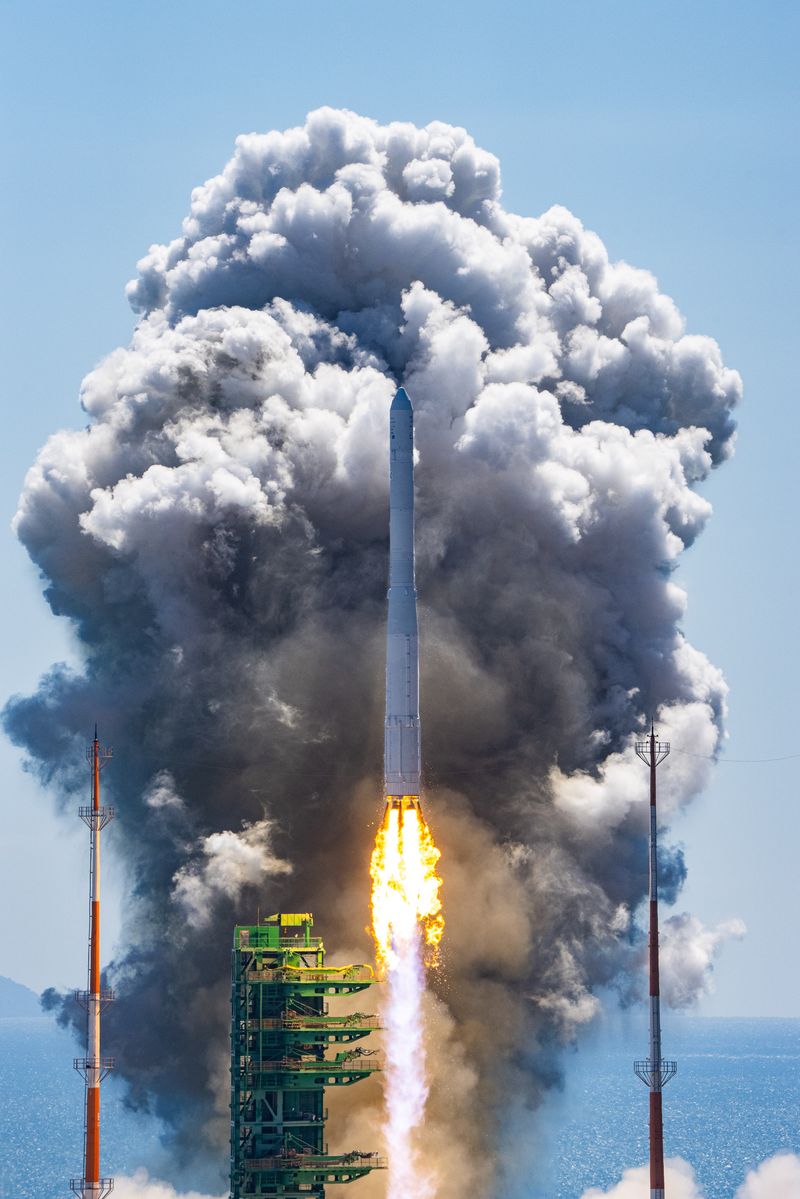
[Financial News] South Korea’s Nuri, a homegrown launch vehicle, has completed a successful fifth launch. All five primary payload satellites aboard Nuri headed into space, ushering in the era of constellation-satellite launches. The launch is seen as boosting observational responsiveness through satellite constellations and helping build a low-cost satellite industry ecosystem.
■Launch success rate rises to 80%... Nine CubeSats ejectedThe Korea Aerospace Administration and the Korea Aerospace Research Institute said the fifth launch of Nuri succeeded as scheduled at 12:25 p.m. on the 7th at the Naro Space Center in Goheung, South Jeolla Province. The launch placed all five primary payload satellites, NeonSat, aboard Nuri into their target orbit. Of the 10 secondary payloads, nine CubeSats were successfully placed in their target orbit. Nuri’s flight lasted a total of 1,999 seconds.
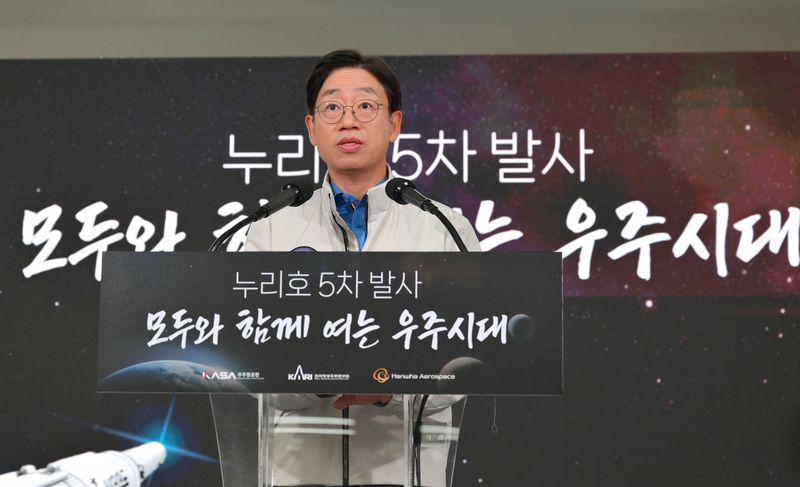
“The criteria for judging whether the launch vehicle was successful this time are whether all five primary payload satellites separated normally and whether they separated at the desired angle,” Oh Tae-seok, head of the Korea Aerospace Administration, said. “After that, the launch is judged by whether each satellite receives signals normally and operates normally in space.”
One CubeSat did not separate normally. Although it received a normal separation signal from the launch vehicle, its cover did not open, so it was not ejected into space.
“The CubeSat that was not ejected is PERSAT02, made by Quaternions. Nuri sent the separation signal normally, but the cover did not separate, so the final separation signal could not be confirmed,” said Park Chong-chan, a division head at the Korea Aerospace Research Institute. “We are still investigating the exact cause.”
With this successful launch, Nuri will have completed three consecutive successful missions to launch actual satellites, following the third launch in 2023 and the fourth last year. Its launch success rate has also risen from 75% to 80%, a development seen as improving its reliability.
■Expanded role for private sector... Constellation satellites boost cost-effectivenessNotably, for the fifth launch, private space company Hanwha Aerospace, as the system integration company for Nuri, oversaw the vehicle’s overall production and assembly. Hanwha Aerospace also expanded its role in this launch to include launch preparations and operations.
“The private sector needs to build a space ecosystem so that the many space technologies developed under the government’s clear direction do not go to waste,” said Kim Seon, head of Hanwha Aerospace’s space business. “Six or seven successful launches of the launch vehicle would make commercial launches possible. To that end, for next year’s sixth launch, we will expand the private sector’s role further and actively discuss developing Nuri’s performance and reducing costs.”
Following this launch, Nuri’s sixth launch is scheduled for next year and its seventh for the year after.
The fifth launch is seen as ushering in the era of constellation-satellite launches. Constellations have the advantage of boosting mission capabilities by building and launching multiple small satellites at low cost, while also reducing satellite development costs.
Oh said the significance was that “NeonSat, an Earth-observation satellite, is also being launched as part of a constellation and is expected to keep pace with the global trend of satellites carrying out missions as a system.” He added, “Our goal is to build satellites that cost less to develop but deliver better performance.”
Following this Nuri launch, operations of NeonSat and 14 CubeSats will also get underway in earnest. The NeonSat constellation will closely monitor the Korean Peninsula, while the CubeSats are expected to explore the space environment through experiments involving space pharmaceuticals and industrial components, as well as observations of space radiation and Earth’s magnetic field.
[email protected] Yeon Ji-an Reporter