Minister Kang Shin-cheol: “Signs of North Korean mine-laying detected at several locations south of the MDL; joint investigation with the UNC”
- Input
- 2026-10-07 13:29:39
- Updated
- 2026-10-07 13:29:39
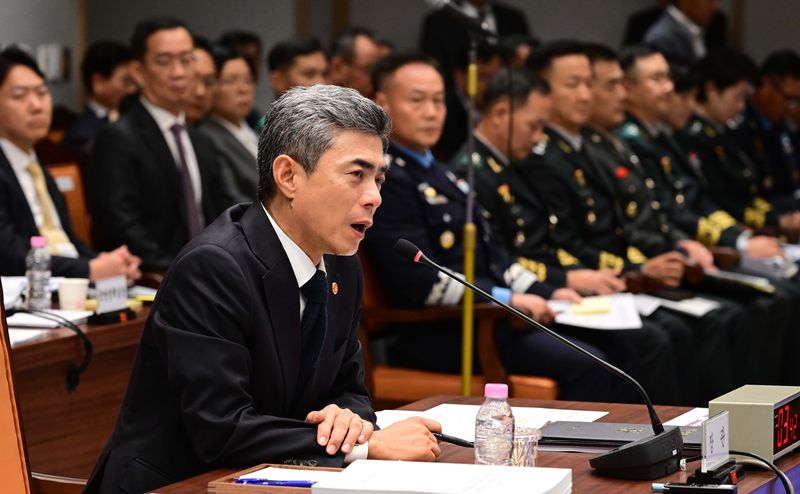
At a National Assembly Defense Committee audit at the Ministry of National Defense in Yongsan-gu, Seoul, on the 7th, Defense Minister Kang Shin-cheol was asked by Yoo Yong-won of the People Power Party whether there were suspected mine-laying sites south of the MDL other than in the area of the Army’s 25th Division. He replied, “Rather than suspicions, we are seeing signs of that,” and said the number of sites was “several.” He expressed agreement that several hundred mines may have been planted and said a joint investigation with the UNC was planned. He also said the North Korean Foreign Ministry’s “self-staged act” statement was a result of its being rattled by our military’s response.
In particular, responding to claims that North Korean troops’ frequent MDL incursions were deliberate provocations, Minister Kang described the situation on the ground: “Judging by the enemy’s actions now, they consider that to be their own territory and are patrolling it.” He added, “Because we respond firmly every day, from our standpoint, North Korea, the UNC and our South Korean side need to verify the situation on the ground.” On questions about the effectiveness of warning shots during incursions, he made clear that the rules of engagement would be followed with restraint: “Although they are wearing helmets, they enter unarmed and without rifles. Whether to do anything beyond firing warning shots is determined according to principles and regulations.”
Regarding North Korean troops’ repeated crossings in the area of the 21st Division, he said they were using the area as a patrol route to cross south of the MDL, and explained that incursions by unarmed troops were assessed according to the rules of engagement.
That day’s audit grew heated as the ruling and opposition parties traded blame over the previous and current governments’ responses to North Korea, amid debate over North Korea’s “border fortification” work and the effectiveness of the Sept. 19 military agreement. Cheon Jun-ho of the Democratic Party of Korea said the Yoon Suk Yeol administration had failed to respond properly when North Korea declared that the two Koreas were “hostile states” and began fortifying its border. In response, Lim Jong-deuk of the People Power Party cited the head of the Defense Intelligence Headquarters, rebutting that “at the time, there was no clear confirmation that North Korea had planted mines south of the MDL; there were only estimates of suspected areas.”
There was also a dispute over inter-Korean agreements. Song Young-gil of the Democratic Party of Korea said the Sept. 19 military agreement had helped ease tensions on the Korean Peninsula and prevent accidental clashes, and called for inter-Korean military talks. By contrast, Kang Sun-young of the People Power Party criticized the agreement for restricting the South Korean military’s aerial surveillance and reconnaissance activities and creating a security vacuum. Minister Kang agreed with the criticism that restrictions on aerial reconnaissance had created a gap, but said, “This was an area where sufficient results could have been achieved if it had been carried out clearly on the basis of mutual trust, but that did not happen.” He added, “Military agreements between the two Koreas clearly have significance, but they are changing because of political issues.” As the two sides continued their sharp debate, Minister Kang stressed that the military would take the initiative in the DMZ, saying, “No matter which government is in power or how policies change, the military remains unchanged. The military maintains a firm state of readiness and is dedicated to protecting the country.”
[email protected] Lee Jong-yun Reporter