SMEs Minister to Consider Restrictions on Sales of High-Priced Electronics Through Online Traditional Market Malls
- Input
- 2026-10-07 14:21:17
- Updated
- 2026-10-07 14:21:17
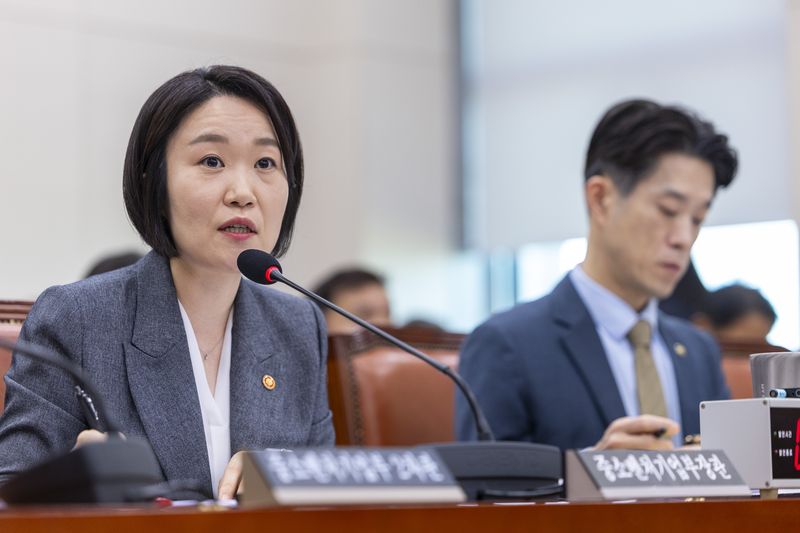
[Financial News] Lee So-young, Minister of SMEs and Startups, said she would consider measures to restrict the sale of high-priced imported electronics, travel products and other goods that can be purchased with Onnuri gift certificates through online traditional market malls.
Minister Lee said this on the 7th in response to the criticism from Park Seong-min of the People Power Party during the Ministry of SMEs and Startups’ parliamentary audit before the National Assembly’s Trade, Industry, Energy, SMEs and Startups Committee: “I don’t think this is in line with the purpose of using Onnuri gift certificates.”
Online traditional market malls are online shopping platforms designed to help traditional market and shopping district merchants secure online sales channels and make it easier to use Onnuri gift certificates. Products can be purchased with the certificates at shopping malls that have agreements with the Small Enterprise and Market Service. Some online traditional market malls currently sell imported audio equipment priced at 7.95 million won, speakers for 3.67 million won, and cruise travel packages in the 2 million won range.
Minister Lee said, “A retailer that imports or purchases and sells electronics can be listed on an online traditional market mall simply because it has a shop in a traditional market, and can then make discounted sales using Onnuri gift certificates.” She added, “It is technically and contractually possible to limit the items that can be sold by retailers operating through online traditional market malls where Onnuri gift certificates can be used, so I will review the matter and report back.”
She also reiterated her intention to reverse the decision to abolish the Youth Startup Academy. The Ministry of SMEs and Startups has fully cut the academy’s budget for next year while consolidating startup programs within the ministry this year.
Minister Lee said, “The academy’s alumni network, built over 16 years, is a valuable asset that could not be recreated even with several hundred billion won if it were lost.” She added, “We are looking for a way to keep the academy going, and will also discuss the matter actively with the National Assembly.”
In response to a question from Jeon Eun-su of the Democratic Party of Korea about health insurance premiums being charged twice when members terminate Yellow Umbrella, a mutual aid scheme for small businesses and small merchants, before the end of their term, she replied, “It does appear to amount to double charging,” and said, “I will consult with the Ministry of Health and Welfare.”
Jeon pointed out that Yellow Umbrella members pay contributions from income on which health insurance premiums have already been charged, but that premiums are charged again on this income when they receive their contributions back after terminating their membership early. A review found that in one case, a member who voluntarily terminated their Yellow Umbrella membership in the past three years was charged 9.39 million won in health insurance premiums.
[email protected] Kim Hyeon-cheol Reporter