Woo Sang-ho marks 100 days as Gangwon governor... AI data center investments bring wins, but fiscal woes remain a challenge
- Input
- 2026-10-07 11:54:48
- Updated
- 2026-10-07 11:54:48
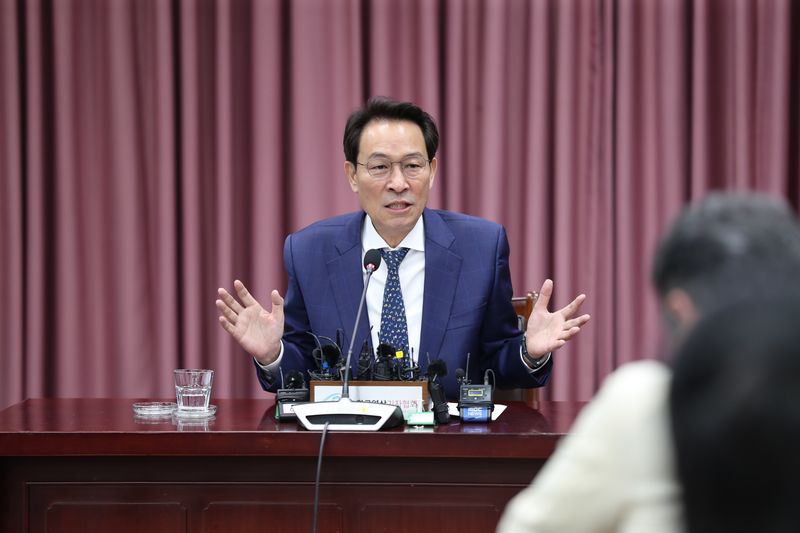
[Financial News, Chuncheon = Reporter Kim Gi-seop] Marking his 100th day in office, Gangwon Governor Woo Sang-ho cited investment by major companies led by AI data centers and a record 11 trillion won in central government funding as achievements, but identified the province’s finances—so strained that not even discretionary funds remain for new projects—as his biggest challenge.
Governor Woo held a press conference marking his 100th day in office at a small meeting room in the new provincial government building on the morning of the 7th, outlining his administration’s achievements so far and its future direction. He said that attracting advanced industries, especially major companies, was the area he had focused on most over the past 100 days.
In Donghae, GS’s investment in an AI data center has been confirmed, with construction set to begin within the year. Talks are also continuing with SK in Gangneung, KT in Wonju and Shinsegae in Chuncheon over investment terms. Four medical device and biotech companies that grew in the province have also pledged to reinvest a total of 124.9 billion won. “It is the first time in Gangwon Province that a major company has confirmed a data center investment while talks are proceeding simultaneously with three others,” Governor Woo said. “If the two pillars of advanced industry and tourism both bear fruit, the regional economy will reach a major turning point.”
In tourism, the province has signed investment agreements for two sites, including the Haesolia Complex Resort and Tourism Complex in Goseong, and is holding further talks with four or five others. After asking the defense minister to ease military restrictions, it had 6.39 million square meters of military protection zones in the Sokcho and Goseong areas lifted, also clearing the way for complex tourism developments such as the Hwajinpo International Tourism Complex. The province is also pursuing a plan to move the Civilian Control Line north by an average of about 2 km.
As achievements in dealing with the central government, Governor Woo cited securing 11 trillion won in central government funding and ranking second nationwide in the number of projects included in the Sixth National Highway and National Regional Road Construction Plan. He said the province continues to urge the government to relocate as many public institutions as possible to Gangwon in the second round of relocations. On livelihood issues, he explained that Hwacheon, following Jeongseon, had been included in the rural basic income pilot program, helping boost the population and revitalize local commercial districts. Starting next year, the province plans to focus on improving living conditions, including rental housing with shared living spaces for young people, a Gangwon-style care system and better public transportation.
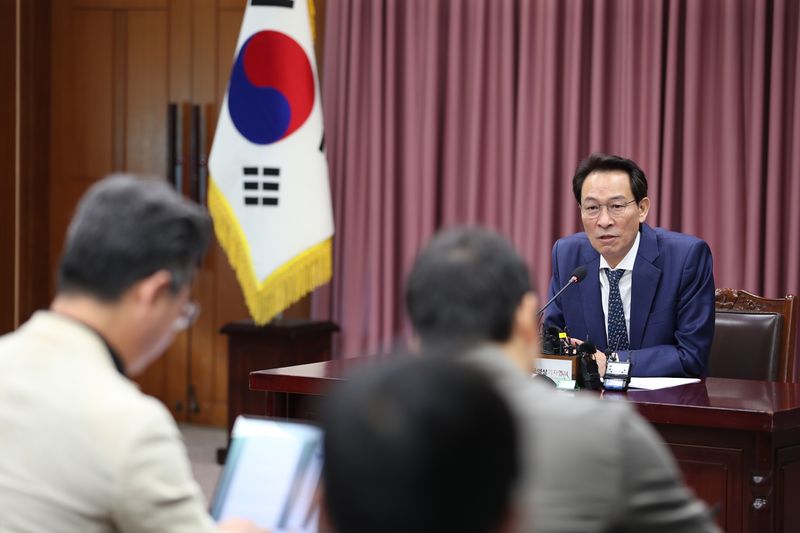
However, he did not hide the difficulties facing the province’s finances. Governor Woo said that approximately 90 trillion won in grants had not been paid to local governments over the past three years, forcing metropolitan and provincial governments to issue local bonds to stay afloat. “When we drew up next year’s budget, virtually no discretionary funds were left to put toward new projects,” he said. “That is also why we were the first to propose to the government a Future Response Fund that would share excess tax revenue with local governments, and we will expedite talks with the national party leadership.” He also made clear that the province would issue no additional local bonds next year and would secure new sources of revenue by attracting businesses.
On the comprehensive audit of business expenses at affiliated investment- and contribution-funded institutions, he sought to dispel controversy that it was intended to pressure their heads. He said the province would prioritize restructuring its operations and curb indiscriminate new hiring, and again stressed the need for an ordinance aligning the terms of the governor and heads of affiliated institutions. “The purpose of the comprehensive audit is to check whether residents’ tax money is being properly spent and to restore the institutions’ health, not to force anyone out,” Governor Woo said. “An ordinance aligning terms is essential, if only for the benefit of the next governor.”
Regarding the designation of Peace Economy Special Zones, for which the application period recently closed, he said the province should focus its efforts rather than allow cutthroat competition among cities and counties. That is because, as with an international skating rink or the headquarters of a research and development special zone, competition among local governments within the province could delay the government’s decision. Since Goseong County was the sole applicant in this round, the province plans to give its bid for special-zone designation full support.
He called for a cautious response to tensions in border areas, including a landmine incident on the western front. Governor Woo stressed that Gangwon, which directly experiences the threat of division, must manage peace differently from other regions, and that accidental clashes must be contained to prevent them from escalating into localized conflict or prompting an excessive response.
“If the past 100 days were a period of preparation for a leap forward, now is the time to turn investments in data centers and complex tourism developments in Donghae, Gangneung, Chuncheon and Wonju into visible results,” Governor Woo said. “We will overcome tight fiscal conditions and make Gangwon a model for regional development.”
[email protected] Kim Gi-seop Reporter