Early-admission reach choices hold at 2.7 on average ... ‘Match’ choices decline, ‘safety’ choices rise
- Input
- 2026-10-07 11:37:48
- Updated
- 2026-10-07 11:37:48
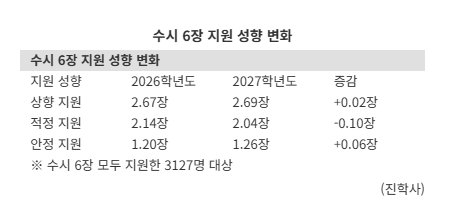
[Financial News] This year, applicants who used all six of their early-admission choices allocated an average of 2.7 to reach options, keeping the figure close to last year’s level. However, they made fewer match applications and more safety applications. An admissions consulting firm interpreted the results as reflecting applicants’ desire to secure a definite acceptance as they face changes to the college admissions system. The findings come from a comparison with a survey for the 2026 academic year, based on responses from 3,127 applicants who used all six choices in the 2027 early-admissions process, according to Jinhaksa on the 6th. Reach applications are those to institutions where an applicant believes their chances of admission are relatively low, while safety applications are those to institutions where they believe their chances are high. The three categories reflect applicants’ own assessments of their chances of admission.
Woo Yeon-cheol, head of Jinhaksa’s Admissions Strategy Research Institute, said, “This year, there was a change in how applicants distributed risk across their six early-admission choices,” adding, “Maintaining a focus on reach applications while making fewer match applications and more safety applications can be seen as a strategic decision to improve their chances of admission through early admissions.”
Director Woo interpreted the changes among students in the grade 1 band as reflecting a desire to secure a safety net with a high likelihood of admission, even when applying to reach options, amid concerns that competition would intensify as the number of repeat test-takers grew. He added, “In particular, the greater burden of trying again ahead of the 2028 college admissions reform may have affected how applicants put together their applications.”
The average number of reach applications edged up from 2.67 last year to 2.69 this year, accounting for about 45% of all applications. Match applications fell from 2.14 to 2.04, while safety applications rose from 1.20 to 1.26.
The shift was especially pronounced among students with grade 1-level school records. Their average number of match applications fell by 0.36, from 2.42 to 2.06. By contrast, safety applications rose by 0.23, from 1.10 to 1.33, while reach applications also increased by 0.14, from 2.48 to 2.62.
Graduates (repeat test-takers) showed a different pattern. They made an average of 2.98 reach applications, more than the 2.65 made by current students, but 0.33 fewer than the 3.31 made by graduates last year. Their match applications rose from 1.86 to 1.98, and their safety applications from 0.83 to 1.05.
[email protected] Kim Man-ki Reporter