Corporate surplus funds hit a record 67 trillion won amid semiconductor boom; household net lending falls
- Input
- 2026-10-07 12:00:00
- Updated
- 2026-10-07 12:00:00
[Financial News] In the second quarter of this year, strong performance in key industries such as semiconductors and a sharp rise in corporate net profits helped nonfinancial corporations achieve record-high net lending. Household financial assets also grew substantially, while the ratio of household debt to gross domestic product (GDP) fell to the low 80% range.
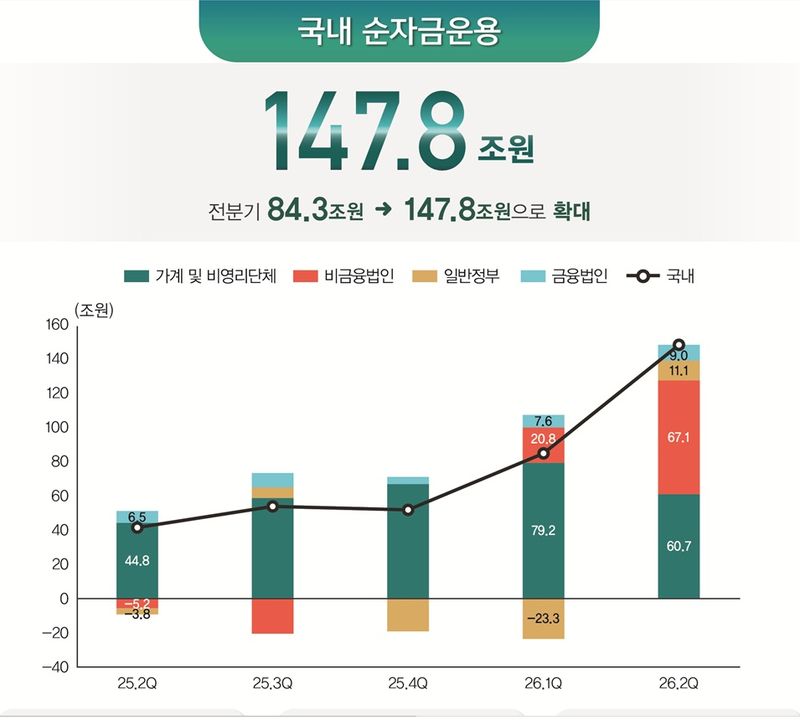
According to preliminary funds-flow statistics for the second quarter of 2026 released by the Bank of Korea on the 7th, net lending by the domestic sector rose sharply to 147.8 trillion won from 84.3 trillion won in the previous quarter.
First, corporations’ (nonfinancial corporations’) surplus funds surged.
Nonfinancial corporations’ net lending in the second quarter totaled 67.1 trillion won, the highest since statistics began in 2009. It was nearly three times the previous record of 20.8 trillion won, set in the first quarter of this year.
This was driven by a surge in corporate net profits, including in the semiconductor industry, which generated substantial surplus funds. On the funds-management side, deposits at financial institutions and trade credit grew particularly sharply; on the financing side, funding through direct finance, such as bond issuance, and trade credit also increased substantially.
Kim Yong-hyun, head of the Bank of Korea’s Flow of Funds Team, said, "The net profits of listed companies such as Samsung Electronics and SK hynix rose from 111 trillion won in the first quarter of this year to 189 trillion won in the second quarter." He added, "Net lending expanded as corporate profits increased on the back of strong semiconductor exports."
Unlike corporations, households’ surplus funds declined.
Net lending by households and nonprofit institutions totaled 60.7 trillion won in the second quarter, down from 79.2 trillion won in the previous quarter.
A Bank of Korea official explained, "Households’ surplus funds declined as household income fell from the previous quarter and net acquisitions of housing increased. They were also affected by a drop in deposits at financial institutions, even as investment in equity securities and investment funds increased."
By contrast, indicators of household financial soundness improved.
At the end of the second quarter, household financial assets surged by 513.2 trillion won from the previous quarter-end to 6,930.2 trillion won, while financial liabilities increased by just 28.2 trillion won to 2,495 trillion won.
The financial-assets-to-liabilities ratio, which shows how much households hold in financial assets such as deposits and stocks relative to their debt, rose by 0.18 points from 2.60 in the previous quarter to 2.78.
In particular, household debt as a share of nominal GDP stood at 81.1%, down 4.2 percentage points from 85.3% at the end of the previous quarter. This was the lowest level since the second quarter of 2016, when it was 80.2%.
The government’s finances got some breathing room.
With government revenue, including corporate and income tax receipts, increasing, general government shifted from net borrowing of 23.3 trillion won in the previous quarter (−23.3 trillion won) to net lending of 11.1 trillion won in the second quarter.
The rest-of-world sector’s net borrowing was recorded at −147.8 trillion won, reflecting factors including a wider current-account surplus. This was also the highest level since 2009. It means South Korea’s external assets invested overseas increased substantially.
[email protected] Jung Sang-gyun Reporter