Lee Hyeong-il: “We will mobilize every available policy tool to ease polarization through housing, jobs and inclusive finance ... and prioritize support for young people”
- Input
- 2026-10-07 11:16:09
- Updated
- 2026-10-07 11:16:09
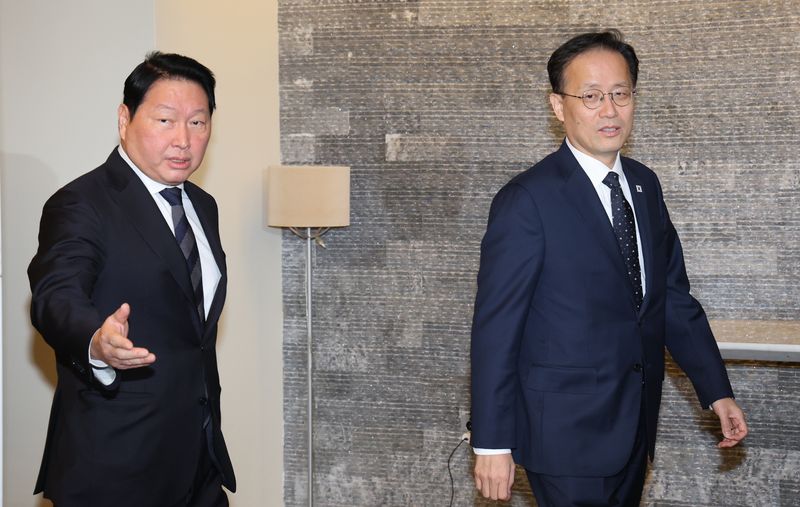
Lee made the remarks at the sixth meeting of the Public-Private Consultative Body for Supporting Corporate Innovation, held alongside a meeting of the heads of six major economic organizations at the KCCI in Jung District, Seoul. “We will step up policy efforts to revive potential growth and ease polarization, and do our utmost to deliver results that people can feel,” he said.
The meeting was arranged for the government to share recent economic trends and the direction of future economic policy with business organizations and seek their cooperation.
“Real change that businesses can feel starts with voices from the field,” Lee said. “When the government and the private sector work through issues together on the ground and find solutions, policy can lead to tangible results.”
At the meeting, Lee revisited the details of the second support package for corporate investment and innovation, announced earlier. These included cutting permitting and approval time by up to two years (from three years to one) for a 4-trillion-won project to convert an automobile plant in Ulsan Metropolitan City from internal-combustion vehicles to electric vehicles, and bundling electrical and telecommunications work under a single contract for semiconductor fab (production plant) construction.
Assessing the current economic situation, Lee said, “Despite difficult economic conditions, growth has picked up, helped by the global semiconductor boom and other factors.” He also noted, “While the cost-of-living burden, including high prices, continues, structural problems remain, including a decline in potential growth due to a shrinking working-age population and stagnant productivity, as well as polarization across sectors.”
He added, “We will pursue large-scale, forward-looking investments in the future through the three mega-projects and other initiatives, and resolve on-the-ground obstacles that hold back corporate investment to create the world’s best business environment, brimming with creativity and vitality.”
Lee said he would devote every effort to improving housing, jobs and inclusive finance to ease polarization. He also said, “We will prioritize support for young people, the future of our country.”
Meanwhile, representatives of the business organizations asked the government to cooperate in ensuring that necessary support, such as permits and infrastructure, is provided promptly in line with companies’ investment schedules. They also proposed tailored artificial intelligence (AI) support for small and medium-sized enterprises to ease polarization between large and small and medium-sized businesses.
Regarding the extension of the retirement age being pursued by the government and political circles, they proposed flexible approaches such as rehiring workers after retirement.
[email protected] Kim Jun-hyeok Reporter