Geumjeong District in Busan, Dongducheon-si and Tongyeong-si newly designated as Depopulation Regions
- Input
- 2026-10-07 10:33:27
- Updated
- 2026-10-07 10:33:27
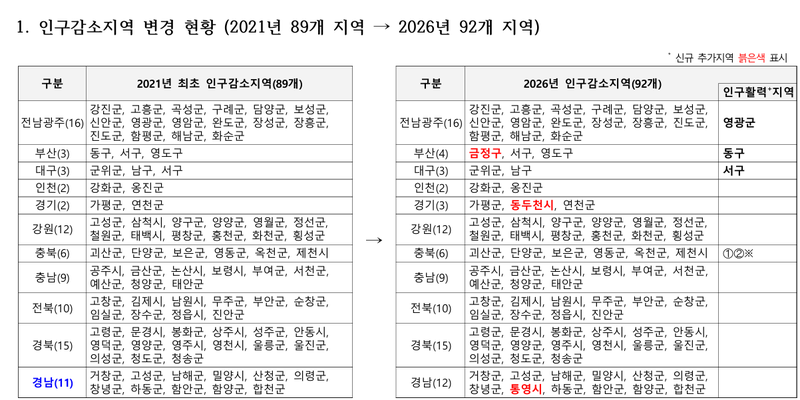
[Financial News] Geumjeong District in Busan, Dongducheon-si in Gyeonggi Province, and Tongyeong-si in South Gyeongsang Province have been newly designated as Depopulation Regions. Five years after the first designation in 2021, the government has revised the criteria to consider not only population decline but also regional economic vitality, including the number of employed people and the living population.
Places whose conditions have improved among the existing Depopulation Regions and Areas of Concern will be classified separately as Population Vitality Plus areas, and will continue to receive existing support for the next five years.
The Ministry of the Interior and Safety announced on the 7th the results of the redesignation of Depopulation Regions and its plans for future responses.
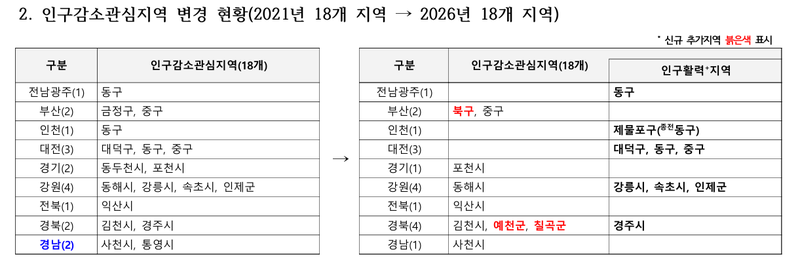
Under the new criteria, 92 areas nationwide were designated as Depopulation Regions and 18 as Depopulation Areas of Concern. Geumjeong District, Dongducheon-si and Tongyeong-si have been added to the 89 existing Depopulation Regions. Buk District in Busan and Yecheon and Chilgok counties in North Gyeongsang Province were added to the areas of concern.
Places where population conditions and regional vitality have improved were classified separately as Population Vitality Plus areas. Among the existing Depopulation Regions, three areas qualify: Yeonggwang County in South Jeolla Province, Dong District in Busan and Seo District in Daegu. Among the areas of concern, nine qualify: Dong District in Gwangju; Jemulpo District in Incheon; Daedeok District, Dong and Jung districts in Daejeon; Gangneung, Sokcho City and Inje County in Gangwon Province; and Gyeongju in North Gyeongsang Province. The government decided to maintain existing support for these areas for the next five years so that the improvements can continue.
Criteria no longer focus solely on population... Jobs and the living population also taken into account
The criteria for assessing regions have also changed in this redesignation. In addition to the existing indicators, such as population growth and decline rates, the proportions of older people and children, and the net migration rate of young people, the government added indicators of regional economic vitality, including the number of employed people, the living population and the urbanization rate, assessing regions on a total of nine indicators. The urbanization rate is the proportion of a region’s total area that has been developed for urban uses such as housing, commerce and industry.
The aim is to assess regional decline not only by how much the registered population has fallen, but also by looking at jobs, people who actually travel to and stay in the area, and the foundations of daily life. The assessment is intended to reflect the movements of people who support local economies and everyday services—such as tourists and people commuting to work or school—even though they are not counted in the resident registration figures.
Interior and Safety Minister Yoon Ho-jung said, “When the population declines, the foundations that support daily life, such as transportation and commercial districts, weaken, making it difficult to maintain essential services like health care, education and care reliably.” He added, “This in turn leads to an outflow of young people and declining regional vitality, creating a vicious cycle.”
Focus shifts from facilities to housing, income and care
The government plans to manage more systematically whether projects to address depopulation lead to actual changes in population and residents’ lives. It also outlined plans to provide greater support to areas with strong results.
The focus of investment will also shift away from simply building facilities toward projects that improve settlement conditions, including housing, income and care, and strengthen the foundations for regional self-reliance. The government will also expand cooperation and coordination at the level of people’s daily living areas, so that neighboring regions, provincial and metropolitan governments, and the central government can jointly address problems that individual cities, counties and districts cannot resolve on their own.
Since the first designation in 2021, the government has enacted the Special Act on Support for Depopulation Regions and has invested 1 trillion won annually in the Local Extinction Response Fund. During this period, the rate of population decline in Depopulation Regions fell from 6.0% in 2018–2021 to 4.3% in 2022–2025. Population movement also shifted from an average annual net outflow of 32,251 people in 2020–2021 to an average annual net inflow of 1,615 people in 2022–2025. However, the population of Depopulation Regions itself continues to decline.
The government plans to focus investment not on simply building facilities but on projects that improve settlement conditions, including housing, income and care, and strengthen the foundations for regional self-reliance. It will also expand cooperation and coordination at the level of people’s daily living areas, so that neighboring regions, provincial and metropolitan governments, and the central government can jointly address challenges that individual cities, counties and districts cannot resolve on their own.
Minister Yoon said, “We will also strengthen the feedback process on performance so that better-performing areas can receive more support.” He added, “We will focus investment on projects that go beyond simply building facilities to improve local settlement conditions, including housing, income and care, and strengthen the foundations for regional self-reliance.”
[email protected] Bomi Lee Reporter