Chuja’s 2.37-GW Offshore Wind Project Sees Two Failed Bidding Rounds... Jeju Launches Task Force to Clear Bottlenecks
- Input
- 2026-10-07 09:59:31
- Updated
- 2026-10-07 09:59:31
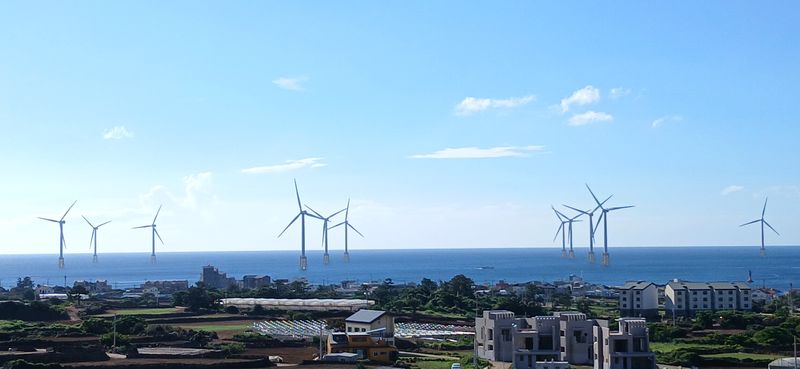
【Financial News, Jeju—Jung Yong-bok】 A cross-agency collaboration framework has been launched to get the 2.37-GW Chuja offshore wind project back on track after two failed calls for bids, and to tackle at once the grid, permitting and maritime-boundary issues holding back offshore wind projects across Jeju.
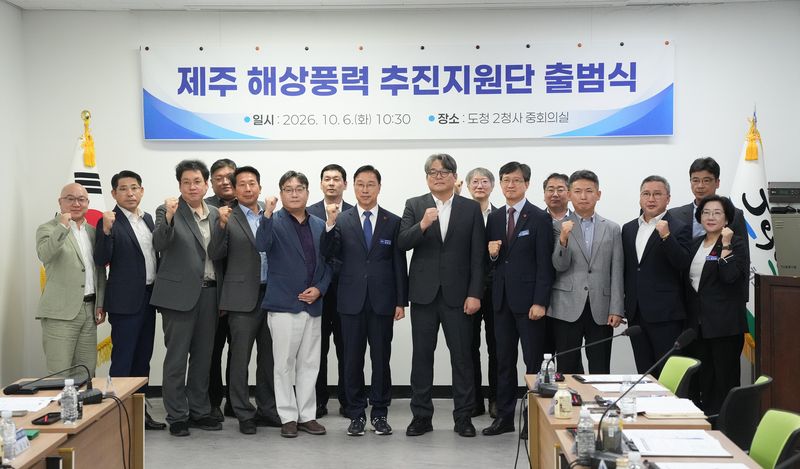
Jeju Special Self-Governing Province said on the 7th that it launched the Jeju Offshore Wind Project Support Task Force and held its first meeting the previous day at the second building of the Jeju Provincial Government Office.
The task force has 17 members across five fields: overall coordination and project management; marine affairs and the environment; communications, law and institutions; grid and technology; and industry and external cooperation. It is headed by Lee Chang-heum, Jeju’s vice governor for climate and the economy.
Participants include Jeju Special Self-Governing Province and Jeju Energy Corporation, as well as Korea Electric Power Corporation, the Korea Power Exchange, Jeju National University, the Korea Institute of Energy Research and the wind power industry. The group brings into a single consultative body issues previously handled by separate departments and organizations, including marine spatial planning, environmental impact assessments, permits for the occupation and use of public waters, power grids, transmission facilities, communication with residents and maritime boundaries.
The province’s decision to establish a dedicated task force reflects the reality that offshore wind projects across Jeju are encountering bottlenecks at different stages, one after another.
Four major projects are currently underway in Jeju: Chuja Offshore Wind, the Handong-Pyeongdae Offshore Wind Farm, the Tamra Offshore Wind Farm expansion and West Offshore Wind. Chuja and West Offshore Wind have both seen calls for bids fail, while permitting procedures are underway for Handong-Pyeongdae and the Tamra expansion.
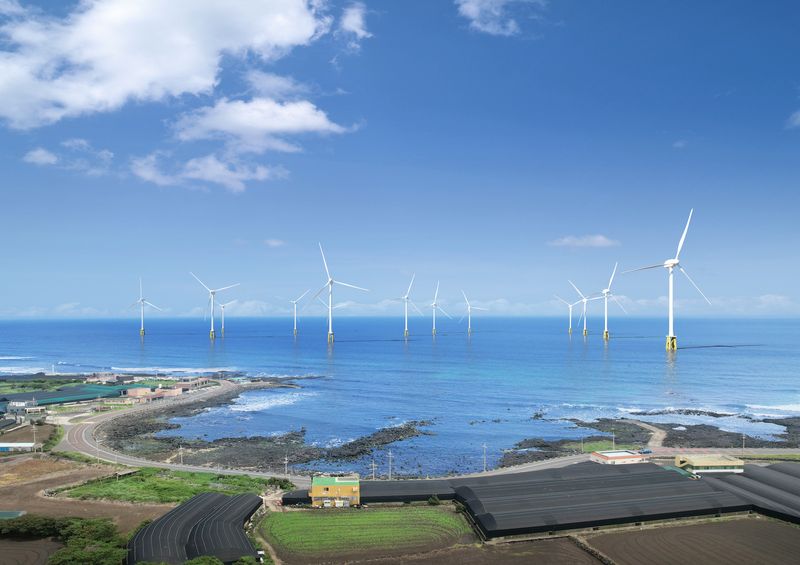
The biggest issue is Chuja Offshore Wind. The mega-project would build a 2.37-GW wind farm in the waters around Chuja Island, with the investment cost estimated at approximately 24 trillion won under the existing project plan.
But the effort to find a developer ran into difficulties from the outset. The first call for bids failed after only one bidder submitted a bid. In the rebidding, the project was ultimately declared unsuccessful in February after no bidder that passed the first-stage preliminary qualification review submitted a second-stage proposal. Jeju Province has since been reviewing its strategy for moving the project forward. With the task force’s launch, the province has once again put the Chuja project at the forefront.
The more fundamental issue is the power grid. According to figures Jeju Province recently presented to the National Assembly, Jeju can accommodate additional power capacity of around 1 GW at most. Since the planned capacity of Chuja Offshore Wind alone is 2.37 GW, the province believes grid capacity must first be secured to transmit power generated in Jeju to the national grid, including the mainland, if a project of this scale is to become a reality.
Jeju Province is therefore focusing its policy efforts on securing the inclusion of Jeju offshore wind’s connection to the national grid in the 12th Basic Plan for Electricity Supply and Demand. On the 1st, Wi Seong-gon, governor of Jeju, also visited the National Assembly and asked that the plan include a national-grid connection for Chuja Offshore Wind and infrastructure for demonstrating floating offshore wind.
That is also why KEPCO’s Jeju Regional Headquarters and the Korea Power Exchange’s Jeju Office are directly involved in the task force’s grid and technology field. The view is that it would be difficult to accelerate projects by pursuing policies to increase power generation separately from transmission and grid operations.
Unlike the Chuja project, the Handong-Pyeongdae Offshore Wind Farm in Gujwa-eup, Jeju City, has a developer in place and is moving through follow-up procedures. It has been pursued as Jeju’s first publicly led, resident-participation offshore wind project, with a total project cost of approximately 590 billion won. It was selected in the 2025 competitive auction for fixed-price wind power contracts and is now undergoing further permitting, including approval to implement the development project, with construction targeted to begin in 2027.
A project to expand the existing Tamra Offshore Wind Farm is underway in waters off Hankyeong-myeon, Jeju City. The West Offshore Wind project, meanwhile, must restart its developer-selection process under the Public-Led 2.0 model.
The regulatory landscape has also changed. The Special Act on Promoting Offshore Wind Deployment and Fostering the Industry took effect on September 18, introducing a system in which the government plans project locations and, after consulting stakeholders, designates development zones and selects developers. This replaces the previous approach, under which developers first chose their own sea areas and pursued permits individually.
When a preliminary zone is designated, its impact on fishing activities, maritime traffic safety and the power grid must all be assessed. Once a preliminary zone is selected, a public-private council involving representatives of fishers’ organizations, residents and experts is formed to discuss the basic design, benefit-sharing with residents and fishers, and ways to revitalize the fisheries industry and the local economy.
It is important to distinguish Jeju Province’s task force from the public-private council stipulated under the Special Act. The newly launched task force is a collaborative body of relevant organizations and experts working to address permitting, grid and regulatory issues; it is not the public-private council established by law.
The task force roster does not include representatives of residents or fishers’ organizations. By contrast, under the enforcement decree of the Special Act, representatives of fishers’ organizations and residents must make up at least half of the public-private council’s members. Once the actual project sites are defined, a separate statutory consultation process involving residents and fishers must follow.
Immediately after the new system took effect, the fisheries industry also called on the government to protect fishing grounds and aquaculture farms, ensure fishers’ meaningful participation in public-private councils, and expand the sharing of power-generation revenues. In Jeju, where proposed offshore wind areas overlap with existing fishing grounds, fishers’ acceptance and compensation standards for losses are likely to be major factors in projects, no less than grid access.
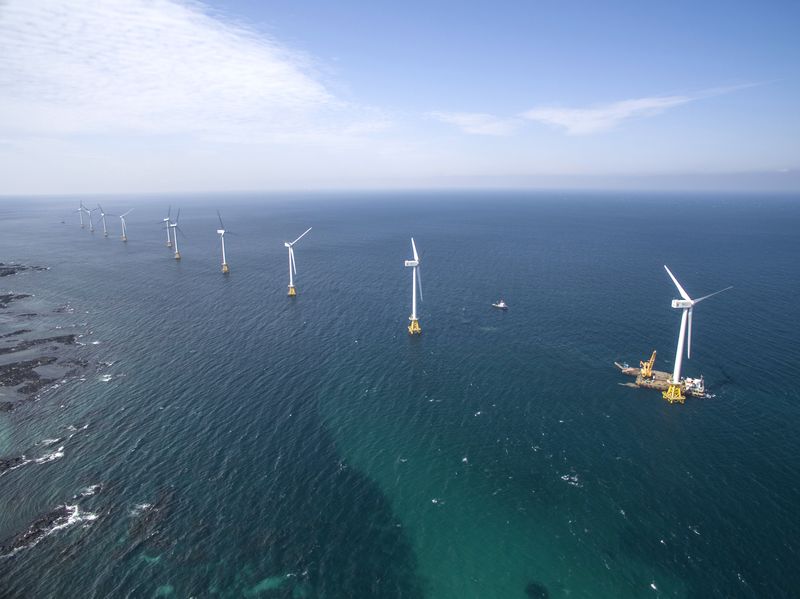
The task force will review issues facing each project, including community acceptance, and identify areas where the permitting system can be improved. For issues that are difficult to resolve on its own, it will recommend regulatory improvements to the government and relevant organizations, and incorporate industry feedback into project development.
Wi Seong-gon, governor of Jeju, said, “The Chuja offshore wind project will be the first to move forward in earnest,” and urged, “Please join forces to ensure that Jeju offshore wind’s connection to the national grid is included in the 12th Basic Plan for Electricity Supply and Demand.” Wi also called for domestic demonstrations of floating offshore wind and a review of electricity tariff arrangements suited to renewable energy.
The next test for Jeju’s offshore wind industry is less about expanding generation capacity than about putting in place the foundations needed to get projects moving. Since the task force’s launch, its key challenge will be to determine whether it can redesign the developer-selection strategy for Chuja, secure access to the national grid, and address permitting, maritime boundaries, environmental concerns, and acceptance by residents and fishers in parallel.
[email protected] Jung Yong-bok Reporter