Gwacheon Juam Data Center Releases Environmental Assessment Results: “EMF Is Harmless; Noise and Vibration Meet Standards”
- Input
- 2026-10-07 10:04:18
- Updated
- 2026-10-07 10:04:18
[Financial News] Construction of data centers, essential infrastructure in the age of artificial intelligence (AI), is being delayed in communities across the country due to opposition from residents. The small data center in the Gwacheon Juam District is also facing opposition from nearby residents over electromagnetic fields, noise and vibration, and the heat island effect. Experts say these “concerns” are excessive and have little scientific basis.
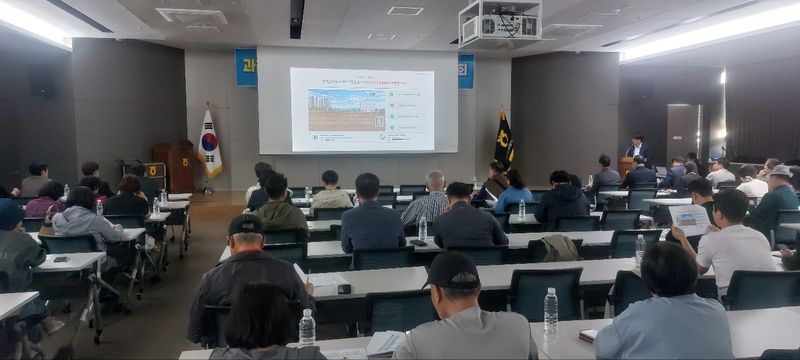
According to industry sources on the 7th, Gwacheon Juam Daeto REITs (Juam Daeto REITs), the developer of the data center in the Gwacheon Juam District, held a residents’ briefing on the 6th and shared the results of an “environmental impact review” conducted by a group of experts.
The project is being developed on Block 1-9 of the Juam District business area. The site covers 2,274 square meters, with three basement levels and seven above-ground floors, and a total floor area of 14,538 square meters. It is a small data center with a power receiving capacity of 9.5 MW. Small data centers support services such as autonomous driving, smart cities and robot control near urban centers. The building’s height was adjusted and its facade specially designed to take account of nearby office and residential facilities.
At the briefing, Juam Daeto REITs explained that the data center would receive power through the same 22.9 kV distribution lines as nearby apartments and office buildings, so there would be no need to build separate transmission towers or extra-high-voltage transmission lines. It also noted that quite a few data centers are already located close to residential areas. One data center in Bundang, for example, is 5 meters from a residential area.
As for the electromagnetic fields that residents are concerned about, the company said measurements around the site showed a maximum of 1.46 mG, a minimum of 0.02 mG and an average of 0.44 mG. It said levels around the site are far lower than those from household appliances and have almost no impact on the human body. It also noted that all projected and measured values are no more than 0.2% of the domestic standard of 833 mG. In September last year, the government announced that measurements of electromagnetic fields at data centers were lower than those at hospitals and hotels.
The company also described concerns about the heat island effect as excessive. It said heat discharged by chillers is designed to dissipate quickly into the surrounding air without affecting temperatures in nearby residential areas. It claimed simulations showed there would be almost no heat island effect of the kind residents fear.
The company said noise and vibration would also be managed through soundproofing and vibration-control measures for each piece of equipment. It plans to install soundproofing and vibration-control devices on generators and chillers to reduce them. Forecast levels that take these measures into account meet all government standards. For residential areas, the standards are 45 dB(A) for noise and 49 dB(V) for vibration.
The company also outlined a fire prevention plan. In addition to establishing a monitoring system operating 24 hours a day, 365 days a year, it plans to enclose the battery room separately with firewalls to prevent a fire from spreading. It also plans a more robust design than that of a standard office, adding automatic fire-detection sensors and alarms, fire compartments and smoke-control facilities. The company said it would maximize the distance between the residential area and the battery room to minimize the spread of damage to homes in the event of a fire.
A person involved in the environmental impact analysis urged residents to bear in mind that the analysis and review found there would be almost no impact of the kind they are concerned about.
Experts say conflicts surrounding data centers should not be left solely to residents, project developers and local governments. According to a Samsung Securities report, domestic data center capacity is projected to grow from about 1.9 GW at the end of 2025 to 14.8 GW by 2030.
One source said, “Baseless rumors about data centers are fueling ‘NIMBY’ sentiment,” adding, “Accurate directives and guidelines are needed at the central-government level.”
Moon Byung-seop, vice president of the Korea Institute of Civil Engineering and Building Technology, stressed, “Data centers are not IT facilities but national infrastructure construction projects,” adding, “The main cause of bottlenecks, such as the lack of procedures for handling conflicts, lies in the institutional framework.”
[email protected] Lee Jong-bae Reporter