Bukangi, the “people’s shark,” turns out to be endangered... 3-meter female heuk-sangeo confirmed
- Input
- 2026-10-07 09:04:52
- Updated
- 2026-10-07 09:04:52
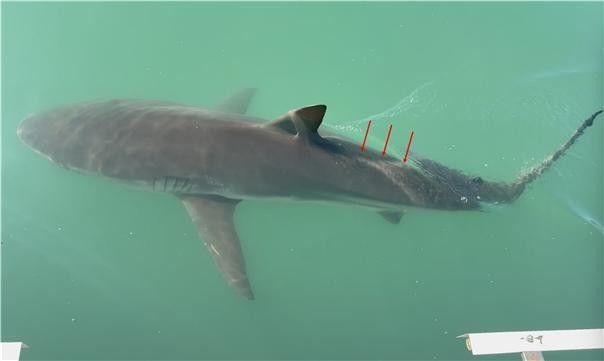
[Financial News] The identity of “Bukangi,” the shark that has drawn nationwide attention since first appearing in Busan on the 18th of last month, has been definitively confirmed as a heuk-sangeo.
NIFS: “Bukangi” at Busan North Port is a heuk-sangeo, not a mutae-sangeo
On the 6th, the National Institute of Fisheries Science (NIFS) definitively confirmed that “Bukangi,” which is staying at North Port Waterfront Park, is a heuk-sangeo, not a mutae-sangeo.
Since Bukangi was first spotted at Busan North Port Waterfront Park on the 18th, it had been presumed, based on its appearance, to be either a mutae-sangeo or a heuk-sangeo in the requiem shark genus. After NIFS conducted close-up photography and video analysis, it confirmed the characteristic appearance of a heuk-sangeo, with a clearly developed ridge between its first and second dorsal fins.
According to NIFS, mutae-sangeo and heuk-sangeo are closely related species that are difficult to distinguish with the naked eye, but they can be told apart by whether a ridge is present (heuk-sangeo) or absent (mutae-sangeo) between the first and second dorsal fins. A large shark, the heuk-sangeo has a broad, rounded snout and a developed ridge between its two dorsal fins; its upper-jaw teeth are triangular and serrated.
At birth, they measure about 70–100 cm in length and can grow to a maximum of about 4.2 m. By comparing Bukangi with nearby landmarks whose dimensions were known, its length was estimated at about 3 m. Its sex was identified as female based on the shape of its genitalia on its underside.
Heuk-sangeo are widely distributed from coastal waters to the open sea in tropical, subtropical and temperate regions around the world, including the coastal waters of Korea, and tend to prefer water temperatures of 18–26 degrees. They are also known to migrate long distances in response to changes in water temperature.
Their diet includes fish and squid. Although no studies have yet examined the diet of heuk-sangeo living in the North Pacific, those off the coast of Australia are known to prey on mackerel, horse mackerel and sardines. They give birth to live young after carrying them in the uterus until they are sufficiently developed. Because the species grows and reproduces slowly, it is classified as Endangered (EN) on the International Union for Conservation of Nature (IUCN) Red List due to its declining population.
Reported to academia as previously unrecorded in Korea in 2019... later found along the entire coast
In Korea, heuk-sangeo had been considered the same species as mutae-sangeo, but in 2019 it was reported to the scientific community as a species not previously recorded in the country. Since then, it has been found along the country’s entire coastline, including off Namhae in South Gyeongsang Province, Samcheok in Gangwon Province, Shinan in South Jeolla Province, Jeju and waters near Busan.
Meanwhile, NIFS plans to continue monitoring Bukangi’s swimming behavior and health, and to work with relevant agencies, including Busan City, if any abnormal signs appear. NIFS Director Kwon Sun-wook said, “Cases of large sharks appearing in Korea’s coastal waters are being confirmed on an ongoing basis,” adding, “We will continue to monitor the presence of large sharks through surveys of accidental catches and other means, and strengthen related ecological research.”
[email protected] Kim Hee-seon Reporter