A mother’s blood sugar management shapes her child’s lifelong health ... Gestational diabetes raises a child’s diabetes risk by up to 4.3 times
- Input
- 2026-10-07 12:00:00
- Updated
- 2026-10-07 12:00:00
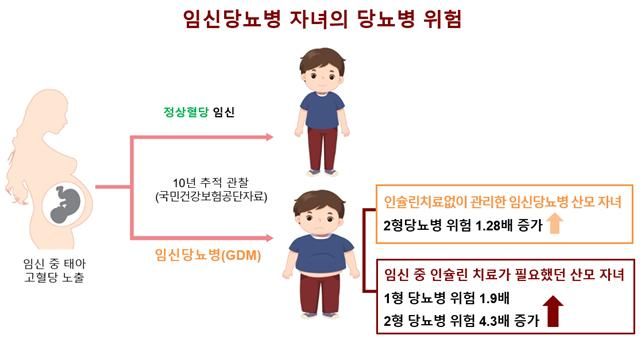
[Financial News] Mothers who received insulin treatment during pregnancy should continue to monitor their children’s weight and blood sugar regularly after childbirth. A study has found that their children face a significantly higher risk of developing diabetes.
The Korea National Institute of Health, under the Korea Disease Control and Prevention Agency, announced on the 7th that it had published findings in the international journal BMC Medicine showing that children of mothers who had gestational diabetes face a higher risk of developing diabetes as they grow up.
Gestational diabetes is a condition in which high blood sugar is first detected during pregnancy in someone who did not have diabetes before becoming pregnant. It is a complication affecting at least one in every 10 pregnancies worldwide. Blood sugar is managed through diet and physical activity, and medication such as insulin is used when these measures are not sufficient. Blood sugar returns to normal after childbirth for most women, but mothers remain at higher risk of type 2 diabetes and need ongoing care.
Risks around childbirth, such as premature birth, cesarean delivery and having a large baby, have been relatively well known. However, evidence has been limited on the effects on children’s health as they grow up.
This is the largest study of its kind to analyze separately the effects of gestational diabetes on type 1 and type 2 diabetes in children in an Asian population. Using data from the National Health Insurance Service, the research team followed 3,491,680 mother-child pairs whose children were born between 2009 and 2018, until the end of 2022, for up to 14 years (median: 9.5 years).
The research team divided the mothers into three groups—those without gestational diabetes, those with gestational diabetes managed without insulin treatment, and those with gestational diabetes treated with insulin—and compared the incidence of diabetes among their children.

The analysis found that children of mothers whose gestational diabetes was managed without insulin had 1.28 times the risk of type 2 diabetes than children of mothers without gestational diabetes. For children of mothers who needed insulin treatment during pregnancy, their risk rose to as much as 4.3 times that of children of mothers without gestational diabetes.
For type 1 diabetes, no clear association was found among children in the group whose mothers managed gestational diabetes without insulin treatment. However, children of mothers who needed insulin treatment had a 1.9 times as high a risk of developing type 1 diabetes.
“Managing blood sugar during pregnancy is connected not only to the mother’s own health but also to her child’s lifelong health,” said Kim Won-ho, director of the Division of Chronic Disease Convergence Research at the Korea National Institute of Health. “In particular, children of mothers with high-risk gestational diabetes need individualized, ongoing care as they grow.” He added, “On Pregnant Women’s Day (October 10), I urge pregnant women and their families to pay attention to blood sugar management during pregnancy and health care after childbirth.”
[email protected] Jeong Myeong-jin, Medical Correspondent Reporter