Kim Min-seok: “Cho Hee-dae should step down if he can’t handle the renomination”
- Input
- 2026-10-07 08:45:06
- Updated
- 2026-10-07 08:45:06
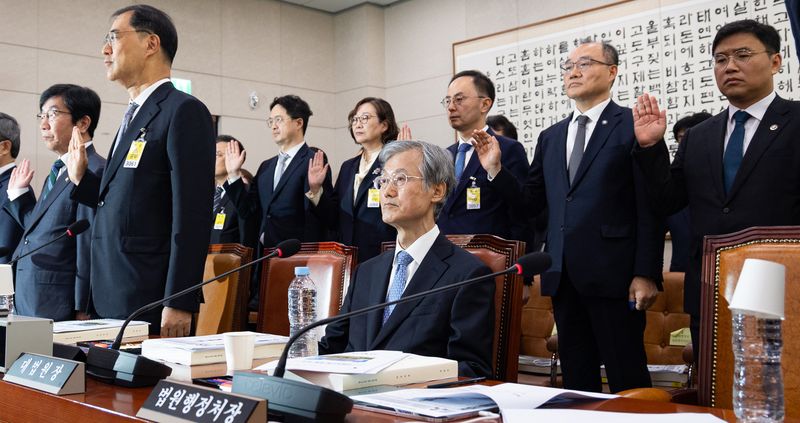
Appearing that day on the Democratic Party’s YouTube program “Minty07,” Kim said of Cho, who had appeared as an ordinary witness at the National Assembly’s Legislation and Judiciary Committee audit the previous day, “Ultimately, this comes down to his failure to properly handle the renomination issue,” and made the remark above.
The presidential office and Chief Justice Cho have been at odds for months over the appointment of a successor to former Supreme Court Justice Rho Tae-ak. In January, the Committee of Recommendation of Supreme Court Justice Candidates recommended four candidates, but the appointment process stalled for a prolonged period because the presidential office and the judiciary could not agree on a final candidate.
On August 18, Chief Justice Cho ultimately broke with the practice of nominating candidates after prior coordination with the president and submitted a written nomination of Judge Son Bong-gi, a presiding judge at the Daegu District Court. Ten days later, the presidential office called it “a unilateral written nomination without substantive consultation” and demanded that Cho renominate another candidate rather than submit Son’s confirmation motion to the National Assembly. But on the 22nd of last month, Chief Justice Cho rejected the demand, saying it lacked specific reasons and a constitutional basis. The presidential office immediately countered that this reflected “the unconstitutional view that the Chief Justice’s nomination power takes precedence over the president’s appointment power,” and the two sides’ dispute escalated into an open confrontation.
At the Supreme Court audit the previous day, the Democratic Party and Chief Justice Cho also clashed over the renomination of a Supreme Court justice candidate. Selected as an ordinary witness at the Democratic Party’s initiative, Cho refused to take the witness oath or testify, citing the separation of powers and the independence of the judiciary. However, as Democratic Party lawmakers continued questioning him, Cho took out a prepared document and retorted, “Just as the Chief Justice cannot intervene at all in the National Assembly’s confirmation process or the president’s appointment process, neither the National Assembly nor the president can intervene at all in the Chief Justice’s nominations.” He also stated that there was no constitutional basis for intervening in Supreme Court justice nominations and that forcing such intervention would be unconstitutional.
Democratic Party lawmakers continued their offensive, arguing that Chief Justice Cho’s refusal to renominate a candidate infringed on the president’s power to appoint Supreme Court justices. Democratic Party lawmaker Park Gyun-taek said, “It is a grave misconception to think that the nomination power is above the president’s appointment power,” and argued that the refusal to renominate could be grounds for impeachment.
[email protected] Song Ji-won Reporter