Nuri to Be Fueled in Morning, Switch to Automatic Mode 10 Minutes Before Launch
- Input
- 2026-10-07 09:14:16
- Updated
- 2026-10-07 09:14:16
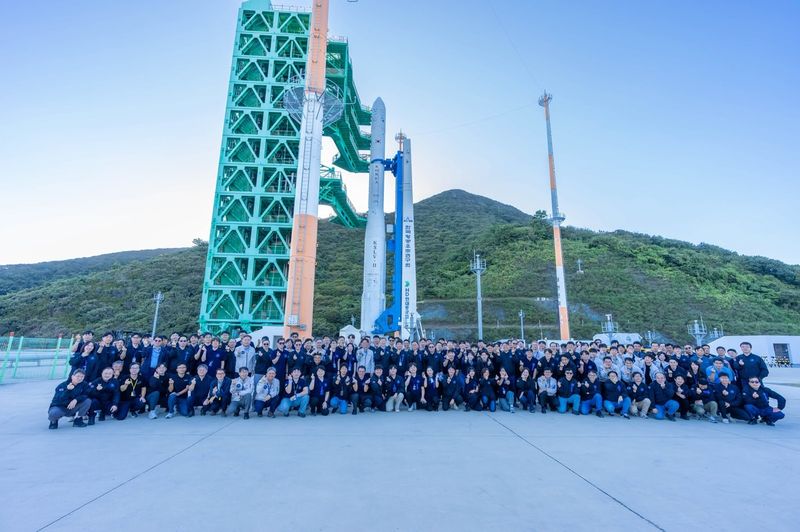

[Financial News] With Nuri's fifth launch set to proceed as scheduled at around 12:25 p.m., fuel and oxidizer will be loaded in the morning. The rocket will then switch to automatic operation mode 10 minutes before the scheduled 12:25 p.m. launch.
Korea AeroSpace Administration Commissioner Oh Tae-seok announced the outcome of the Nuri Launch Management Committee meeting on the morning of the 7th, saying, "The Launch Management Committee has set Nuri's final launch time at 12:25 p.m."
Commissioner Oh said, "The launch window today is one hour, from 12:23 p.m. to 1:23 p.m.," and added, "After this time, fuel and oxidizer loading operations are scheduled to take place at the launch pad." Kerosene, the fuel, is scheduled to begin loading at around 9:40 a.m., while liquid oxygen, the oxidizer, is scheduled to begin loading at around 10:15 a.m. Each loading operation will take about 70 minutes.
Commissioner Oh explained, "At 12:15 p.m., 10 minutes before launch, Nuri will switch to automatic operation mode, and all subsequent steps will proceed automatically. Nuri will check the status of the entire launch vehicle by itself, then carry out subsequent procedures such as engine ignition and liftoff." He continued, "Ten seconds before launch, the onboard computer will enter the liftoff-ready state. Four seconds before launch, the first-stage engine will ignite, and once it reaches normal output, the launch vehicle restraints will be released and the launch will take place."
However, he said, if an abnormality is detected during automatic operation, the launch sequence may be halted immediately.
Nuri was transported to the launch pad the previous morning and erected there, and connections for fuel and power supply, including the umbilicals, were completed. Additional work, including connecting the igniters for umbilical separation and removing components not needed for flight, was completed at 11:30 p.m. last night. Inspections of sensors and equipment on the launch vehicle and launch pad have been underway since 5 a.m. today.
Regarding the results of the Launch Management Committee's comprehensive review of Nuri's technical readiness and launch-safety factors such as weather, Commissioner Oh said, "Launch preparations have proceeded normally according to the planned schedule so far, and no technical problems have arisen."
The temperature, precipitation and air pressure around Naro Space Center all currently meet launch requirements. The average wind speed is 2 meters per second, with an instantaneous maximum of 5 meters per second, posing no problem for launch, he said. However, he noted that even if ground-level winds are light, stronger winds may blow at higher altitudes, or wind direction and speed may change sharply with altitude. He added that clear skies with no clouds are forecast today, so conditions do not fall under launch restrictions related to lightning.
Commissioner Oh said, "According to today's forecast from the Space Environment Center, the likelihood of alerts related to solar flare eruptions and solar particle influx is low, and we determined that geomagnetic and ionospheric disturbances are not expected to reach levels that would affect Nuri's launch." He added, "The analysis of possible collisions between Nuri's flight path and trackable space objects, including the International Space Station, operational satellites and space debris, also found no risks likely to affect the launch."
[email protected] Yeon Ji-an Reporter