Yoon Ho-joong: “Prosecutors steeped in special investigations won’t be sent to the Serious Crimes Investigation Agency” [2026 parliamentary audit]
- Input
- 2026-10-06 18:42:11
- Updated
- 2026-10-06 18:42:11
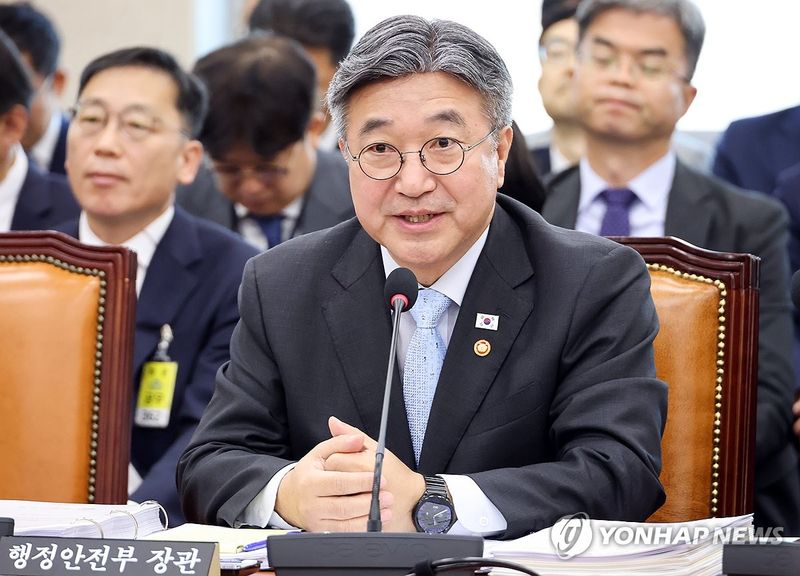
[The Financial News] Yoon Ho-joong, Minister of the Interior and Safety, said the government would not transfer to the Serious Crime Investigation Agency prosecutors accustomed to the prosecution’s past special-investigation practices. The policy is intended to draw on prosecutors’ investigative experience while blocking their established practices, amid concerns that the agency could become a “second prosecution service.”
On the 6th, during the National Assembly Public Administration and Security Committee’s audit of the Ministry of the Interior and Safety, Minister Yoon told Democratic Party lawmaker Lee Sang-sik, who asked that the agency’s remaining positions be filled as far as possible by people without prosecution backgrounds, “We are not planning to give anyone special disadvantages simply because they come from the prosecution.” He added, “Those who have become too accustomed to the old special-prosecution divisions and special investigations, and have learned techniques such as fabricated investigations or burying investigations, will all be left in the prosecution.”
In response to criticism that merely dividing prosecution personnel between the Public Prosecution Office and the Serious Crimes Investigation Agency would not amount to a meaningful separation of investigation and prosecution, he said the reform was intended to address the concentration of authority in the existing prosecution service.
“Many problems arose because a single prosecutor or a prosecution office held both investigative and prosecutorial authority,” Minister Yoon said. “That is why we are separating them.” He added, “We brought the Serious Crimes Investigation Agency under the Ministry of the Interior and Safety because, if it were placed within the Ministry of Justice, the two sides could collude even more than they do now.”
However, he also said that the prosecution’s existing investigative capabilities should not be excluded.
“Some members of the public wonder whether we can create a new investigative agency, completely discard the prosecution’s existing investigative capabilities, achieve social justice and root out crime,” Minister Yoon said. “We are working to develop a plan that addresses both concerns.”
In response to the opposition’s claim that the Serious Crimes Investigation Agency could be turned into an investigative body that caters to the ruling administration, he firmly stated, “We have absolutely no such intention.”
People Power Party lawmaker Joo Ho-young questioned the agency’s political neutrality, citing the fact that its deputy chief, Jeon Jong-min, had handled the college admissions corruption case involving the child of Cho Kuk, head of the RKP’s Institute for Innovation Policy, as well as lawsuits related to the dismissal of Democratic Party lawmaker Lee Sung-yoon; he also noted that Hong-Ju Moon, head of the Daejeon Serious Crimes Investigation Agency, had served as an assistant special prosecutor on the Kim Keon-hee special counsel team.
When Joo asked, “Aren’t you going to put all your own people in place as part of the reorganization?”, Minister Yoon countered, “Are you saying we should bring in the prosecution under Yoon Suk Yeol?” He added, “I will make sure that what you are concerned about does not happen.”
Internal criticism of the preparations for the Serious Crimes Investigation Agency’s launch also came under scrutiny that day. Asked how prepared the agency had been at launch, Minister Yoon said, “I judged that it was about two-thirds ready.” When People Power Party lawmaker Park Sang-woong asked, “Would that be 70%?”, he replied, “About 67%.”
Earlier, Lim Eun-jung, head of the Gwangju Regional Serious Crime Investigation Agency, said on her way to work that morning, “The agency opened without being adequately prepared, so it is impossible for it to operate normally right away.” Lim said that its budget had not been properly allocated and that even officials at Grade 5 or above were not told where they would be posted until the day before the agency opened.
Minister Yoon disputed this, saying, “I don’t think all of that is accurate.” In response to claims that the office building and IT facilities were not ready, he said, “PCs, telephones, network equipment and the like have all already been installed.”
Regarding Lim’s appointment, he explained, “There was one person from the prosecution who applied for a special-case appointment.” He added, “At Grade 1—the grade at which deputy chiefs and regional agency heads can be appointed—Lim Eun-jung was the only prosecutor who applied.”
On the overlap between the investigative jurisdictions of the Serious Crimes Investigation Agency and the Corruption Investigation Office for High-ranking Officials, he recognized the CIO’s priority. Minister Yoon said, “For high-ranking public officials, the agency must notify the CIO, and if the CIO asks for the case to be transferred, it must hand it over because the CIO has priority investigative authority.”
On the possibility of merging the CIO and the Serious Crimes Investigation Agency, he said, “First, we should ensure that the division of the prosecution into prosecutorial and investigative bodies takes hold. It is something we could consider later if necessary.”
If the police and the Serious Crimes Investigation Agency have conflicting investigative jurisdictions, the matter will be resolved through consultation between the two agencies until the Investigative Jurisdiction Coordination Council is launched next February.
[email protected] Lee Bo-mi Reporter