Stock Tokenization Is Reshaping Trading and Settlement Infrastructure: “Transparent Guidance and Supervisory Cooperation Needed”
- Input
- 2026-10-13 09:00:00
- Updated
- 2026-10-13 09:00:00
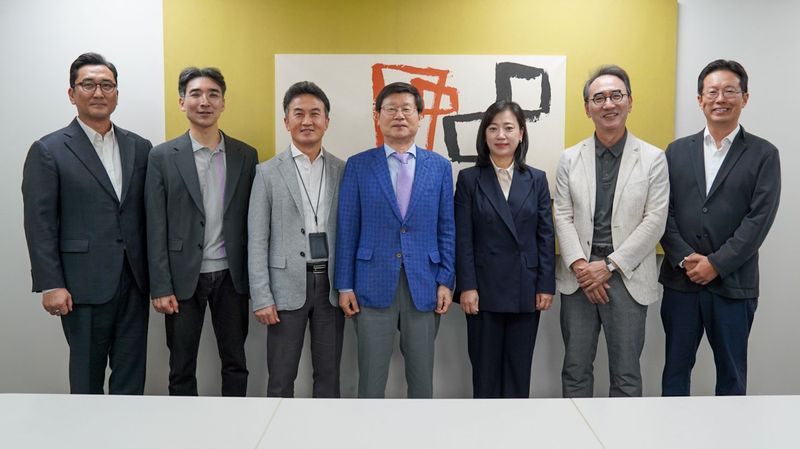
At the seventh regular meeting recently held by the Korea Private Financial Reform Committee at Financial News headquarters in Seoul’s Seocho District, Hwang Se-woon, a senior research fellow at the Korea Capital Market Institute, said this, adding, “As overseas stock-tokenization markets have moved beyond private-sector experiments and expanded to the point of being linked to settlement assets, the domestic market, led by financial authorities, must also focus its efforts on infrastructure design.” Experts attending the Financial Reform Committee meeting likewise argued that infrastructure must be built urgently, saying tokenized stocks have a clear role in inter-institutional trading as well as in the retail market.
In his presentation, Senior Research Fellow Hwang said, “Excluding stablecoins, the on-chain real-world asset market grew from $4.8 billion at the end of July 2024 to about $37.5 billion at the end of July this year.” It had expanded about 7.8-fold in two years. As of the end of July this year, the stock-tokenization market was worth about $3.56 billion, accounting for 9.5% of the overall on-chain real-world asset (RWA) market.
Stock tokenization means issuing existing listed shares as digital tokens based on distributed ledger technology (DLT). It offers features such as asset divisibility, programmability through smart contracts, the composability of various financial functions, and instant settlement. The process involves three layers—acquisition and custody of the underlying assets, token issuance, and distribution and settlement—and numerous participants, including issuers, custodians, transfer agents, exchanges and oracles, divide up the work. The way these stages are connected determines the legal structure of rights and operational risks.
Senior Research Fellow Hwang said, “The stock-tokenization industry has completed its division of labor into an issuance group, such as Ondo and xStocks, which handles custody of the underlying shares and token issuance; a distribution group, such as Kraken, Bybit and Bitget, which provides trading services; and a clearing and custody group, which handles trading and custody of the underlying shares.” He added, “This process could lead to a concentration of back-office functions and increased systemic risk.”
Traditional financial infrastructure is also moving quickly to enter the market. Nasdaq, NYSE, and The Depository Trust Company (DTC)/DTCC in the United States are supporting tokenized delivery while maintaining the existing market’s legal rights, quotes, and securities depository and settlement systems. In other words, crypto-native infrastructure and traditional capital-market infrastructure are converging.
Overseas, attention is already focused on who will provide the market’s core infrastructure. The focus of market competition has shifted from token issuance to providing that core infrastructure. As a result, the spread of private platforms, the division of labor between issuance and distribution, the entry of traditional infrastructure, and the convergence of on-chain and regulated markets are all unfolding at the same time.
Committee member Hwang said, “It is urgent to design policies for the domestic capital market around a native approach based on electronic securities, combining their legal advantages with the efficiency of on-chain infrastructure.” He added, “With domestic investors already able to access offshore platforms, clear and transparent information about the substance of products and the structure of rights, cross-border supervisory cooperation, and protected domestic alternatives are needed.” Specifically, a legal foundation, product regulation, investor protection, and market infrastructure must be put in place.
Committee member Hwang explained, “Stock tokenization is less about creating new assets than about transforming trading and settlement infrastructure. Institutional reforms need to be carried out in stages but swiftly, balancing investor protection with market innovation.”
Kang Hyung-gu, a professor in the Department of Finance and Management at Hanyang University, said, “The authorities’ policy appears to be aimed at preventing the use of public blockchains such as Ethereum. They are blocking them on the grounds of gas fees, but allowing widely tested public coins despite the gas fees could be an effective way to reduce the ultimate cost of building infrastructure.”
Koo Min-woo, an adjunct professor at Hallym University, pointedly remarked, “Korea, where positive regulation has traditionally been strong, missed an opportunity in 2016, but this is a second chance. The Korea Deposit and Settlement Agency insists that STOs must be designed as closed systems, and the market has reached the point where it feels there is no room for dialogue.”
Kim Jun-hong, CEO of Fair Square Lab, explained, “Overseas, they are tokenizing and circulating rights to securities, not the securities themselves. Rights associated with shares broadly consist of shareholder rights to participate in corporate governance and claims to dividends and returns. The former is complicated, so it has been set aside, and only the latter is being tokenized.”
[email protected] Park Moon-soo Reporter