‘Physical AI’ gathers in Seoul... A glimpse of future cities coexisting with robots [Full report]
- Input
- 2026-10-06 16:55:17
- Updated
- 2026-10-06 16:55:17
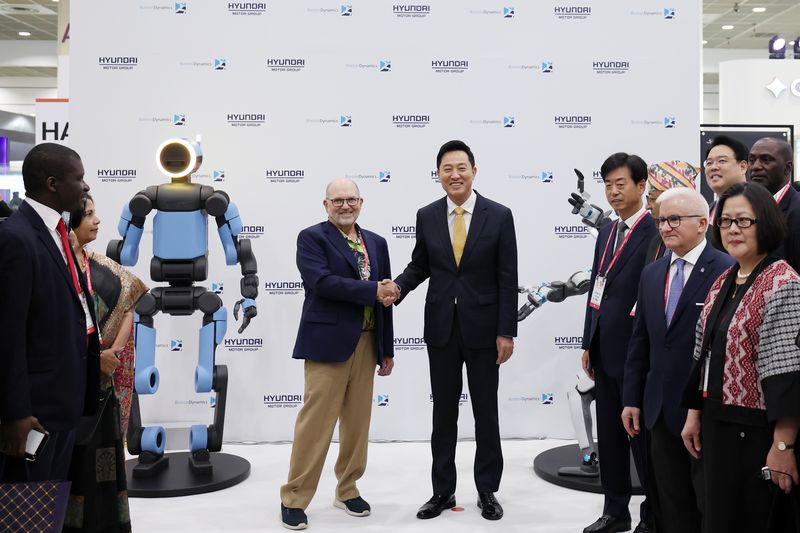
[Financial News] A smart city expo showcasing how physical AI—a combination of artificial intelligence (AI) and robotics—could transform future cities opened in Seoul. This year, the event puts physical AI technologies, including humanoid and autonomous mobile robots, front and center, focusing on how AI could reshape citizens’ daily lives and urban spaces beyond industrial sites.
The Seoul Metropolitan Government said it held the opening ceremony of Smart Life Week 2026 (SLW 2026) at COEX in Seoul’s Gangnam District on the 6th, and that the event would run for three days, through the 8th. This year’s event, themed “Designing Life with AI,” brought together a total of 515 businesses, institutions and cities, including 312 companies, 102 institutions and 101 cities from overseas.
This year, the exhibition dedicated to physical AI spans a total of 18,378 square meters, a 46% increase from the previous year. It has been designed to let visitors experience how AI technologies that move and make decisions directly in the physical world, beyond generative AI, could change everyday life and industrial sites.
Around 300 people attended the opening ceremony, including Seoul Mayor Oh Se-hoon, Marc Raibert, founder of Boston Dynamics and head of Hyundai Motor Group’s RAI Institute, mayors from overseas cities and ambassadors stationed in Korea. Traditional percussion performance team TAGO and Mind AI robots opened the event with a performance combining large-drum and janggu music with the robots’ movements.
“Patience Is Needed for Advances in Robotics”
In his keynote address, Raibert said that while the combination of AI and robotics is rapidly changing how robots learn, long-term investment and time are needed before the technology can be widely applied in real life.
“Technological progress requires long-term support and patience,” Raibert said. “What we’re showing today is also from 15 years ago, and it was possible because investment had continued for years, starting much earlier. The same will be true of future robotics technology.” Even so, he explained, the way AI trains robots is already evolving rapidly. Whereas engineers once had to spend four to five months programming a single movement into a robot, reinforcement learning and simulation can now help robots learn new movements much faster. He cited facility and equipment inspections, as well as dangerous sites that are difficult for people to access, as areas where physical AI could be used.
In his opening remarks, Mayor Oh also highlighted the potential for physical AI to transform cities and citizens’ daily lives. “Seoul is emerging as a world-leading city for physical AI,” he said. “The question we need to ask is how AI can make citizens’ days safer, more convenient and more meaningful.” He added, “Just as the Seoul Metropolitan Government helps citizens get around early with autonomous buses and supplements the workforce in welfare settings with care and wearable robots, we are focusing on creating the warmest changes with the coldest technology.”
Six Humanoid Robot Models Take the Stage... Robots Even Play Soccer Against Each Other
The 2026 Seoul AI Robot Show, taking place in Hall B of COEX during the event, will focus on showcasing advanced robotics. Six homegrown humanoid robot models will take center stage, and the exhibition and hands-on programs have been expanded to make it easier for citizens to experience the progress of physical AI.
Visitors will be able to play tennis with robots themselves and watch soccer and boxing matches between robots.
The “Robot in Seoul” zone focuses on technologies already being used in real cities. Examples include AI-powered autonomous patrol robots and convenience-store robots that are already operating in parts of Seoul or are likely to be introduced in the future. The zone is designed to show how technologies developed in research and industry are expanding into areas of citizens’ lives such as safety and everyday convenience.
Hall A at COEX reimagines some of Seoul’s major landmarks as settings for a future city. Using eight locations—including Sejong-daero, Yangjae and Suseo, Gwanghwamun, the Han River, Seoul Station, Seoul Metropolitan Library, Bukchon Hanok Village and Dongdaemun Design Plaza (DDP)—the exhibition depicts how advanced technologies in AI-powered administration, safety and care, mobility, and education are used in a real city.
Smart City Innovation Competition: 133 Cities from 55 Countries
The awards ceremony for the fourth Seoul Smart City Prize, which shares innovative practices from cities around the world, was also held that day. Co-hosted by the Seoul Metropolitan Government and the World Smart Sustainable Cities Organization (WeGO), this year’s event received 210 entries from 133 cities in 55 countries worldwide, with 21 winners selected across four categories.
The gold award in the People-Centered Project category went to a project in Quelimane, Mozambique, to strengthen climate resilience by drawing on cultural intelligence. In the Technology Innovation Project category, Madrid, Spain, won gold for its efforts to build a human-centered city using data, AI and urban intelligence.
Eighteen international conferences, including the Mayors Forum and the Physical AI Forum, will also take place during the event.
“We will grow Smart Life Week into a global platform where cities, businesses and researchers from around the world can share their experience and technology, so that one city’s innovations can become solutions for another,” Mayor Oh said.
[email protected] Seong Chorong Reporter