Jeju National University’s ‘Kumda Humanities’ expands its nationwide network ... through exchanges with HK3.0 researchers
- Input
- 2026-10-06 15:53:25
- Updated
- 2026-10-06 15:53:25
【Financial News, Jeju = Jeong Yong-bok】 ‘Kumda Humanities,’ which seeks to extend Jeju’s accumulated experience of inclusion and hospitality into solutions to global challenges such as refugees and migration, has begun building a nationwide cooperation network with Humanities Korea 3.0 (HK3.0) researchers.
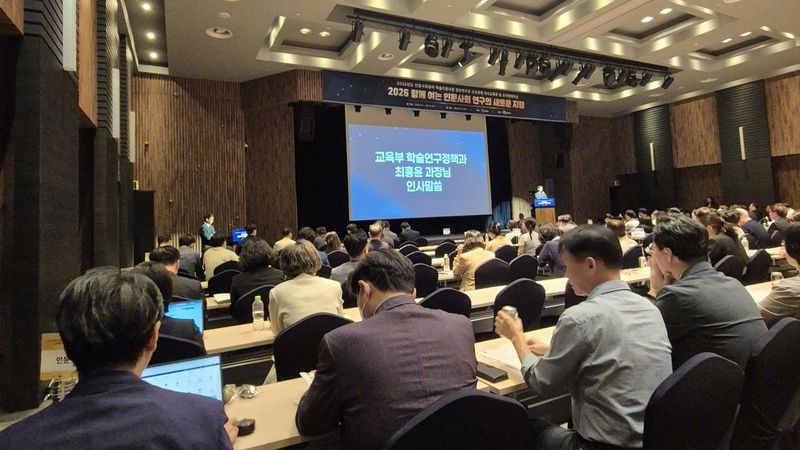
According to the Tamna Culture Research Institute at Jeju National University on the 6th, the Kumda Humanities team attended the ‘2026 Academic Support Program for Humanities and Social Sciences: Knowledge Exchange Meeting and Orientation for New Projects in the Group Research Track’ held at the aT Center in Yangjae, Seoul, on the 1st.
About 300 people attended the event organized by the National Research Foundation of Korea, including principal investigators and participating researchers on new projects in the humanities and social sciences, among them HK3.0 projects. Researchers shared information needed to carry out their projects and discussed research directions and operational plans for each project, as well as future collaboration, at field-specific exchange meetings.
The Kumda Humanities team at the Tamna Culture Research Institute introduced its research direction and plans under the theme ‘Kumda Humanities in an Age of Global Anomie: Toward Archipelagic Life and Hybrid Ways of Knowing.’
‘Kumda’ is a research concept rooted in a word in the Jeju language meaning ‘to embrace.’ The idea is to draw principles of inclusion and hospitality from Jeju’s historical experiences of migration and settlement, conflict and coexistence, and connect them to solutions to problems in contemporary society.
Anomie is a condition in which a community loses shared standards as the norms and relationships that sustained society weaken. The research team plans to examine problems facing contemporary society, including refugees, migration and community conflict, through joint research spanning history, language and society, and to develop its work into ‘policy humanities’ that connects research findings with local communities and policymaking.
The exchange meeting also focused on identifying opportunities for academic collaboration among new HK3.0 researchers, beyond the research achievements of individual institutions. This aligns with the Tamna Culture Research Institute’s vision of connecting regional humanities rooted in Jeju with other research hubs in Korea and, in the long term, expanding into an international network for island studies.
Kim Chi-wan, head of the Kumda Humanities team, said, “It was a meaningful occasion for the newly launched research teams to share their research directions with one another,” adding, “I will work to ensure that research rooted in Jeju takes hold as a humanities of coexistence connecting the region and academia.”
[email protected] Jeong Yong-bok Reporter