Bargaining with principal contractors remains stalled seven months after Trade Union Act took effect... Civil society says, “The government must step in”
- Input
- 2026-10-06 15:54:42
- Updated
- 2026-10-06 15:54:42
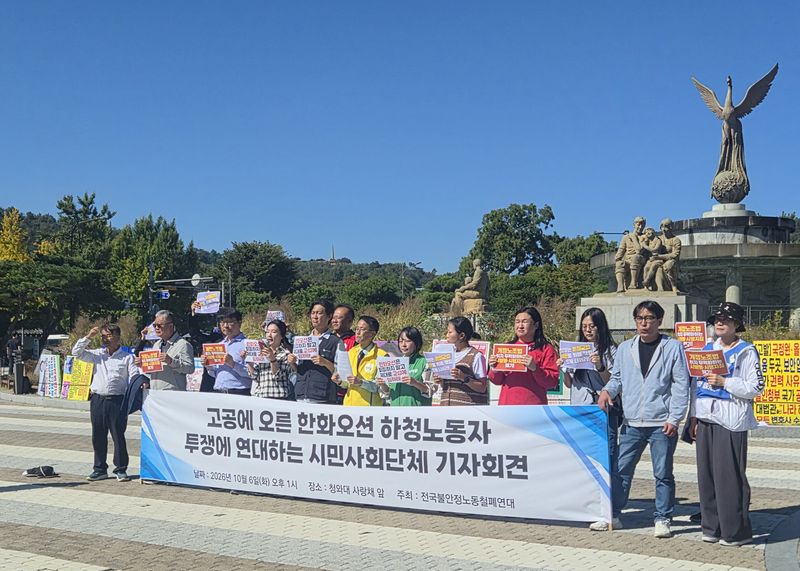
[Financial News] As subcontract workers at Hanwha Ocean launched a high-altitude sit-in protest demanding bargaining with the principal contractor, civil society groups called for active government intervention. They argue that supplementary measures are needed to make the system more effective, as bargaining has not taken place in practice despite labor relations commissions recognizing principal contractors as employers since the amended Trade Union and Labor Relations Adjustment Act (Trade Union Act) took effect.
Lawyers for a Democratic Society and labor and civil society organizations held a press conference in front of Cheongwadae Sarangchae in Jongno District, Seoul, on the 6th and said, “The government must amend the enforcement decree and do its part to bring principal contractors to the bargaining table.”
They said that although seven months have passed since the amended Trade Union Act took effect, bargaining between principal contractors and subcontractor unions has not been properly conducted on the ground. As a key example, they cited the Geoje-Tongyeong-Goseong Shipbuilding Subcontractors Branch of the Korean Metal Workers’ Union (Geotonggo Shipbuilding Subcontractors Branch), which has been staging a high-altitude sit-in protest since the 30th of last month, demanding bargaining with Hanwha Ocean as the principal contractor.
The Korean Metal Workers’ Union (KMWU) demanded collective bargaining with Hanwha Ocean on March 10. The union says that the Regional Labor Relations Commission and the National Labor Relations Commission subsequently recognized Hanwha Ocean as an employer with respect to some working conditions, but the company contested the rulings, filed an administrative lawsuit and applied for a stay of execution.
After a court recently rejected the application for a stay of execution, Hanwha Ocean posted a “Notice Confirming Unions Requesting Bargaining” on the 2nd. The union said that the process, which should have taken place in March, was delayed by about seven months and that actual bargaining between the principal contractor and the subcontractor union has yet to begin.
Kim Hyung-su, vice chairman of the Korean Metal Workers’ Union, told a reporter that day, “No bargaining has taken place yet, and the process of finalizing the notice is underway. We’ll have to review the contents of the official reply the company said it would send before we can know what happens next.” He added that if the company’s response differed from the union’s demands, “we would continue to press for principled bargaining.”
Civil society groups pointed to the current enforcement decree and implementation guidelines under the Trade Union Act as one cause of delays in bargaining with principal contractors. They argue that even when a labor relations commission recognizes a principal contractor as an employer, actual bargaining may still take considerable time if the contractor files an administrative lawsuit and applies for a stay of execution.
Kim Sang-eun, chair of the labor committee at Lawyers for a Democratic Society, said, “Bargaining was delayed when Hanwha Ocean filed an administrative lawsuit despite the labor relations commission recognizing its status as an employer,” and stressed that the government should actively examine whether principal contractors are refusing to bargain.
Civil society groups also stressed the need for institutional safeguards to prevent principal contractors from delaying bargaining for extended periods even after a labor relations commission has determined their employer status. They said effective penalties for avoiding bargaining by principal contractors should be established and that the current enforcement decree and implementation guidelines should be revised to align with the intent of the amended Trade Union Act.
[email protected] Lee Dong-hyeok Reporter