Solar 'Tandem Panels' That Raise Power-Generation Efficiency by 25% Challenge China's Dominance; Hanwha Qcells and Others Lead the Field
- Input
- 2026-10-06 14:53:01
- Updated
- 2026-10-06 14:53:01
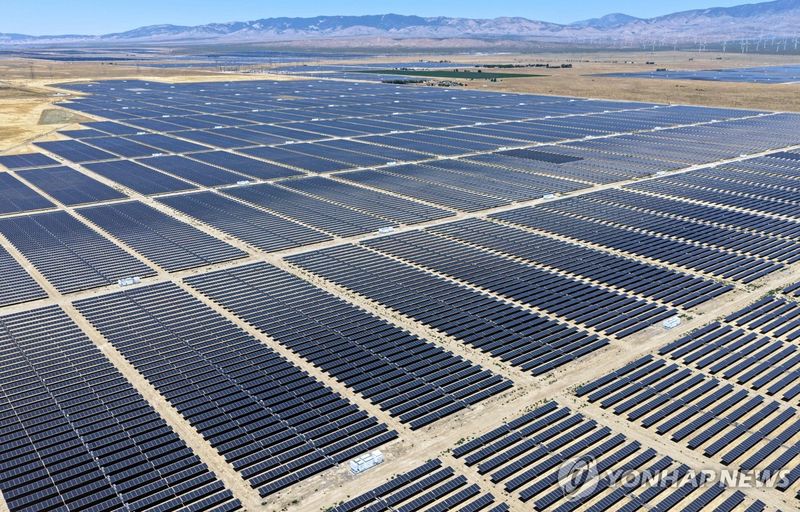
[Financial News] U.S. companies are challenging China's dominance in the global solar market, where China controls 80% of the market, with tandem solar panels.
The New York Times (NYT) reported on the 6th, local time, that U.S. solar companies are accelerating the development and commercialization of next-generation tandem solar technology, which can increase power-generation efficiency by up to 25% or more.
Unlike conventional solar panels, which have a single layer, tandem solar panels stack layers like a cake to convert more solar energy into electricity. They can convert more sunlight into electricity using less land and fewer rooftops, helping meet rapidly rising electricity demand.
Tandem PV, First Solar, and South Korea's Hanwha Qcells have completed technology validation and certification and are preparing to launch commercial products.
Tandem PV, First Solar, and Hanwha Qcells Prepare to Launch Commercial Products
Mike Carr of the U.S. Solar Energy Manufacturers Association said, "Chinese companies are also developing tandem solar systems, but their technology is not superior to ours and may actually be lagging behind."
According to the U.S. Energy Information Administration (EIA), introducing tandem panels could raise the average capacity factor of U.S. solar power plants from the current 24% to more than 31%.
However, tandem panels cost three to 3.5 times as much as conventional panels, making price competition with low-cost Chinese panels the biggest challenge.
One key to easing investor concerns will be proving that tandem panels can withstand degradation and other forms of deterioration, maintain power-generation efficiency over the long term, and do not suffer performance losses faster than today's mainstream panels.
NYT reported that Hanwha Qcells is attracting investors by conducting durability tests with German research institutes and others under harsh conditions, including bombarding panels with hailstones the size of golf balls and projecting LED light onto them.
The Trump administration's policy of increasing reliance on fossil fuels and nuclear power is also a factor affecting the expansion of new solar power plants.
"Hanwha Qcells Invests Billions of Dollars in Georgia and Elsewhere in the U.S. to Launch Production Lines"
NYT reported, "After acquiring the German solar manufacturer Qcells in 2012, Hanwha Qcells invested billions of dollars in Cartersville, Georgia, and elsewhere in the United States to operate large-scale production lines."
The newspaper projected that the country that establishes a mass-production system through tandem commercialization ahead of China will regain the lead in the global solar market.
It also predicted that widespread use of tandem panels could increase the share of solar power and help meet the electricity demand of artificial intelligence (AI) data centers. China currently controls about 80% of the global solar-panel and component market.
German, U.S., and Japanese companies that had led the market before 2010 were pushed to the brink of collapse by China's low-price offensive. Buoyed by tariffs and subsidies under the Joe Biden and Trump administrations, U.S. companies are seeking a revival by building new factories.
First Solar, a U.S. company, uses thin-film materials and is considered a leader in tandem-panel design after investing more than $2 billion in thin-film research and development.
[email protected] Lee Seok-woo, International Affairs Specialist Reporter