K-Halal sets its sights on a 2-quadrillion-won market, expanding into the Middle East
- Input
- 2026-10-07 13:36:48
- Updated
- 2026-10-07 13:36:48
[Financial News] K-food is stepping up efforts to tap the global halal market, valued at 2 quadrillion won. Exports to the Middle East have surged nearly 30%, making it the fastest-growing major region.
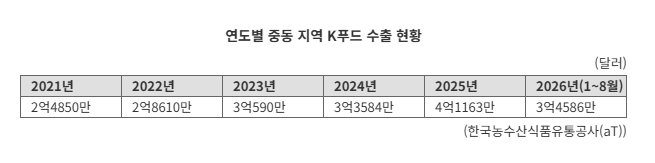
According to the Korea Agro-Fisheries & Food Trade Corporation (aT) on the 7th, K-food exports to Gulf Cooperation Council (GCC) countries totaled $345.86 million from January to August this year, up $76.03 million (28.2%) from $269.83 million in the same period last year. Export growth by region over the same period was 24.4% in Central and South America, 18.9% in the European Union (EU), 9.8% in the United States, 6.7% in China and 1.6% in ASEAN, making the Middle East the region with the steepest increase.
Exports have also risen steadily year by year. K-food exports to GCC countries totaled $248.50 million in 2021, $286.10 million in 2022, $305.90 million in 2023, $335.84 million in 2024 and $411.63 million in 2025, steadily expanding the market.
GCC countries are a region where most of the population is Muslim, and most foods other than those made with plant-based ingredients can only be exported if they receive halal certification.
Halal certification was once viewed simply as a religious rule prohibiting the use of certain ingredients, such as alcohol and pork. In recent years, however, it has become a key competitive factor, guaranteeing safe and hygienic production throughout the entire process, from sourcing ingredients to manufacturing, storage and distribution. The process is particularly stringent: manufacturers must strictly prevent products from mixing with non-halal products during production and establish separate dedicated production lines, among other requirements. Obtaining certification alone takes at least a year.
Thanks to these stringent standards, demand for halal food is spreading beyond the Middle East to markets around the world. Indonesia, which has a large Muslim population, will further tighten oversight by introducing a system requiring all imported food to be labeled halal or non-halal starting on the 18th. Malaysia and Singapore are also considered countries where halal certification is essential for entering the market. Market research firm Global Market Insights estimates that the global halal market was worth more than 2 quadrillion won last year.
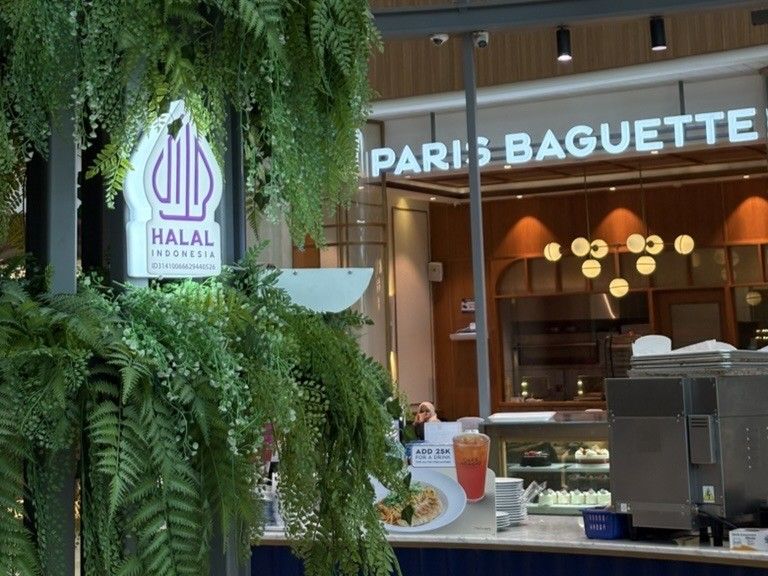
South Korean food companies are also stepping up their efforts to tap the market with halal products. Paris Baguette has completed construction of a halal-certified bakery in Malaysia and is using it as a base for supplying markets in Southeast Asia and the Middle East. This year, it also obtained official halal certification for all its stores in Singapore and Indonesia.
In 2017, Samyang Foods became the first South Korean ramen company to receive certification from Indonesia's halal certification body, MUI. Nongshim has also completed halal certification for more than 40 products, including Shin Ramyun and Neoguri. It currently operates part of its Busan factory as a dedicated halal production line.
Daesang develops and sells halal foods, focusing on its Indonesian brand Mama Suka. Fermented foods such as jang and kimchi can be difficult to certify as halal because alcohol is naturally produced during fermentation. Daesang, however, has successfully overcome barriers to entering the Muslim market by obtaining halal certification for key kimchi and jang products through R&D tailored to local needs.
An industry official said, “Halal is seen not merely as a religious means of targeting Muslim consumers, but as an indicator that manufacturing and hygiene are being managed rigorously,” adding, “Although Korean food is far removed from traditional halal food, the number of products clearing the certification hurdle through active R&D is growing rapidly.”
[email protected] Park Gyeong-ho Reporter