Consumers now choose shampoo like cosmetics... Hair care becomes a new growth engine for retail channels
- Input
- 2026-10-07 14:34:56
- Updated
- 2026-10-07 14:34:56
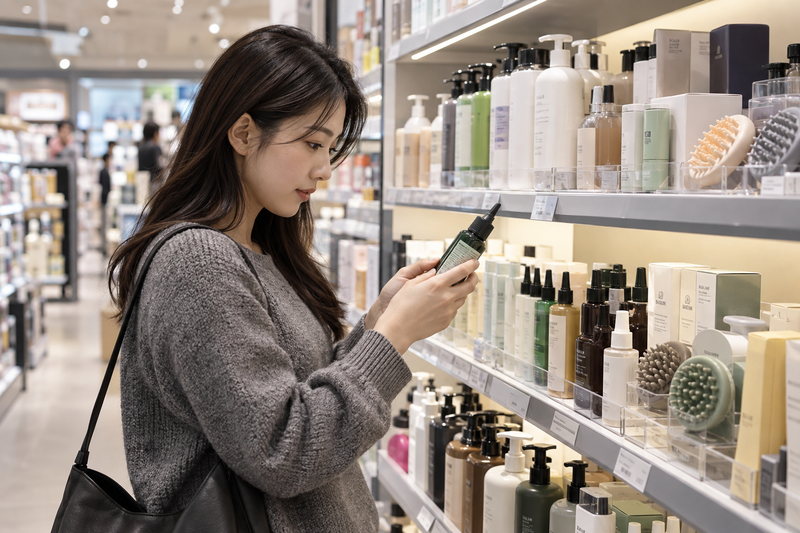
[Financial News] The K-beauty boom, sparked by skincare and inner beauty, has recently spread rapidly into products for the scalp and hair. Hair products such as shampoo, once regarded as everyday essentials, are being recast as “beauty products” that consumers choose based on their efficacy and ingredients, including for easing hair loss, soothing and cooling the scalp, and nourishing the hair. Retail channels across the board, from health-and-beauty (H&B) stores to duty-free shops, are expanding their hair-care offerings.
According to the Ministry of Food and Drug Safety on the 7th, domestic production of hair products totaled 1.6642 trillion won last year, up 8.9% from 1.528 trillion won the year before. Their share of total cosmetics production also rose by 0.6 percentage points, from 8.7% in 2024 to 9.3% last year. Over the same period, total cosmetics production grew 2.3%, from 17.5426 trillion won to 17.9382 trillion won, showing that hair-product production grew relatively quickly.
Sales growth is also clear across related retail channels. At CJ Olive Young Corporation, sales across the hair-care category rose by an average of at least 70% annually from 2023 to 2025. As of last year, the number of hair-care brands carried had increased by about 50% in three years.
Demand for “personal care”—products suited to each customer’s scalp condition—is growing. From January to August this year, sales of hair tonics and ampoules rose 42% from the same period a year earlier. Care routines that once centered on shampoo and conditioner are becoming more segmented, with step-by-step routines incorporating tonics and ampoules. This is driving demand toward specialist retail channels where shoppers can compare products with different functions in one place. Amid this trend, competition among brands to secure placement across channels is also intensifying.
The so-called “skincare-ification of the scalp” is also advancing rapidly at duty-free stores. In August this year, sales of scalp- and hair-care products at Shinsegae Duty Free rose about 65% from the previous month. The product range has diversified beyond shampoo and conditioner to include hair tonics, cooling gua sha tools and scalp massagers, reflecting different care needs and ways of use. Shinsegae Duty Free is working to broaden its assortment with exclusive products from hair-care brands such as Swiss Just, as well as the exclusive pre-launch of Vibe Lab, a scalp- and hair-care brand.
Industry players cite the expansion of self-care from facial skin to the scalp and hair, along with a growing trend of choosing products based on efficacy and ingredients rather than price, as factors behind the growth. Rising demand for self-care at home or while traveling, instead of visits to specialist shops, is also helping expand sales channels. As hair products once seen as value-for-money essentials become more specialized by function, they are emerging as a new growth category in beauty for retailers.
A Shinsegae Duty Free spokesperson said, “More customers are looking to care for their scalp and hair with segmented routines, just as they do their facial skin, and interest in related products is diversifying—from tonics to gua sha tools and cooling products.”
[email protected] Kim Hyun-ji Reporter