South Korea's 'Sustainable Distant-Water Tuna Fisheries' Introduced as an International Best Practice
- Input
- 2026-10-06 14:12:13
- Updated
- 2026-10-06 14:12:13
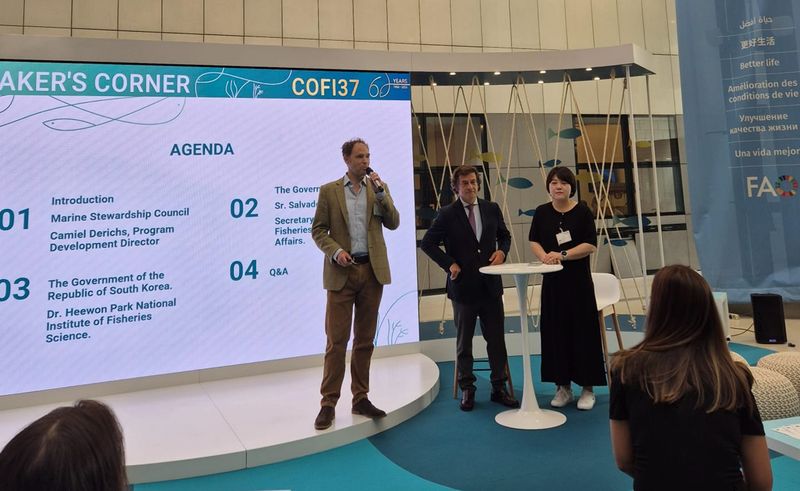
[Financial News] South Korea's sustainable tuna fisheries were recently selected as a global best practice at an event organized by the Marine Management Council of the FAO Committee on Fisheries.
According to NIFS on the 6th, Korea's case of 'science-based resource management and public-private cooperation for sustainable tuna fisheries' was introduced at the FAO Committee on Fisheries' Marine Management Council event, 'Scaling Up Solutions,' held recently.
Around 300 participants, including representatives from the FAO's 129 member countries and NGOs, attended the event. Dr. Hee Won Park of NIFS presented the key achievements of Korea's Sustainable Tuna Fisheries Roundtable.
Since 2022, the roundtable has expanded its scope of cooperation from sharing information on international sustainable fisheries standards to managing protected species, electronic monitoring, bait resources and joint responses through international fisheries organizations.
NIFS established a scientific management system by identifying the species and assessing the stocks of bait resources used in distant-water tuna fishing. This is an example of public-private cooperation in which a national research institute objectively verified data and samples from actual fishing operations provided by the industry.
NIFS Director Soonwook Kwon said, "The selection of this initiative as a global best practice is highly significant because it means that Korea's achievements in science-based resource management and public-private cooperation have been shared with the international community. We will continue to fulfill our role so that scientific resource management can lead to sustainable tuna fisheries."[email protected] Byun Ok-hwan Reporter