A 'European Counterpart to Section 301 of the Trade Act of 1974' Nears Reality as EU-China Trade Tensions Escalate [Lee Seok-woo's Global 24]
- Input
- 2026-10-06 14:36:40
- Updated
- 2026-10-06 14:36:40
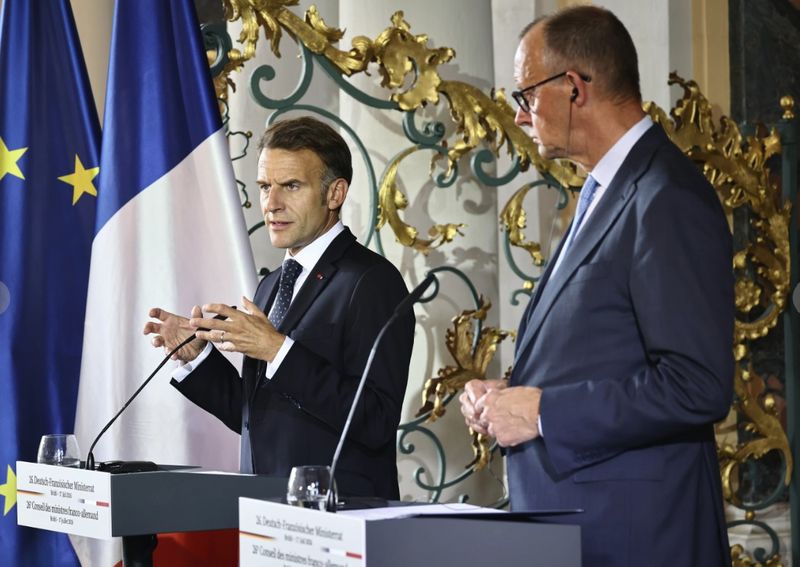
[Financial News] Tensions between the European Union (EU) and China over trade imbalances are intensifying.
As the creation of a new power to block China's access to the EU market—a European counterpart to Section 301 of the Trade Act of 1974—takes shape, tensions between the two sides are growing further, including amid opposition from China.
German Chancellor Friedrich Merz and French President Emmanuel Macron made the proposal in a joint letter sent on the 5th local time to European Commission President Ursula von der Leyen. They said that the EU was facing "unprecedented challenges" and that new measures going beyond its existing trade-defense tools were urgently needed.
EU Runs a Trade Deficit with China Equivalent to 1.5 Trillion Won a Day
According to Politico Europe and other foreign media outlets, Merz and Macron proposed introducing new measures that would enable Europe to strike back more strongly and swiftly against trade disputes threatening the continent. They said that certain countries were weaponizing trade and deliberately undermining fair competition and the restoration of market order through political and economic means, while distorting the EU single market. They urged the EU to restrict those countries' access to the bloc's single market.
Although the two leaders did not identify a specific country in their letter, China was the intended target. The proposal is aimed at China as the EU faces an astronomical trade deficit with the country, amounting to 1 billion euros per day, or approximately 1.5 trillion won, based on last year's figures. The EU recorded a 360 billion euro deficit, equivalent to approximately 541 trillion won, in trade in goods with China last year, a 15% increase from the previous year.
They also said that companies should diversify their supply chains first so that they would not become excessively dependent on suppliers from any particular country.
The remarks came as EU officials are scheduled to visit Beijing on the 8th and 9th for high-level trade talks on the trade dispute. Germany and France are seeking to have the proposal approved at an EU summit scheduled for the 15th and 16th. The proposal must receive approval from the governments of all 27 EU member states and the European Parliament.
China: "We Will Respond Resolutely to Protect Our Legitimate Rights and Interests"
As soon as reports emerged that the EU might introduce measures against China similar to Section 301, the Ministry of Commerce of the People's Republic of China (MOFCOM) took a hard line, issuing a preemptive warning that it would respond resolutely. Chinese authorities, having learned of the EU's move, foreshadowed a strong response in a question-and-answer format with reporters.
On the 30th of last month local time, a spokesperson for MOFCOM responded after reports of the proposed measures began circulating in the media, posting a question-and-answer exchange with reporters on the ministry's website. The spokesperson stated, "If the EU insists on implementing discriminatory restrictions against Chinese companies and products, China will respond resolutely to protect the legitimate rights and interests of Chinese industries." The spokesperson described the measures as "typical protectionist and unilateral measures" and noted that they would "disrupt bilateral trade and the stability of global supply chains."
The spokesperson added, "If the EU, which has always portrayed itself as a champion of multilateralism, takes the lead in violating World Trade Organization (WTO) rules, it will deliver a serious blow to the rules-based multilateral trading system."
Global Times Hints at Retaliatory Measures, Including Investigations into Industrial and Supply-Chain Security
A MOFCOM spokesperson also stated, "If the EU escalates pressure on China, it will seriously undermine mutual trust, hinder overall progress in negotiations and affect the broader framework of bilateral economic and trade cooperation." The spokesperson added, "We urge the EU to remain on the correct path of managing differences through dialogue. We will closely monitor the EU's subsequent moves."
China's state-run Global Times noted that if the EU's measures become reality, China could launch investigations into discriminatory measures, industrial and supply-chain security, and the impact of foreign subsidies.
China's Commerce Minister Wang Wentao had already begun taking swift countermeasures. On the 28th of last month, he held a video call with Germany's economy and energy minister, Katherina Reiche, to exchange views on economic and trade relations between China and Germany and between China and the EU.
[email protected] Lee Seok-woo, International Affairs Specialist Reporter