Cho Hee-dae: "Neither the National Assembly nor the president can intervene in the Chief Justice's recommendations for Supreme Court justices" ... He counters with the constitutional text (Comprehensive)
- Input
- 2026-10-06 14:03:32
- Updated
- 2026-10-06 14:03:32
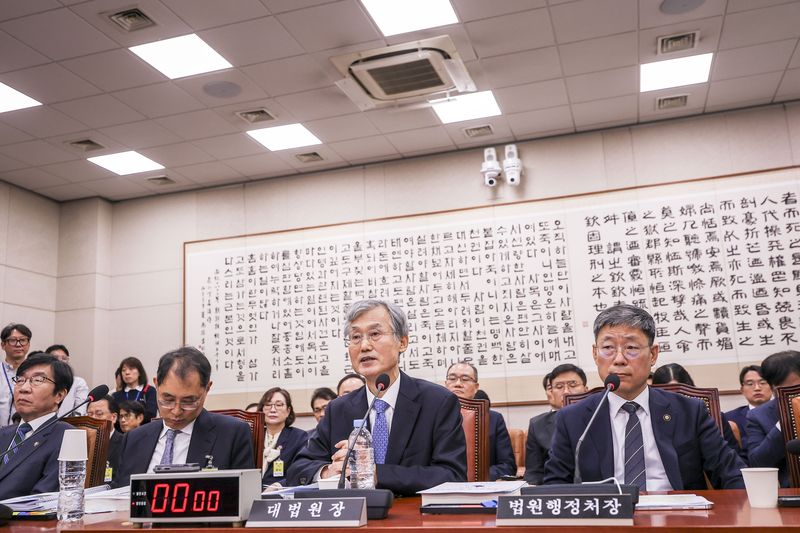
At a National Assembly audit of the Supreme Court of Korea held by the Legislation and Judiciary Committee on the 6th, Chief Justice Cho said, "Just as the Chief Justice cannot intervene in the National Assembly's consent procedure or the president's appointment procedure, neither the National Assembly nor the president can intervene in the Chief Justice's recommendation." He emphasized, "Forcing this would mean that the Legislation and Judiciary Committee, one part of the National Assembly responsible for the consent procedure, is interfering—without any constitutional basis—with the Chief Justice's recommendation, which belongs to the other branch of the process. It would be unconstitutional because it runs counter to the distribution of powers among institutions expressly established by the Constitution and to judicial independence." He was responding to Democratic Party of Korea lawmaker Kim Ki-pyo's criticism that Cho, who had been selected as an ordinary witness, was refusing to take an oath or answer questions.
Chief Justice Cho also addressed the practice of consulting Cheong Wa Dae over Supreme Court justice candidates. "Although it has no basis in the Constitution, the Chief Justice voluntarily cooperated to ensure a swift and smooth appointment," he said, adding, "There is no constitutional problem even if there is no consultation." Regarding the first written recommendation in constitutional history, he added, "The Constitution places no restrictions on it whatsoever."
He also rejected Cheong Wa Dae's interpretation of the provision requiring respect for the Committee of Recommendation of Supreme Court Justice Candidates. The Court Organization Act requires the Chief Justice to respect the committee's recommendations when recommending Supreme Court justice candidates. Chief Justice Cho said, "It only states that 'the Chief Justice shall respect them,'" adding, "Even if they are not respected, it remains a political issue and is not unconstitutional or unlawful." He continued, "It can be said that the Chief Justice's recommendation completes all of the constitutional powers and corresponding duties at the same time." He added, "Because the Constitution contains no procedure or method for the National Assembly to question or challenge this matter, I have no choice but to refuse to take an oath or give testimony."■ Under textual interpretation, the authority to recommend belongs to the Chief JusticeWhen Cheong Wa Dae requested a new recommendation in August, it argued that the authority to recommend should be understood not as a power that replaces the authority to appoint, but as a power that supports the proper exercise of that authority. Legal experts, however, said that Chief Justice Cho's argument is more persuasive when viewed through the methodology of legal interpretation. Legal interpretation begins with textual interpretation, proceeds through systematic and historical interpretation, and ultimately reaches purposive interpretation. Textual interpretation, the first step, means reading the language exactly as written in the provision. Article 104(2) of the Constitution, which governs the appointment of Supreme Court justices, states, "Supreme Court justices shall be appointed by the president with the consent of the National Assembly upon the recommendation of the Chief Justice." This means that the authority to recommend itself belongs exclusively to the Chief Justice.
The issue is that the government has customarily forwarded those recommendations to the National Assembly. A legislative affairs expert who formerly worked at the Ministry of Government Legislation explained, "Article 52 of the Constitution gives the authority to submit bills only to National Assembly members and the government, leaving the judiciary with no channel to submit documents directly to the National Assembly. As a result, the practice of the government submitting recommendation documents and other materials on behalf of the judiciary became established." The expert added, "However, this only means that the government submits the recommendation documents on behalf of the judiciary. It is legally sound to view the customary submission by proxy as unable to infringe on the Chief Justice's authority to recommend itself."■ Standoff continued at National Assembly audit ... Dispute enters its second monthEarlier, in his opening remarks, Chief Justice Cho explained, "Because Cheong Wa Dae's official letter requesting a new recommendation did not clearly state specific reasons or constitutional grounds, I determined that it would be difficult to proceed with the subsequent steps." He added, "This was based on the principle that the Chief Justice's authority to recommend, the National Assembly's power to give consent, and the president's power to appoint must each be respected in accordance with their constitutional meaning." Regarding the prolonged vacancy on the Supreme Court, he bowed his head and said, "I sincerely regret causing concern to the people."
The pro-government camp strongly protested. When Chief Justice Cho refused to take the oath, Legislation and Judiciary Committee Chair Seo Young-kyo warned, "If it is difficult to view the refusal to take the witness's oath as having a legitimate reason, follow-up measures may be taken under the Act on Testimony, Appraisal, etc. before the National Assembly." Progressive Party lawmaker Son Sol asked Cho, "Are you perhaps dreaming of becoming a second Yoon Suk Yeol?" Son added, "Many people are asking whether you are practicing politics while wearing judicial robes." Chief Justice Cho had declined to answer questions about the new recommendation, saying he could not take an oath or testify, but he responded to this question, saying, "Those remarks are extremely insulting and deeply sad."
It is customary for the Chief Justice to leave after delivering opening remarks at a National Assembly audit. However, on the 28th of last month, the Legislation and Judiciary Committee selected Chief Justice Cho as an ordinary witness at the initiative of the Democratic Party of Korea. On the 2nd, Cho submitted a written statement explaining his absence, arguing that requiring the Chief Justice to attend and answer questions was inconsistent with the purpose of Article 121 of the National Assembly Act. There has been no precedent of a Chief Justice answering questions as a witness since National Assembly audits were revived in 1988.■ Written recommendation and request for a new recommendation ... Standoff enters its second monthThe conflict began in January, when the Committee of Recommendation of Supreme Court Justice Candidates recommended Kim Min-ki and Park Soon-young, judges of the Seoul High Court; Yoon Sung-sik, a presiding judge of the Seoul High Court; and Judge Son Bong-gi of the Daegu District Court to replace former Supreme Court justice Rho Tae-ak. Rho retired on March 2, making the vacancy a reality. On August 18, Chief Justice Cho submitted a written recommendation for Son, whose candidacy had not been agreed upon. Ten days later, on August 28, Cheong Wa Dae requested a new recommendation instead of submitting Son's appointment consent bill to the National Assembly. It was the first time a president had requested a new recommendation under the current constitutional system established in 1987.
Twenty-five days later, on the 22nd of last month, Chief Justice Cho announced that he would not comply with the request for a new recommendation and cited Article 82 of the Constitution, which states that official acts of the president under national law must be conducted in writing. That afternoon, Cheong Wa Dae countered, "The statement distorts the facts as if the president's request for a new recommendation were defective because it failed to comply with the constitutional principles of written form and countersignature." Cheong Wa Dae explained that the official letter dated August 28 had been sent as an electronic document and countersigned by the prime minister. It also said, "It is difficult to understand the intention behind the Chief Justice alone claiming not to know the reason for the rejection because it was not included in the official letter, when all the people already know it."
The following day, Chief Justice Cho issued an additional position through a Supreme Court of Korea press notice. He stated, "Based on the provisions of the Constitution and laws, it is difficult to accept the claim that a 'procedural defect in the recommendation process' exists." He added, "The official letter must present clear grounds and reasons in its wording for there to be no dispute over its effect and for procedures to proceed in accordance with the Constitution and laws." Regarding his reference to Article 82 of the Constitution, he explained, "That was a general statement of principle; it did not mean that the official letter dated August 28 contained a formal defect." About four hours later, Cheong Wa Dae issued another notice, saying, "Anyone can clearly see from the official letter that the president's position is to refuse the appointment." It added, "The attempt to exclude lawfully recommended candidates from consideration for recommendation is precisely what undermines procedural fairness."
[email protected] Kim Dong-gyu Reporter