Cho Hee-dae Insists, "The Authority to Recommend Justices Rests with the Chief Justice," in National Assembly Audit Remarks
- Input
- 2026-10-06 13:33:32
- Updated
- 2026-10-06 13:33:32
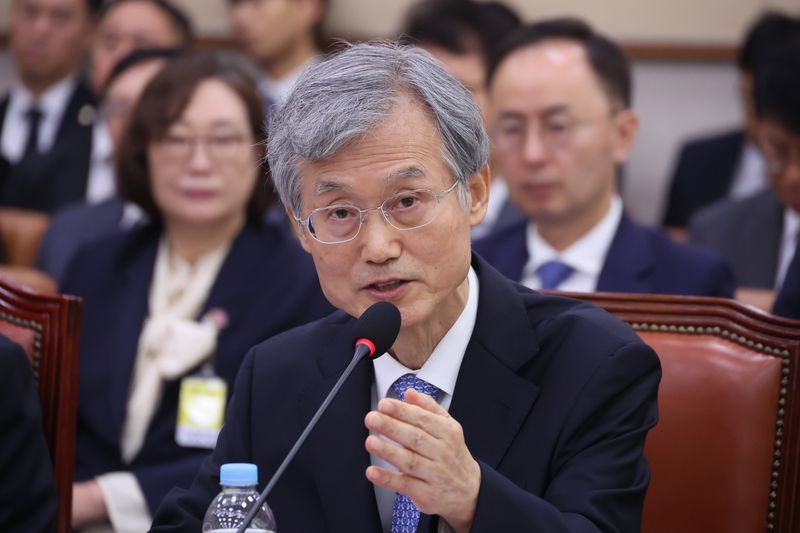
In his opening remarks at the Legislation and Judiciary Committee's National Assembly audit of the Supreme Court of Korea on the morning of the 6th, Chief Justice Cho Hee-dae said, "I determined that it would be difficult to proceed with the subsequent procedures because the document from Cheong Wa Dae requesting a renewed recommendation did not clearly state specific reasons or a constitutional basis." He added, "As many citizens are paying attention, I would like to explain what happened," and personally outlined the dispute over the recommendation.
Chief Justice Cho said, "We carefully reviewed the qualifications and abilities of the Supreme Court justice candidates recommended by the Committee of Recommendation of Supreme Court Justice Candidates and continued consultations for the subsequent procedures. However, we ultimately recommended a candidate for appointment without reaching a final agreement." Regarding the document from Cheong Wa Dae, he said, "It did not clearly state specific reasons or a constitutional basis for asking us not to proceed with the appointment of the candidate already recommended and instead to recommend another candidate." He added, "It was difficult to understand the purpose of the document from its contents alone."
He also firmly stated who holds the authority to make the recommendation. Chief Justice Cho said, "This was in accordance with the principle that the Chief Justice's authority to recommend, the National Assembly's authority to consent, and the President's authority to appoint must each be respected in accordance with their constitutional meaning." By placing the three authorities on an equal footing, he made clear that the recommendation belongs to the Chief Justice. Article 104(2) of the Constitution, which governs the appointment of Supreme Court justices, states, "A Supreme Court justice shall be appointed by the President with the consent of the National Assembly upon the recommendation of the Chief Justice." Under textual interpretation, the first principle of legal interpretation, this means that the authority to make the recommendation belongs exclusively to the Chief Justice.
Chief Justice Cho also rejected a demand that he testify. He said requiring him to testify about the recommendation of Supreme Court justices could undermine the principles of separation of powers and judicial independence. After his opening remarks, when Seo Young-kyo, chair of the Legislation and Judiciary Committee, asked, "Are you saying that you will not take the witness oath?" he replied, "As I stated at the outset, I must tell you that I cannot take the oath or testify." It is customary for the Chief Justice to leave after delivering opening remarks, but he remained in his seat after the committee, led by the Democratic Party of Korea, designated him as an ordinary witness.
Regarding the prolonged vacancy, he expressed regret. Chief Justice Cho said, "I sincerely regret causing concern to the public as the vacancy of a Supreme Court justice has continued for an extended period," adding, "I will make every necessary effort to ensure that the Supreme Court of Korea is fully constituted as soon as possible, in accordance with the principles set forth in the Constitution and laws."
The dispute began in January, when the Committee of Recommendation of Supreme Court Justice Candidates recommended Kim Min-ki and Park Soon-young, both judges at the Seoul High Court, as well as Yoon Sung-sik, a presiding judge at the Seoul High Court, and Judge Son Bong-gi of the Daegu District Court to succeed former Supreme Court Justice Rho Tae-ak. While Cheong Wa Dae and the judiciary failed to narrow their differences over the final candidate to be recommended, Rho retired on March 2, and the vacancy became a reality. Six months later, on August 18, Chief Justice Cho recommended Son despite the lack of agreement. Ten days later, on August 28, Cheong Wa Dae requested a renewed recommendation without submitting a motion seeking the National Assembly's consent to Son's appointment. On the 22nd of last month, Chief Justice Cho stated that he would not comply with the request. In an additional statement the following day, he countered that it was difficult to accept the claim that the procedure was flawed.
[email protected] Kim Dong-gyu Reporter