Yun Ho-jung: "Full funding for Future Response Fund projects is the principle; minimize local matching burdens" [2026 National Assembly audit]
- Input
- 2026-10-06 13:21:28
- Updated
- 2026-10-06 13:21:28
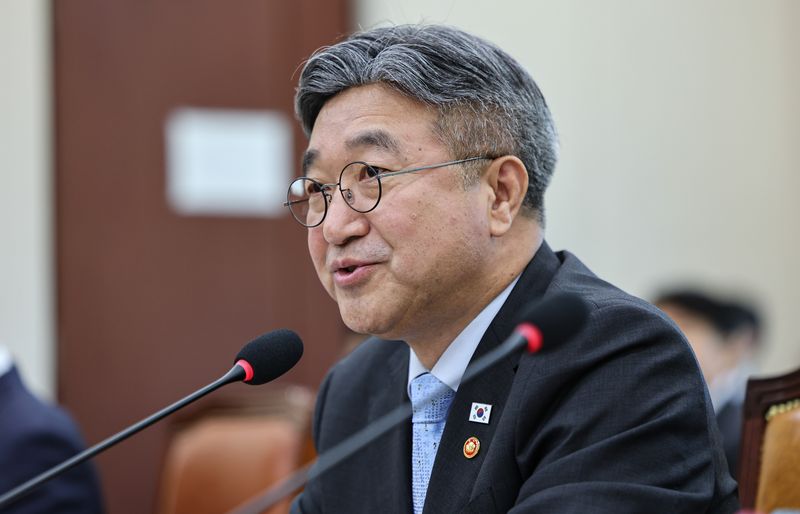
[Financial News] Minister of the Interior and Safety Yun Ho-jung said on the 6th that the government was planning, in principle, to provide as much of the full project costs as possible so that local governments would not face matching burdens amid concerns that the Future Response Fund could increase their financial strain. The move is intended to reduce the need for local governments to contribute their own budgets to fund-supported projects.
Yun made the remarks in response to a question from Park Jeong-hyeon of the Democratic Party of Korea during the National Assembly's Security and Public Administration Committee audit of MOIS that day. He added that the government was also considering giving local governments control over project decision-making and policy design.
Park raised concerns that local governments, which had expected an increase in grant taxes following higher tax revenues, might not receive as much as anticipated. Unlike grant taxes, whose uses are not predetermined, Future Response Fund projects require local governments to provide matching funds, which could reduce the flexibility of local finances, Park pointed out.
In response, Yun explained that 3.5 trillion won of the 15 trillion won allocated to the Future Response Fund's local account would be distributed as general-purpose revenue, while the remainder would be spent on projects through the fund. He said the government would make full funding of these project costs the guiding principle wherever possible in order to minimize local governments' matching burden.
On local fiscal autonomy, Yun said, "There could also be questions about whether the central government would hold the initiative in policy decisions if it were to administer the Future Response Fund." He added that the government was also considering setting the categories for budget spending while leaving local governments in charge of decision-making and policy design.
When People Power Party lawmaker Kwon Young-jin questioned whether the central government was trying to control local finances by putting funds that should be distributed as Local Grant Tax into the Future Response Fund, Yun replied, "The 19.24% Local Grant Tax rate has not changed at all."
Regarding the purpose of creating the fund, Yun said, "The central government does not intend to spend everything it wants, either." He added, "The aim is to secure strategic investment funds for responding to the future. It also means that local governments will participate alongside the central government to the extent of what the central government contributes."
Yun and Kwon also clashed over why local governments have been forced to borrow money to run their finances. Yun said, "This is because the Yoon Suk Yeol administration shifted local governments' fiscal shortfalls onto them during its three years in office." When Kwon countered, "Are you blaming the Yoon Suk Yeol administration again?" Yun replied, "Because that is the reality."
Park called for specific mechanisms to strengthen local autonomy. Yun stated, "We will develop the plan as fully as possible in line with the budget review and submit it."
[email protected] Lee Bo-mi Reporter