Yun Ho-jung: "Apply the Local Preference Index Across All Policies and Expand Support for Non-Metropolitan Areas" [2026 National Assembly Audit]
- Input
- 2026-10-06 12:50:11
- Updated
- 2026-10-06 12:50:11
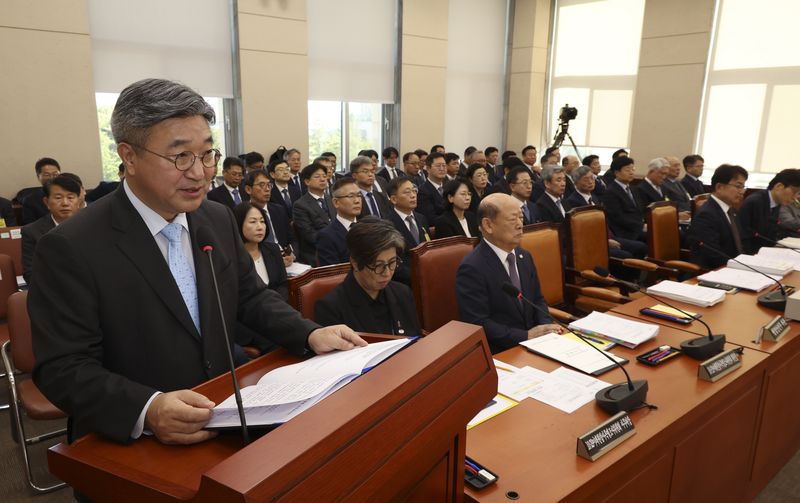
Yun Ho-jung, minister of the Ministry of the Interior and Safety (MOIS), said on the 6th, "We will apply the local preference index, which takes regional disparities into account, broadly across all policies and provide more substantial and ambitious support to non-metropolitan areas."
In opening remarks at the National Assembly Security and Public Administration Committee's parliamentary audit, Yun Ho-jung said, "We will open the way to balanced growth led by local communities." He added that the government would newly designate depopulation areas to reflect changes in population and regional conditions while strengthening tailored support.
On local finances, he said, "We will continuously expand local governments' independent sources of revenue to support locally led growth." He also announced plans to reform the local tax system by converting part of existing tax bases into a local housing welfare tax and supporting local governments in expanding their public housing supply.
He said the government would improve transparency in local governments and local councils while expanding residents' direct participation through measures such as operating local administration monitoring groups. Based on the Framework Act on Social Solidarity Economy, it will support local governments, social solidarity economy organizations and residents in jointly resolving local issues and creating new growth engines.
In the disaster and safety sector, he said the government would pursue the enactment of the Social Disaster Countermeasures Act to systematically prepare for social disasters. Yun Ho-jung stressed that swift recovery support for wildfire and heavy-rain damage would be the top priority, saying, "The state will take responsibility until the victims of social tragedies and disasters have fully recovered their everyday lives."
The government will strengthen disaster-prevention standards in response to climate change and establish a disaster prediction and response system using artificial intelligence (AI) and data, he said. It will prepare for autumn wildfires and heavy snow and cold waves in winter, while making every effort to maintain "zero" crowd-related accidents at festivals and events held during the year-end and New Year period.
Regarding administrative services, he said through the AI national secretary, "We will ensure that the benefits people need reach them before they even have to search for them." He added that one-stop services for complex civil petitions involving multiple government departments would also become widely available.
To strengthen the government's AI capabilities, he said it would train 20,000 public-sector AI experts by 2030 and expand government-wide efforts to convert documents into formats that AI can easily use. The government will also help frontline officials create the services they need directly with AI and solve problems. Yun Ho-jung said, "We will promote AI-based policy discussions and deliberations and institutionalize public participation in the policy decision-making process."
Regarding the Serious Crime Investigation Agency, which was launched on the 2nd, he said the government would support it in responding firmly to serious crimes while protecting the human rights of socially vulnerable groups. Yun Ho-jung stressed, "While dealing with crimes committed by the most powerful people in our society, we will protect the rights of those with the least power, so that the agency can establish itself as an investigative body that looks only to the people and earns their trust."
On police reform, he said, "To restore public trust in the police, which has been damaged by flawed and concealed investigations, we are also pursuing police reform forcefully, including eradicating internal corruption and overhauling the investigative system."
Yun Ho-jung cited this year's achievements as the enactment of the Framework Act on Life Safety, the payment of compensation for damage caused by high oil prices, achieving "zero" crowd-related accidents at mass gatherings, and a reduction in casualties from summer heavy rains and water-related activities. He also listed the launch of the Jeonnam-Gwangju Integrated Special City and the enactment of the Framework Act on Social Solidarity Economy as achievements.
On issues involving the past, he said, "We will sincerely apologize for state violence, correct inappropriate government awards and lay the foundation for genuine social integration."
[email protected] Lee Bo-mi Reporter