Banks to open at 9:30 a.m. from next April as financial-sector labor and management sign wage and collective bargaining agreement
- Input
- 2026-10-06 15:24:55
- Updated
- 2026-10-06 15:24:55
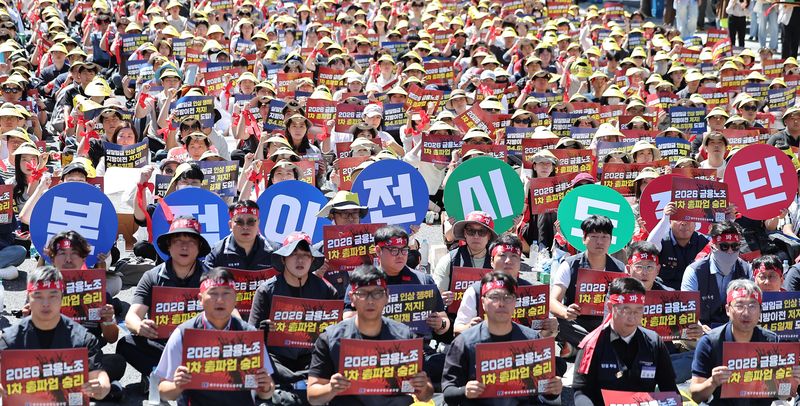
According to financial industry sources on the 6th, labor and management in the financial sector held their fifth industry-wide bargaining meeting that day and signed a 2026 wage and collective bargaining agreement. The agreement followed 58 rounds of negotiations over about six months, beginning with the first round in April.
Under the agreement, wage increases will be based on 3.0% of total payroll, with labor and management at each institution allowed to set the rate according to their circumstances.
The biggest change is the adjustment to branch opening times. Labor and management in the financial sector agreed to push back branch opening times from 9 a.m. to 9:30 a.m. starting next April. Branches will continue to close at 4 p.m.
The measure reflects changes in the financial environment, including the spread of digital finance, and in customer usage patterns. The aim is to improve the quality of customer service and strengthen financial consumer protection by allowing sufficient preparation before business hours. Each financial company will determine the specific implementation arrangements to suit its circumstances.
The employers' council explained, “While taking into account the intent of the current government's policy agenda to reduce actual working hours, we have decided to improve work and business arrangements within the current five-day workweek system, taking into comprehensive consideration the characteristics of the financial industry and the convenience of financial consumers.”
The banking sector plans to draw up specific measures to minimize inconvenience to customers before the changes take effect next April. If working hours change in the future, for example with the introduction of a 4.5-day workweek, business hours will be discussed again with customer inconvenience and other factors taken into consideration.
Labor and management in the financial sector will also set aside funding to expand employment and support social contribution efforts. They agreed to use an amount equivalent to 0.75% of total payroll to hire about 10,000 young interns, depending on each institution's circumstances. Separately, an amount equivalent to 0.25% of total payroll will be contributed to the Financial Industry Public Interest Foundation. They plan to cooperate to ensure the contributions can be used for job-creation initiatives, including support for young and middle-aged people seeking to start businesses or find work.
The parties also revised work arrangements to support work-life balance. They agreed to operate a “flexible start-time system” allowing employees to arrive up to 30 minutes after their scheduled start time, for up to one hour per week. Employees who are unable to use the one-hour early departure on Fridays may bank that time and take it as compensatory leave. The annual limit is two days, and the leave may only be used in the year it is accrued. Results of mystery shopping conducted by the Financial Supervisory Service will not be reflected in management evaluations, and employees and executives will not be disciplined based on the results of banks' own mystery shopping.
Cho Yong-byoung, chairman of the Financial Industry Employers' Council, said, “The significance of this agreement is that labor and management have joined forces not only on wage increases but also on strengthening the financial industry's social role through expanded employment and social contribution.” He added, “As the financial environment and customer usage patterns are changing rapidly, we will work to improve the quality of customer service through sufficient preparation before business hours under the five-day workweek system, and to provide even stronger protection for financial consumers.”
Meanwhile, the agreement does not include the withdrawal of plans to relocate three state-run banks—the Korea Development Bank, the Export-Import Bank of Korea and Industrial Bank of Korea (IBK)—to provincial areas, as demanded by the KFIU.
[email protected] Lee Hyun-jung Reporter