Chief Justice Cho Hee-dae Refuses to Take Witness Oath; Ruling and Opposition Parties Clash Over "Duty to Answer" and "Forced Confinement"
- Input
- 2026-10-06 11:23:42
- Updated
- 2026-10-06 11:23:42
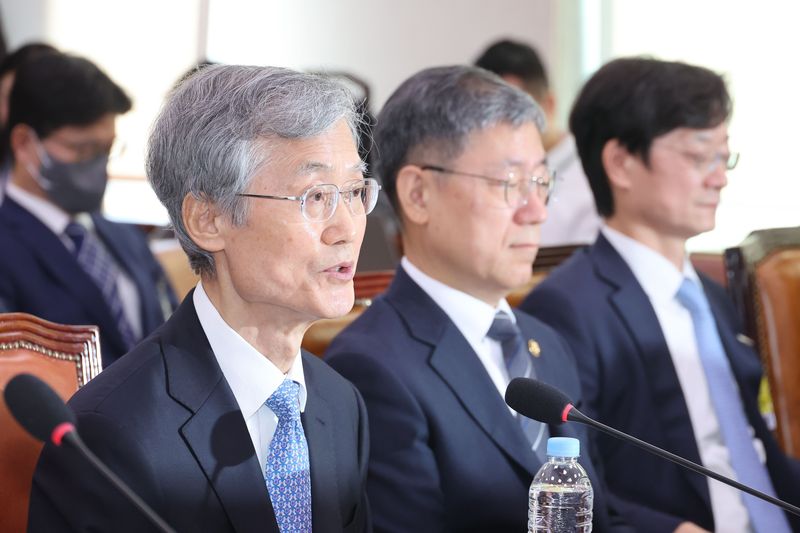
[Financial News] The ruling and opposition parties clashed from the outset on the 6th during the Legislation and Judiciary Committee's parliamentary audit of the Supreme Court of Korea over Chief Justice Cho Hee-dae's witness oath and whether he would be allowed to leave. Cho attended the audit as head of the institution and delivered opening remarks, but refused to take the oath as an ordinary witness. The Democratic Party of Korea said he had to answer directly about his refusal to resubmit a recommendation for a Supreme Court justice candidate and other issues, and did not allow him to leave after his remarks, contrary to customary practice. The People Power Party strongly protested, calling the move "an act that undermines judicial independence."
Cho attended the parliamentary audit at the National Assembly of the Republic of Korea and read prepared remarks as head of the institution, but did not take the witness oath. Although the Democratic Party of Korea had designated him as an ordinary witness, Cho had previously submitted a written explanation for his absence, arguing that requiring him to testify about his authority to recommend candidates for Supreme Court justices ran counter to the principle of separation of powers and judicial independence.
The Democratic Party of Korea pressed Cho to take the witness oath and answer directly about the issue of resubmitting a recommendation for a Supreme Court justice candidate and related matters, since he had appeared at the audit.
When Cho did not take the oath, Seo Young-kyo, chair of the Legislation and Judiciary Committee, warned, "If it is difficult to find a legitimate reason for refusing to take the witness oath, follow-up measures may be taken under the Act on Testimony, Appraisal, etc. before the National Assembly."
Democratic Party of Korea lawmaker Kim Eui-kyeom also pointed out, "Chief Justice Cho has a duty to take the oath and an obligation to answer lawmakers' questions," adding, "The National Court Administration chief's answers last time were far too vague, and there were far too many points that he failed to explain." He continued, "Taking the oath and answering the questions the public wants addressed are obvious duties not only of the chief justice but also of a public official."
Typically, the chief justice delivers opening remarks during the parliamentary audit and then leaves, while the head of the National Court Administration represents the institution and answers lawmakers' questions. However, Cho was not allowed to leave on this occasion.
The People Power Party immediately protested. Its lawmakers attached signs reading "Stop destroying the judiciary" to their laptops and demanded that Cho be allowed to leave.
People Power Party lawmaker Park Hyung-soo said, "For decades, the chief justice has delivered opening remarks, left, and then returned to deliver remarks again when the parliamentary audit concluded," arguing, "The custom exists to respect the independence of the judiciary."
Park particularly criticized the move, saying, "Forcibly keeping the chief justice seated here amounts to arresting and detaining him through the power of the majority." He added, "Isn't the reason the appointment of a Supreme Court justice is not going through that Cheong Wa Dae requested a resubmission? If so, President Lee Jae Myung should appear."
Protests continued from the People Power Party benches, including, "If he appears, Lee Jae Myung should appear too," "Dictatorial regime, step down," and "Legislative dictatorship." Seo Young-kyo responded, "Why are you being so rude and arrogant?" and "Those remarks are violent," as the audit descended into shouting and verbal sparring.
However, the Democratic Party of Korea leadership said ahead of the audit that excessive confrontation should be avoided. Democratic Party of Korea leader Kim Min-seok said that day, "I think Chair Seo will run the proceedings by appropriately regulating and restraining parts that might make the public think, 'Isn't that too much?' while asking all the questions that need to be asked and challenging all the points that need to be challenged."
The same dispute over whether Cho would be allowed to leave also arose during last year's parliamentary audit. At the time, Cho, who had likewise been designated as an ordinary witness, did not take the witness oath and remained in his seat for about an hour and 30 minutes after delivering opening remarks. He left the audit after permission to depart was granted and did not answer lawmakers' questions.
[email protected] Kim Kyung-min Reporter