Pukyong National University (PKNU) Student Develops Web Service to Share Bukangi Sighting Updates
- Input
- 2026-10-06 11:28:41
- Updated
- 2026-10-06 11:28:41
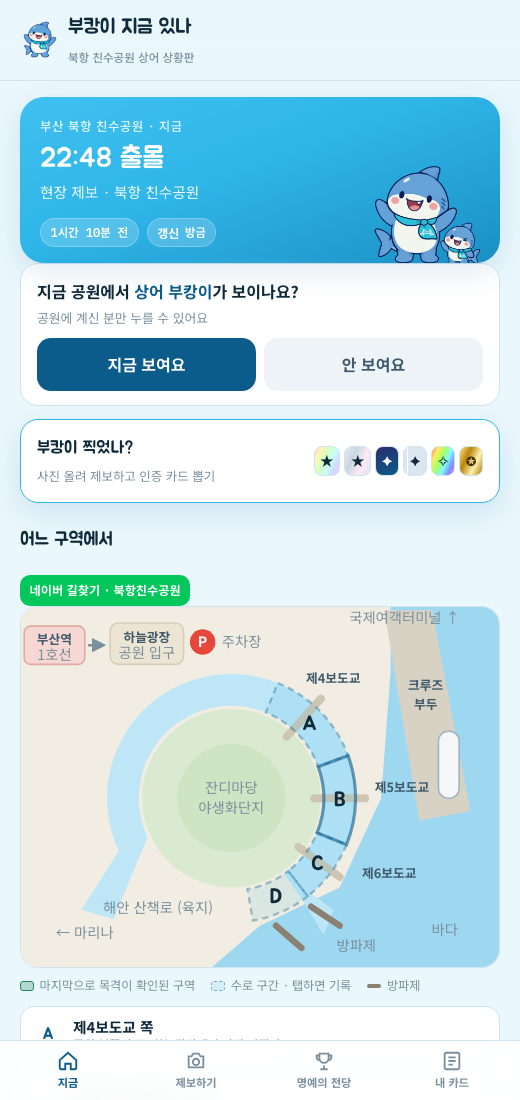
[Financial News] A PKNU student has drawn attention by developing a web service that shares citizen reports on sightings of Bukangi, a shark that appeared at Busan North Port Waterfront Park.
According to PKNU on the 6th, Lee No-a, a researcher at TEAMLAB, the laboratory of Sungchul Choi, a professor in the Department of Systems Management and Safety Engineering, developed and launched the service within a day after a shark appeared in a waterway at Busan North Port Waterfront Park on the 18th of last month, attracting crowds of visitors.
The service allows citizens at the site to press either "I see it now" or "I don't see it" and upload photos. They then receive a verification card, while the sighting area is recorded on a map of the park. Within two weeks of its launch, the service had attracted nearly 20,000 cumulative visits.
When launching the service, the researcher also used Threads, a social media platform, as a channel for collecting citizen reports. Initially, the researcher searched for sighting posts on Threads and transferred them to the map one by one. However, that approach meant the status board could not function without the operator. The system was therefore redesigned so that citizens could submit reports directly from the site, with their reliability secured in two ways. The "I see it now" and "I don't see it" buttons, which do not require photos, accept reports only from within the park's radius. For photo submissions, AI first determines whether the image was taken at the site.
The team built a multimodal judgment module to determine whether submitted photos actually showed a shark. It applied the inference structure of the JEV judgment model to images by taking in a photo along with questions such as "Is a shark visible?" and providing answers based on predetermined choices and probabilities. The system was designed to filter out images not taken at the site, such as screenshots of television broadcasts, as "not valid." Operators manually review and approve reports when the assessment is ambiguous.
The researcher developed the service using skills gained while conducting research projects with the PKNU ICAN Project Group. He completed the ICAN training program, in which companies bring real-world problems and data, and worked on practical assignments including news classification, job application evaluation, and research automation agents. Through the program, he learned how to design systems that make AI acknowledge when it is wrong and leave a basis for its conclusions. The Bukangi service's structure of "initial AI assessment, final human approval" follows the same principle.
Lee No-a said, "At first, I personally searched Threads and transferred the reports, but the limitations were clear. Once citizens could submit reports with a single button and AI could automatically screen the photos, we were able to post the information needed at the site much faster. What I learned in the lab—to create evidence-based judgments rather than plausible answers—was the biggest help when I had to build the service in a hurry."
[email protected] Kwon Byung-seok Reporter