What Can Penetrate Tumors That ADCs Cannot Reach? Hanmi Pharmaceutical Unveils a Next-Generation Anticancer Modality
- Input
- 2026-10-06 11:11:47
- Updated
- 2026-10-06 11:11:47
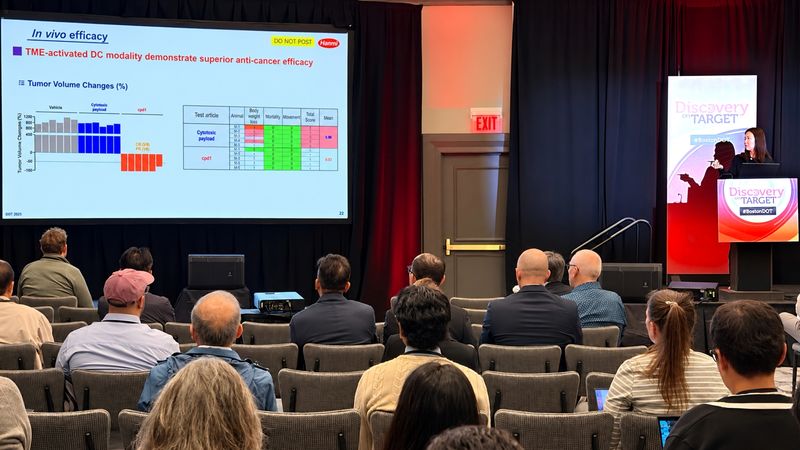
[Financial News] A new anticancer technology has emerged that could overcome the limitations of antibody-drug conjugates (ADCs), whose large molecules prevent them from penetrating deep into tumors.
Hanmi Pharmaceutical announced on the 6th that it had presented research findings on a small-molecule drug conjugate (SMDC) targeting fibroblast activation protein (FAP) in the tumor microenvironment (TME) at Discovery on Target 2026, held in Boston from September 28 to October 1. The move expands the company’s research into next-generation anticancer modalities following its work on new drugs for obesity and other metabolic diseases.
ADCs have recently drawn attention in the industry as a method of delivering drugs by targeting tumor-associated antigens (TAAs) expressed on the surface of cancer cells. However, because their molecules are approximately 150 kDa or larger, their penetration into tumor tissue is very limited. In particular, within tumor microenvironments densely populated by cancer-associated fibroblasts (CAFs) and extracellular matrix (ECM), drug diffusion and access to cancer cells may be restricted.
Hanmi Pharmaceutical focused on SMDCs, whose molecules are much smaller, to address these limitations. It selected FAP as the target because it can maximize the ability of SMDCs to penetrate tumor tissue. FAP is highly expressed in CAFs, which make up the tumor microenvironment, but its expression is limited in most normal adult tissues. By contrast, it is highly expressed in lung cancer, soft-tissue sarcomas, and solid tumors of the digestive system, including pancreatic and colorectal cancers, which respond poorly to ADCs.
Using its next-generation drug discovery platform, DNA-encoded library (DEL) screening technology, Hanmi Pharmaceutical identified novel small-molecule compounds that selectively bind to FAP and developed an SMDC by conjugating cytotoxic drugs to them. The company applied a linker designed to remain stable in the bloodstream and become specifically activated only in the tumor microenvironment, enabling the drug to act effectively at the tumor site.
Preclinical studies confirmed strong anticancer efficacy in a mouse model implanted with an FAP-expressing cell line. In particular, the orthotopic mouse model of pancreatic cancer showed substantial tumor growth inhibition and prolonged survival.
A Hanmi Pharmaceutical official said, "Unlike existing ADCs, which depend on whether a specific antigen is expressed by individual cancer cells, SMDCs are differentiated by delivering drugs through FAP expressed in CAFs within the tumor microenvironment, which is commonly formed across various cancer types. We confirmed their potential as an anticancer modality that can expand the scope of treatment beyond the existing approach of directly targeting cancer cells to include the microenvironment surrounding tumors."
The research findings will also be presented orally at the Nature Conference—Next Generation Cancer Therapeutics, being held from the 6th to the 8th (local time) at The University of Texas MD Anderson Cancer Center (MD Anderson Cancer Center) in Texas.
[email protected] Jung Myung-jin, reporter