Samsung Electronics Vietnam: "We will expand support to help Vietnamese engineers and partner companies enter the supply chain"
- Input
- 2026-10-06 12:14:15
- Updated
- 2026-10-06 12:14:15
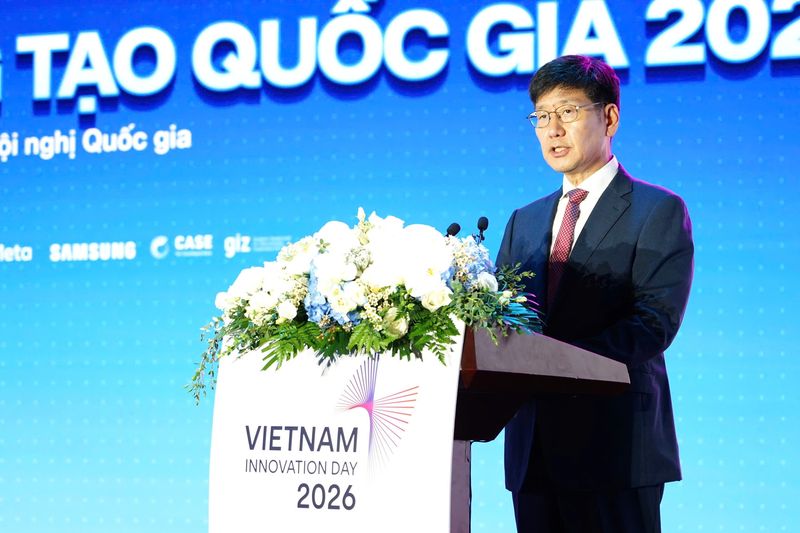
[Hanoi, Vietnam—Correspondent Kim Jun-seok] Na Ki-hong, head of the Strategic Cooperation Office at Samsung Electronics Vietnam, said the company would expand its support so that more Vietnamese engineers can participate in research and development (R&D) and local companies can gain deeper access to global supply chains. He emphasized that Samsung's Vietnam business must move beyond "producing in Vietnam" to "conducting research, making improvements and creating more value together in Vietnam."
According to local media reports on the 6th, Na Ki-hong, head of the Strategic Cooperation Office at Samsung Electronics Vietnam, made the remarks at the 2026 Vietnam National Innovation Day event held on the 4th. Na said, "Innovation is at the core of Samsung's global growth strategy, and this aligns with the Vietnamese government's policy direction of making science, technology and innovation key drivers of growth." He added, "Foreign-invested enterprises (FDI) account for 77.3% of Vietnam's total exports, and as their role has grown, particularly in the electronics and high-tech industries, their economic responsibility has also become more significant."
Na said, "Samsung's contribution in Vietnam cannot be assessed solely by the size of its factories or its export value." He emphasized, "More important benchmarks are the number of Vietnamese engineers who can work directly with technology and the capabilities of local companies to participate deeply in supply chains."
Samsung Electronics has built a large-scale production base centered on its factories in Bac Ninh and Thai Nguyen. After cumulative mobile phone production surpassed 2 billion units at the end of June last year, cumulative exports reached $500 billion (approximately 671 trillion won) as of the end of this June—17 years after commercial production began in Vietnam in 2009.
Beyond its production infrastructure, local engineers at the Samsung Vietnam R&D Center in Hanoi are responsible for developing security, multimedia and flagship smartphone features. In particular, Vietnamese was among the initial 13 supported languages when the Samsung Galaxy S24 series, the world's first on-device AI smartphones, was launched. Samsung explained that this achievement helped its AI technology gain a deeper understanding of Vietnamese users and the value of the language.
Na said, "When Vietnamese engineers solve R&D tasks themselves and the results are applied to global products, technological capabilities accumulate locally in Vietnam." He added, "This is Samsung's new role: turning its presence in Vietnam into opportunities for talent to create value."
To achieve this, Samsung Electronics Vietnam is focusing on two pillars: developing technological talent and strengthening local companies' ability to adopt and improve technology.
In talent development, Samsung continues to hold the Solve for Tomorrow competition for young people and operates the Samsung Innovation Campus (SIC), which provides free training for university students in AI, IoT, big data and semiconductors. From 2012 to the present, Samsung has invested approximately 180 billion dong (approximately 9.3 billion won) in industry-academic cooperation, research and scholarship programs in Vietnam.
To support local companies, Samsung has assisted 91 companies and trained 201 professionals through a smart factory support project being carried out in cooperation with the Ministry of Industry and Trade of Vietnam (MOIT). For example, after a plastic manufacturer in Bac Ninh Province introduced smart production data, its plan attainment rate rose from 80% to 92%, while its defect rate fell sharply from 12% to 0.5%.
Na said, "Vietnam already has a large-scale high-tech production base." He emphasized, "The next step is to increase the number of Vietnamese engineers participating in core R&D projects and expand the number of local companies that lead data, processes and standards, thereby attracting and retaining more technological value in Vietnam." He added, "We will work with the Vietnamese government and businesses to transform the current production advantage into sustainable innovation capabilities."
[email protected] Kim Jun-seok Reporter