Cho Hee-dae Says in Parliamentary Audit, "Cheong Wa Dae's Letter Requesting Renomination Lacked Specific Reasons and a Constitutional Basis"
- Input
- 2026-10-06 10:38:14
- Updated
- 2026-10-06 10:38:14
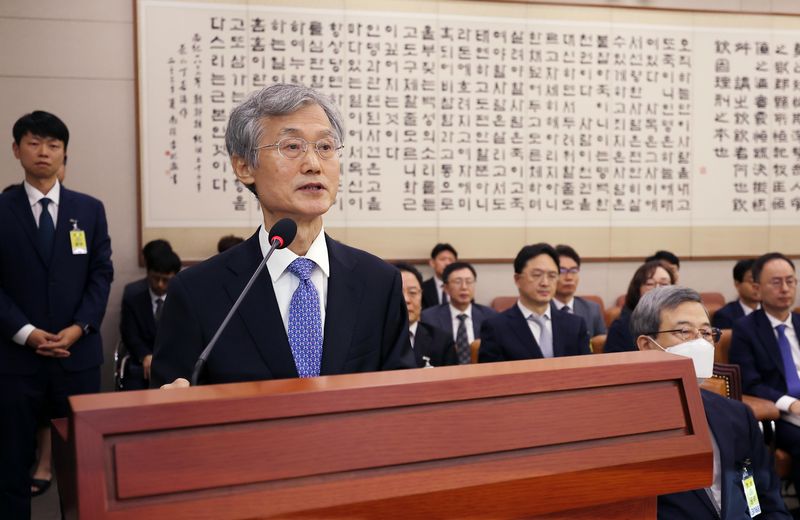
[Financial News] Chief Justice Cho Hee-dae spoke out on the 6th over the dispute between Cheong Wa Dae and the Supreme Court of Korea regarding the renomination of Supreme Court justice nominee Son Bong-gi. Cho pointed out that Cheong Wa Dae's official letter requesting the renomination of a Supreme Court justice nominee "did not state specific reasons or a constitutional basis." He also expressed concern that the National Assembly of the Republic of Korea's demand for his appearance as a general witness at the parliamentary audit could undermine the separation of powers.
Chief Justice Cho Hee-dae made the remarks after appearing before the National Assembly of the Republic of Korea's Legislation and Judiciary Committee for its parliamentary audit of the Supreme Court of Korea on the same day. Although he indicated that he would not appear as a general witness at the parliamentary audit, he attended the session to deliver customary opening remarks as head of the institution.
Regarding the request to renominate a Supreme Court justice, Chief Justice Cho Hee-dae said, "The Constitution stipulates that Supreme Court justices are appointed by the president with the consent of the National Assembly of the Republic of Korea upon the recommendation of the chief justice," adding, "This provision grants authority to the chief justice, the National Assembly of the Republic of Korea, and the president so that the authority to form the Supreme Court can be exercised harmoniously and independently."
He continued, "In light of the purpose of this constitutional provision, a demand for testimony at a parliamentary audit concerning the nomination of a Supreme Court justice could undermine the principles of the separation of powers and judicial independence," and explained, "It is unavoidably difficult to comply with a demand for testimony concerning the nomination of a Supreme Court justice."
Chief Justice Cho Hee-dae stated, "I have a duty to provide the public and the National Assembly of the Republic of Korea with the explanations they need while upholding constitutional principles. As many citizens have shown interest in the nomination of a Supreme Court justice, I will explain what happened," adding, "I carefully reviewed the qualifications and abilities of the Supreme Court justice nominees recommended by the Supreme Court Justice Candidate Recommendation Committee and continued consultations for the subsequent procedures, but ultimately recommended the appointment of a Supreme Court justice without reaching a final agreement."
He said, "I later received an official letter from Cheong Wa Dae requesting that I renominate a Supreme Court justice nominee. However, the letter did not state specific reasons or a constitutional basis for requesting that the appointment process for the nominee already nominated not proceed and that another nominee be recommended," adding, "I therefore determined that it would be difficult to proceed with the subsequent steps under these circumstances."
He emphasized, "This is based on the principle that the chief justice's authority to recommend a nominee, the National Assembly of the Republic of Korea's power to consent, and the president's power to appoint must each be respected in accordance with their constitutional meaning," adding, "I take seriously the need to resolve the vacancy on the Supreme Court. Going forward, I will make every effort to ensure that the Supreme Court is constituted in accordance with the principles established by the Constitution and the law."
[email protected] Lee Hae-ram Reporter