Lifting 20 kg with Ease and Even Performing Weaving Welding: Doosan Robotics' Next-Generation Collaborative Robot
- Input
- 2026-10-06 10:32:02
- Updated
- 2026-10-06 10:32:02
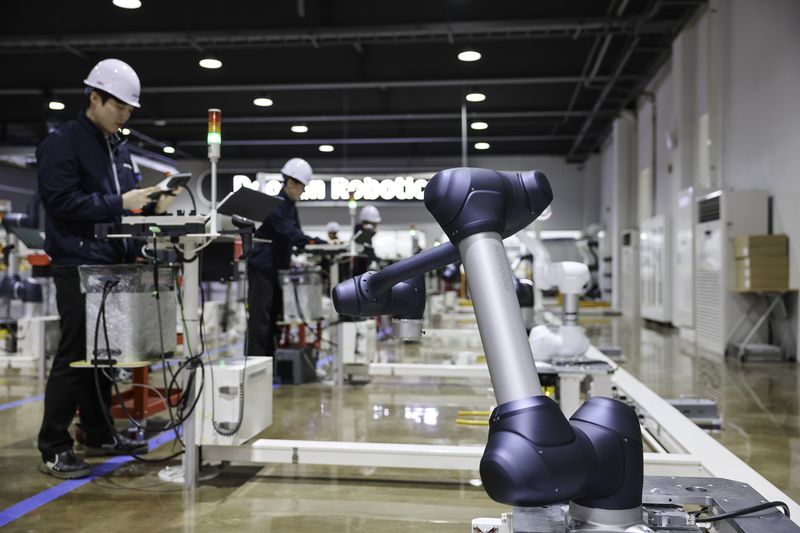
[Financial News] A robot that can lift and move objects weighing up to 20 kg on its own and weld while sweeping a torch from side to side. This is what Doosan Robotics' Korean Physical AI Collaborative Robot Integrated Platform is designed to achieve. Development is being accelerated through a national project backed by approximately 100 billion won in research and development funding.
Doosan Robotics said on the 6th that its next-generation collaborative robot and intelligent welding solution projects, proposed under the K On-Device AI Semiconductor and Robot Industry Technology Development Project jointly overseen by the Ministry of Trade and Industry and the Korea Evaluation Institute of Industrial Technology (KEIT), had been selected as national projects. The projects will run for 54 and 45 months, respectively, with total research and development funding of 98.9 billion won.
The key objective of the next-generation collaborative robot project is to enable robots to perceive, make decisions, and operate without an external PC or cloud connection. The robots will be able to immediately determine how to perform tasks based on information collected on-site through cameras, tactile sensors, torque sensors, and voice input. This is essential for deploying robots in nuclear power plants, the defense industry, biotechnology, and other sectors where the risk of data leaks is high. To make this possible, the plan calls for incorporating an AI processing unit, or NPU, along with real-time communication and control functions into a domestically developed AI system semiconductor, or SoC.
The self-decision-making robots will consist of an industrial humanoid capable of bimanual tasks and omnidirectional movement, as well as three types of collaborative robots with payloads of 5, 10, and 20 kg. The plan is to conduct uninterrupted 72-hour demonstrations at two or more sites, obtain international safety certification, and commercialize the robots in 2031. From 2031, even security-sensitive industrial sites such as nuclear power plants and defense facilities could be automated.
Doosan Enerbility is already attempting to apply Doosan Robotics' robotic welding technology to the manufacture of nuclear power equipment. The company is developing an intelligent welding solution that combines AI and digital twins with collaborative robots to produce movements comparable to those of skilled workers. Demonstrations will be conducted at the Doosan Enerbility Nuclear Center. The technology is expected to be applied to tack welding, preheating, and welding processes for nuclear equipment, with the company also planning to obtain quality certification.
The key to intelligent welding is enabling a robot to identify the welding target with a camera, correct its position, and imitate the movements of skilled workers to automatically create welding paths and weaving motions. Weaving is a highly advanced technique in which the welding torch is moved from side to side to ensure consistent weld width and quality. The goal is for the welding path to match that of a skilled worker by at least 95 percent and for the error to remain within 3 mm, the standard set by a nationally accredited testing institution. The company also expects to automate multilayer welding involving five or more layers.
Inwon Park, CEO of Doosan Robotics, said, "Labor shortages and the aging of skilled workers in manufacturing sites are structural problems that cannot be solved simply by increasing the number of automated systems. By combining on-device AI semiconductors with our own collaborative robot platform, we will reproduce even the tacit knowledge of skilled workers and turn it into a new source of competitiveness for Korean manufacturing."
[email protected] Yoon-ho Kim Reporter