"Turning Pine Wilt-Damaged Trees into Resources"... Korea Forest Service-South Chungcheong Province Cooperate on 'Industrialized Control'
- Input
- 2026-10-06 10:25:15
- Updated
- 2026-10-06 10:25:15
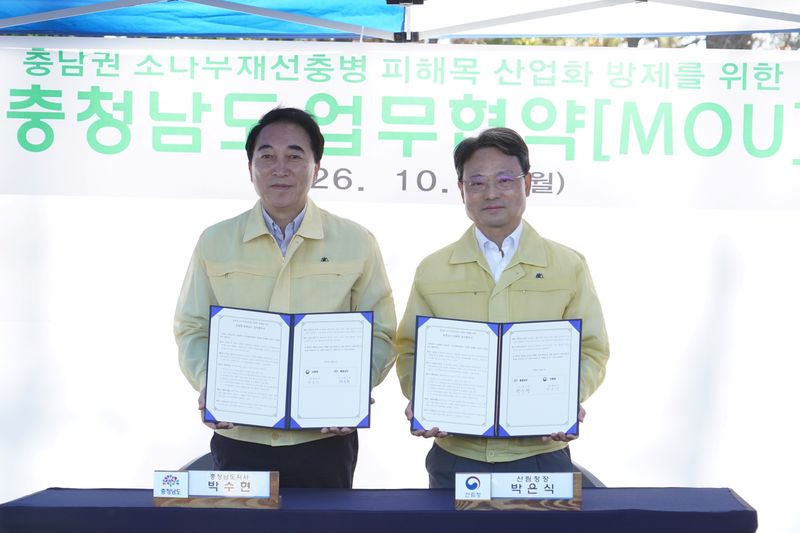
The Korea Forest Service and South Chungcheong Province said on the 6th that they had signed an MOU for the industrialized control of pine wilt disease in the South Chungcheong region at a designated site in Taean County on the 5th. They also held an on-site discussion forum on the staged utilization of affected trees. About 40 people attended, including KFS Commissioner Park Eunsik, South Chungcheong Province Governor Park Soo-hyun, the head of Taean County, and representatives from the plywood and board industries, log-producing businesses, and the Forestry Cooperative.
The MOU was established to build an industrialized control system for pine wilt disease in South Chungcheong Province, preserve healthy forest ecosystems, and increase the value of forest assets. Under the agreement, the two sides will cooperate on building an industrialized control system in the province; promoting the staged utilization of affected trees; leading the expansion of control methods that allow affected trees to be used in log form; promoting wooden construction in public buildings in South Chungcheong Province and introducing affected trees for such use; and conducting surveillance and monitoring during the movement of affected trees.
'Industrialized control' involves cutting down affected trees, treating them for disease control, and then using them in stages for products such as sawn timber, boards, and fuel. This approach seeks to achieve both effective disease control and economic value. Staged utilization refers to the principle of prioritizing high-value uses such as sawn timber and boards, while placing lower-value uses such as fuel later in the process to maximize contributions to carbon neutrality and economic value creation.
Industrialized control, which turns affected trees into resources, is considered an alternative that could reduce costs and build momentum for disease control. However, experts point out that significant challenges remain before the approach can become established in the field. Because the movement of affected trees is strictly restricted, thorough management is essential to prevent the spread of vector beetles during collection and transport. The costs of fumigation and processing, as well as the need to ensure timber quality, must also be addressed.
South Chungcheong Province is considered well suited to establishing an industrialized control model because it has many timber-industry companies producing high-value timber products, as well as power-generation companies that consume wood chips both within the province and in neighboring areas.
A plan by South Chungcheong Province to control pine wilt disease was presented at the on-site discussion forum held after the MOU signing ceremony.
Various methods needed for industrialized control were also demonstrated, including mechanized logging, a transport method combining box vehicles and netting, and large-volume fumigation. The transport method involves wrapping a box in netting to prevent vector beetles from escaping while moving the logs in log form. It was introduced in August this year to allow movement between noncontiguous movement-restricted zones for pine species. Large-volume fumigation involves stacking approximately 150 cubic meters of affected trees at logging sites or in open areas within or near movement-restricted zones, applying chemicals, and using the timber after at least 14 days have passed.
The KFS plans to use the MOU and discussion forum as an opportunity to establish a leading industrialized control model and expand it nationwide. The approach is expected to improve control efficiency and maximize the value of forest assets.
KFS Commissioner Park Eunsik said, "Industrialized control is a golden opportunity to turn the crisis caused by pine wilt disease into valuable timber resources. Starting in South Chungcheong Province, I will do everything possible to expand it nationwide, preserve our precious forests, and help make this a country where people find happiness in forests."
[email protected] Kim Won-jun Reporter