Housing subscription supply up 34%, but competition rate 'plummets'... Demand concentrated in Seoul and the capital region
- Input
- 2026-10-06 10:38:06
- Updated
- 2026-10-06 10:38:06
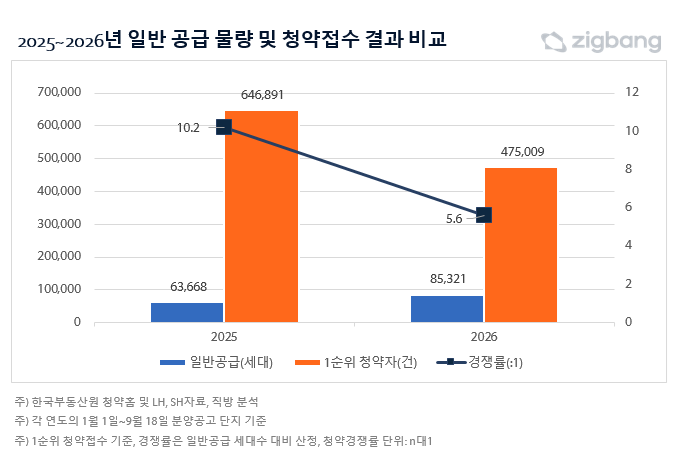
[Financial News] Although the supply of general-allocation homes in this year's nationwide housing subscription market rose sharply, the number of first-priority applicants declined, bringing the average competition rate down to about half last year's level. However, demand concentrated on major housing sites in Seoul and the capital region, including the Third New Towns, making the polarization between regions and individual complexes increasingly pronounced.
On October 6, Zigbang said its analysis of complexes that published housing recruitment notices between January 1 and September 18 this year showed that the average first-priority competition rate stood at 5.6-to-1. This was nearly half the 10.2-to-1 rate recorded during the same period last year.
This year's general-allocation supply totaled 85,321 units, up 34.0% from 63,668 units last year. By contrast, first-priority applications fell 26.6% to 475,009 from 646,891. In other words, supply increased while the number of applicants declined, pulling down the overall average competition rate.
Results varied sharply by housing type. This year, 20 public-sale complexes supplied 6,735 units, which drew 127,842 first-priority applications. The average first-priority competition rate was 19-to-1, down from 38.1-to-1 last year but about 4.3 times the 4.4-to-1 average for private-sale housing.
Private-sale housing, meanwhile, was supplied across 191 complexes, totaling 78,586 units and attracting 347,167 applications. The average competition rate fell to 4.4-to-1 from 7.4-to-1 a year earlier. Although the general-allocation supply increased 35.5% year on year, first-priority applications decreased 19.4%.
By region, Seoul attracted the greatest housing subscription demand. Its average first-priority competition rate stood at 63.1-to-1 this year, the highest in the country. Although this was lower than the 132.9-to-1 rate recorded during the same period last year, all 22 complexes that accepted applications received more first-priority applications than the number of general-allocation units available.
Seoul's general-allocation supply accounted for just 2.8% of the national total, but its 151,473 first-priority applications represented 31.9% of all applications nationwide. Roughly one in three applicants across the country applied for homes in Seoul. By complex, Acro Seocho in Seocho-gu drew 32,973 applicants for 30 general-allocation units, recording the nation's highest competition rate this year at 1,099.1-to-1.
Gyeonggi Province's average first-priority competition rate fell from 11.4-to-1 last year to 5.3-to-1 this year, dropping to less than half. General-allocation supply increased 14.8% to 30,405 units from 26,474, while first-priority applications declined 46.8% from 300,750 to 159,856.
Gyeonggi Province accounted for 84% of the nation's public-sale housing supply this year. The average first-priority competition rate was 21.1-to-1 for public-sale housing, compared with just 1.6-to-1 for private-sale housing. Eight of the 10 complexes with the highest competition rates were public-sale projects.
Incheon saw its average first-priority competition rate double to 6.4-to-1 from 3.2-to-1 last year. General-allocation supply increased 61.0% to 6,224 units, while first-priority applications rose to 39,650, approximately 3.2 times last year's figure.
Outside the capital region, housing subscription demand was relatively weak except in certain areas and complexes. Beomeo Station Park Dream Diar in Suseong-gu, Daegu, was the only complex outside the capital region to record a three-digit competition rate, at 101.5-to-1.
Among cities and provinces, Sejong City posted the highest average competition rate at 17.7-to-1, followed by South Gyeongsang Province at 5.3-to-1 and North Jeolla Province at 5.2-to-1. South Gyeongsang Province's rate rose sharply from 1.1-to-1 last year. In contrast, Jeju Province at 0.2-to-1, Gangwon State at 0.5-to-1, Busan at 0.6-to-1, and Ulsan at 0.8-to-1 all recorded average rates below 1-to-1.
A Zigbang representative said, "This year's housing subscription market produced divergent results among individual complexes, even within the same region and housing type." The representative explained, "Some public-sale projects in areas with strong demand, such as the Third New Towns, recorded competition rates exceeding 100-to-1. However, even among public-sale projects, results varied depending on location, complex size, and the supply situation in nearby areas."
The representative added, "As autumn is generally considered the peak season for housing sales, the supply pipeline is expected to expand and give applicants more choices." The representative continued, "However, given the clear differences in competition rates by region and complex this year, increased supply is unlikely to lead to a broad-based increase in housing subscription demand. Instead, demand is expected to continue moving selectively based on location, price competitiveness, and surrounding supply conditions."
[email protected] Choi A-young Reporter