The Surgery Went Well, So Why Did the Kidneys Worsen? AI Predicts Postoperative Kidney Injury [Health Check]
- Input
- 2026-10-06 09:24:30
- Updated
- 2026-10-06 09:24:30
[Financial News] Surgery may go well, only for kidney function to suddenly deteriorate afterward because of acute kidney injury. An artificial intelligence (AI) model has been developed to identify high-risk patients using just eight types of information routinely collected before surgery.
A research team comprising Lee Joo-han of the Department of Transplant Surgery and Kim, Hyung Woo of the Department of Nephrology at Yonsei University Severance Hospital, along with Yoo Seung-chan and Kim, Seonji of the Department of Biomedical Systems and Informatics at Yonsei University College of Medicine, announced on the 6th that it had developed an AI model to predict the risk of postoperative acute kidney injury using eight preoperative data points. The findings were published in the International Journal of Surgery.
Acute kidney injury is a complication in which kidney function suddenly declines after surgery. It can increase the risk of death, prolong hospitalization and lead to long-term deterioration in kidney function. Therefore, it is important to identify and manage high-risk patients before surgery.
Most prediction models developed to date have required information obtained during or after surgery, or have focused only on patients undergoing specific procedures, such as cardiac surgery. This has limited their use in clinical practice for assessing the risk faced by a wide range of surgical patients before an operation.
The research team built the AI model using data from 184,560 adult patients who underwent surgery lasting at least one hour under general anesthesia at Severance Hospital and Gangnam Severance Hospital between 2006 and 2022. After comparing the performance of a model that used preoperative, intraoperative and postoperative information with that of a model using only preoperative information, the team developed a simplified model based on the eight preoperative factors that had the greatest impact on prediction.
The simplified model used eight types of clinical information and test results, including preoperative kidney function, overall physical condition, and nutritional and anemia status. Because all of these are routinely assessed before surgery, no special tests are needed for risk prediction.
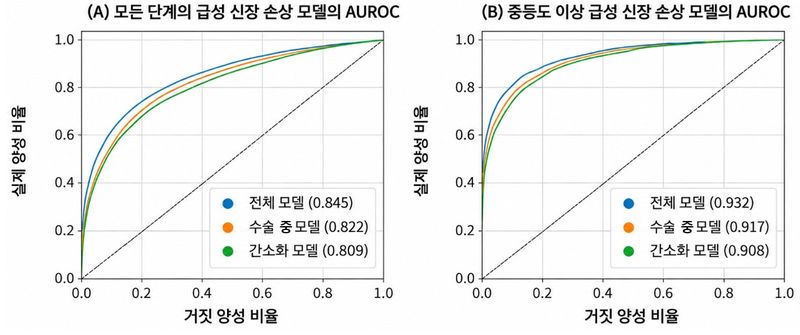
In an external validation involving 52,480 adult patients at another hospital, the simplified model recorded an AUROC of 0.809 for acute kidney injury at all stages and 0.908 for moderate or severe acute kidney injury, defined as stages 2–3. AUROC measures how well a model distinguishes between high-risk patients and those who are not at high risk; the closer the value is to 1, the better the performance.
The more complex model, which used all intraoperative and postoperative information, recorded AUROCs of 0.845 and 0.932, respectively. This means the simplified model achieved near-comparable performance using only eight preoperative data points. The risk predicted by the model also showed a high degree of agreement with the actual incidence of acute kidney injury.
For use in clinical practice, the research team proposed classifying patients as high risk when their predicted risk exceeds 20%, intermediate risk when it is 5–20%, and low risk when it is below 5%. This approach is expected to help identify high-risk patients before surgery and support preventive management, such as closely monitoring blood pressure and fluid status before and after surgery and avoiding medications that place stress on the kidneys.
Professor Lee Joo-han said, "AI prediction models need to be easy to use in clinical practice while retaining sufficient predictive power," adding, "We expect the model developed in this study to help identify and manage high-risk patients."
Professor Yoo Seung-chan stated, "In the future, we plan to link the model with electronic medical records so that a patient's risk of acute kidney injury is automatically displayed before surgery, and to verify through prospective research whether such risk-based management leads to an actual reduction in complications."
This study was conducted with support from Severance Hospital's Clinical Excellence Research Support Program for Research-Centered Hospitals.

[email protected] Jeong Myeong-jin, medical specialist Reporter