Hyundai Glovis Considers Operating a Small Modular Reactor (SMR)-Powered Car Carrier
- Input
- 2026-10-06 09:21:34
- Updated
- 2026-10-06 09:21:34
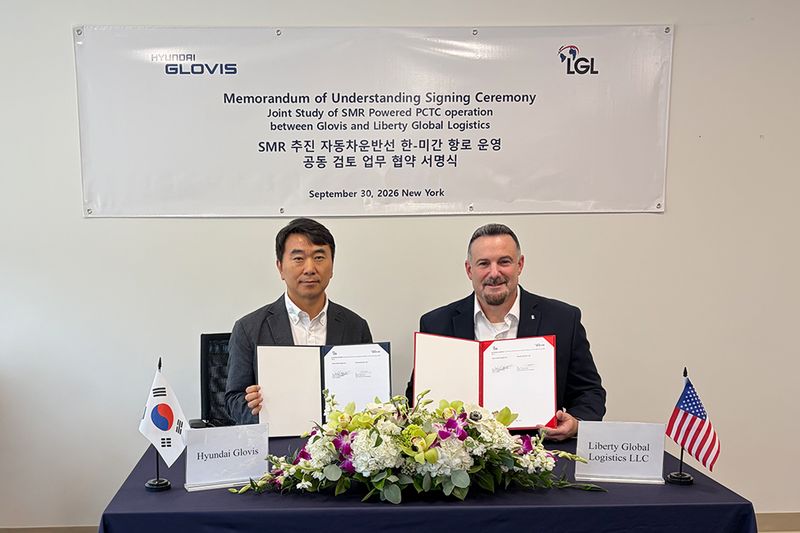
Hyundai Glovis announced on the 6th that it had signed a memorandum of understanding (MOU) with U.S.-based Liberty Global Logistics (LGL) to jointly examine the operation of SMR-powered car carriers on routes between South Korea and the United States.
The signing ceremony was held on the 30th of last month at LGL's headquarters in Jericho, State of New York. Tae-woo Kim, vice president and head of Hyundai Glovis's Logistics Business Division, and LGL President David R. Minetti attended along with other officials from both companies. LGL specializes in shipping and international multimodal transportation, carrying automobiles, heavy equipment, heavy-lift cargo and project cargo. As a major contractor for the U.S. Department of Defense and the U.S. military, it also transports cargo for the U.S. government.
Under the agreement, the two companies will jointly study the feasibility of commercial operations for SMR-powered vessels, focusing on South Korea and the United States. Hyundai Glovis will assess the characteristics of South Korean ports, the regulatory environment and operational requirements, while LGL will review relevant regulations and operating conditions in the United States. They will also examine the feasibility of developing and building the vessel, the flag state that will determine its nationality, the classification society responsible for reviewing safety and technical standards, and commercialization strategies.
Using SMRs as a ship's power source is expected to significantly reduce carbon emissions during operations and enable vessels to operate for extended periods without refueling. It may also improve cargo-loading efficiency by reducing the space required for fuel tanks and exhaust systems on conventional vessels. Against this backdrop, the South Korean government is pursuing the development and expanded use of innovative SMRs (i-SMRs) under a special law on SMRs. As part of the K-Moonshot Project, it is also promoting the development of SMR-powered vessels that combine nuclear power with shipbuilding and marine technologies.
Last June, Hyundai Glovis received Approval in Principle (AiP) from Lloyd's Register (LR) for the conceptual design of an SMR-powered PCTC at Posidonia, a maritime exhibition held in Athens, Greece. Approval in Principle is a process that reviews the technical feasibility and safety of a conceptual design that has not yet been built against international regulations and safety standards.
A Hyundai Glovis official said, "Having already secured the technical feasibility of an SMR-powered PCTC, we plan to use this collaboration to validate the various conditions required for the vessel's actual commercial operation." The official added, "After proactively introducing the world's largest LNG dual-fuel PCTC, we are preparing for the future shipping market by expanding our focus to include next-generation zero-carbon vessel technologies."
[email protected] Jung Won-il Reporter