Parliamentary Inspection Battle Begins Today: Key Points to Watch on the First Day's 'Eight Fronts'
- Input
- 2026-10-06 08:38:21
- Updated
- 2026-10-06 08:38:21
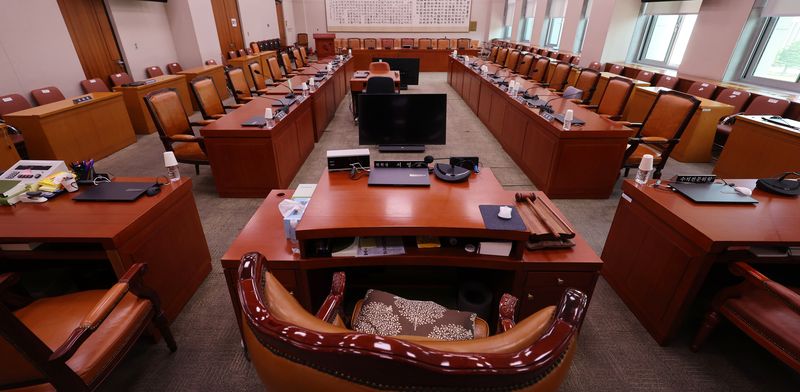
[Financial News] The Parliamentary Inspection of the Administration, which will examine the Lee Jae Myung administration's governance in its second year, begins on Oct. 6. On the first day, eight standing committees—including the Legislation and Judiciary Committee, National Policy Committee, Finance, Economy and Planning Committee, Science, ICT, Broadcasting, and Communications Committee of the National Assembly of South Korea, Foreign Affairs and Unification Committee, Security and Public Administration Committee, Trade, Industry, Energy, SMEs and Startups Committee, and Climate, Energy, Environment and Labor Committee—will operate simultaneously. From the attendance of Supreme Court of Korea Chief Justice Cho Hee-dae to investment in the United States, the launch of the Serious Crime Investigation Agency, foreign affairs and security, and energy policy, major issues will come under scrutiny all at once. An all-out confrontation between the ruling and opposition parties is expected from the first day.
The Democratic Party of Korea plans to emphasize a 'livelihoods, policy and responsibility inspection' during this year's Parliamentary Inspection of the Administration. It will review the government's progress in implementing its key agenda and focus on supporting policy achievements. The People Power Party, meanwhile, is preparing to zero in on the government's policy failures and disorderly administration, with security and people's livelihoods as its two main pillars.
From Cho Hee-dae to the Serious Crime Investigation Agency: Clash Over the Judiciary and Power Agencies
The biggest battleground is expected to be the Legislation and Judiciary Committee. Cho Hee-dae, chief justice of the Supreme Court of Korea, has clashed with the ruling camp over the recommendation of Supreme Court justice candidates. After indicating that he would not comply with a request to appear as a witness, he has triggered a direct confrontation between the ruling and opposition parties even before the inspection begins. The Democratic Party of Korea is demanding that he answer questions in person, arguing that the chief justice cannot be exempt from appearing as a witness at the Parliamentary Inspection of the Administration. The People Power Party has countered that the demand is "an abuse of power and bullying against the judiciary by the National Assembly."
Cho is expected to attend the inspection as the head of the institution and deliver opening remarks. The first key point to watch is whether he will be allowed to leave after his remarks, as is customary, or whether the Democratic Party of Korea will prevent him from leaving and continue its questioning. With tensions between the Blue House and the Supreme Court over the renomination of Supreme Court justice candidates also in the background, each of Cho's remarks is expected to influence the political situation.
The Security and Public Administration Committee will scrutinize the Serious Crime Investigation Agency, which was launched on Oct. 2 without a chief. Key issues include the delay in appointing its first commissioner, preparations for staffing and computer systems, and the division of responsibilities with other investigative agencies. Follow-up measures after the fire at the National Information Resources Service and personal information leaks involving Government24 will also come under inspection.
$200 Billion Investment in the United States and Energy Policy Under Scrutiny
Investment in the United States is the central economic battleground. The Finance, Economy and Planning Committee and the Trade, Industry, Energy, SMEs and Startups Committee are expected to debate the business viability, profitability and investment structure of the $200 billion investment in the United States stemming from the United States–Korea Tariff Negotiations. In particular, the South Korean government has described the Alaska liquefied natural gas (LNG) project as being at the "review stage," while the United States has referred to it as if the investment were essentially finalized. The circumstances behind the conflicting announcements by the two countries are expected to receive close attention.
Other investment projects in the United States, including a gas-fired combined-cycle power plant in Texas and the construction of eight nuclear power plants in the United States, will also be examined for their commercial rationale and the scope of South Korean companies' participation. Major issues for the Trade, Industry, Energy, SMEs and Startups Committee will include the feasibility of three mega-projects promoted by the government—a semiconductor industrial complex in the Honam region, AI data centers and physical AI—as well as regulatory special measures related to mega-special zones.
The Climate, Energy, Environment and Labor Committee is expected to see the ruling and opposition parties clash over the overall energy mix, including electricity supply and demand and nuclear and renewable energy policies. The Science, ICT, Broadcasting, and Communications Committee of the National Assembly of South Korea will focus on information-security investment and accountability following hacking incidents at telecommunications companies and personal information leaks. The Foreign Affairs and Unification Committee is expected to concentrate on foreign affairs and security issues, including tensions between the South Korean and Ukrainian governments over the repatriation of North Korean prisoners of war.
Both the ruling and opposition parties have placed people's livelihoods at the forefront of this year's Parliamentary Inspection of the Administration. Their approaches, however, differ. The Democratic Party of Korea plans to highlight the image of a responsible ruling party by reviewing the implementation of government policies and proposing improvements. The People Power Party intends to cite the real estate market, single-stock leveraged exchange-traded funds (ETFs) and security issues as examples of the government's failures, using them as a basis for its call to hold the administration accountable.
[email protected] Kim Kyung-min Reporter