Five LG Affiliate Components to Fly on Nuri's Fifth Launch for Joint In-Space Technology Demonstration
- Input
- 2026-10-06 10:00:00
- Updated
- 2026-10-06 10:00:00
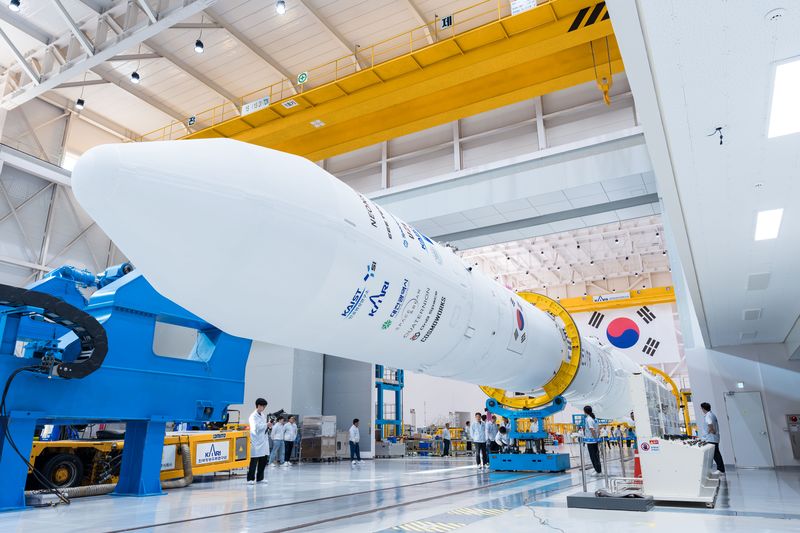
[Financial News] LG will place five components from its affiliates aboard the fifth launch of Nuri (KSLV-II) for its first in-space technology demonstration. Through the demonstration, LG plans to verify whether each component operates properly in actual space and accelerate efforts to expand business opportunities in the space environment.
According to LG on the 6th, LG Sciencepark will jointly demonstrate five components from LG affiliates aboard a CubeSat, or secondary payload satellite, prepared with lunar exploration rover developer Unmanned Exploration Laboratory (UEL). A CubeSat is a very small satellite used for Earth observation and technology validation. A total of 12 CubeSats were carried on Nuri's fourth launch.
If Nuri (KSLV-II), which is scheduled to launch on the afternoon of the 7th, successfully reaches orbit, the CubeSat will sequentially conduct operational tests of each component for approximately 60 days at an altitude of 570 km.
The components include LG Innotek's camera module; LG Energy Solution's battery pack; and LG Electronics' power module, attitude-control actuator and satellite communications antenna.
The camera module will photograph the Korean Peninsula from orbit and transmit the data, while the power module and attitude-control actuator will control the satellite's power supply and orientation. The battery pack will supply power and collect status information. The antenna will operate continuously as the satellite's basic communications system without a separate test.
■ Targeting an In-House CubeSat Launch in 2028
The demonstration will use the existing commercial off-the-shelf (COTS) approach.
Rather than developing products exclusively for space, the approach adapts commercial components whose reliability has been verified on the ground for use in the space environment. It is regarded as a way to promote the growth of a privately led space industry by significantly reducing development costs and time.
Space combines extreme cold, vacuum and radiation, creating operating conditions that differ significantly from those on Earth. LG Sciencepark plans to verify whether each component operates properly in the actual space environment and use reliability data collected during operation to further improve and advance the technologies.
LG also plans to launch an in-house CubeSat in 2028 and accelerate efforts to expand business opportunities in the space environment.
LG Sciencepark participated in component verification for Nuri's fifth launch through collaboration with Unmanned Exploration Laboratory (UEL). It is currently developing a plan to verify its proprietary satellite payload technology.
■ Beginning Development of Space Battery Cells
The collaboration began through LG's open innovation platform, SUPERSTART.
In 2023, LG Sciencepark selected Unmanned Exploration Laboratory (UEL), the only company in South Korea developing lunar exploration rovers, as a startup to support. It has supported UEL through the second incubator program since 2024. UEL was selected for the secondary payload satellite competitions for both Nuri's fourth and fifth launches. After recently attracting KRW 12 billion in investment, it plans to undertake a lunar exploration demonstration mission in 2027. The two companies also successfully conducted a rover driving test last May at a lunar surface simulation testbed in Yeoncheon, Gyeonggi Province.
LG is stepping up efforts to explore opportunities in the space business through the LG Technology Council.
In January last year, LG's Technology Council, which brings together technology executives from its affiliates, held a session on the future and opportunities of the space industry. The affiliates presented various scenarios they could pursue and discussed potential market opportunities. In particular, they discussed various collaboration models related to UEL's rover recording and transmitting conditions at exploration sites while carrying out precision scientific exploration missions.
Suehyun Chung, head of LG Sciencepark, said, "This launch is the first step in confirming how LG's technologies actually operate in the space environment. As we continue validating the technologies we have accumulated on the ground, we will work to contribute to South Korea's space industry ecosystem."
LG Sciencepark also met twice with the Korea Aerospace Administration (KASA) last year to discuss ways to cooperate in the space industry.
LG Energy Solution also announced in November last year that it had begun developing battery cells for aerospace applications with U.S. startup South 8 Technologies. The effort was pursued as part of an "Aerospace Project" being carried out by U.S. thermal-management solutions specialist KULR Technology Group and the U.S. National Aeronautics and Space Administration (NASA).
[email protected] Sohyun Park Reporter