U.S. AI Data Center Delays Hurt Related Industries... Power Crunch Causes Headaches
- Input
- 2026-10-06 08:01:28
- Updated
- 2026-10-06 08:01:28
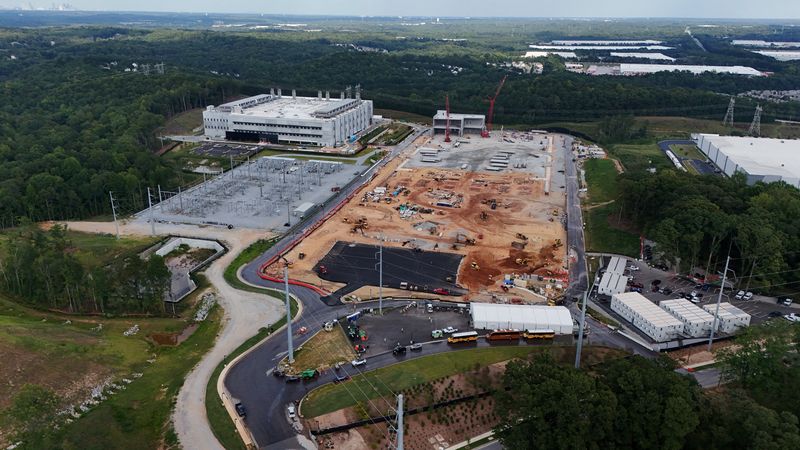
[Financial News] The construction boom for artificial intelligence (AI) data centers in the U.S. has recently run into a wall because of power shortages, prompting concerns that the performance of companies supplying the centers could deteriorate.
In a report on the 5th local time, Morgan Stanley cited delays in AI data center construction and forecast that companies supplying ancillary materials and services would be hit harder than AI chipmakers.
The biggest reason for delays in building new centers is electricity. AI data centers have been a political issue since last year because of their massive power consumption. A hyperscale AI data center uses at least 100 MW (megawatts) of electricity, roughly the amount consumed by a small or medium-sized city. Ahead of the November midterm elections, opposition campaigns have emerged across the U.S., arguing that AI data centers cause power shortages while creating few jobs for local communities.
Morgan Stanley estimated last month that U.S. data center developers would face a net power shortfall of 32 gigawatts (GW) by 2028. That amounts to 34% of the electricity required by data centers. The estimate also factors in alternative sources of power, including on-site generation and fuel cells.
Another investment bank, Goldman Sachs, also pointed to growing constraints on data center expansion in the U.S. Goldman Sachs expects the short-term impact of political opposition to be limited, while Morgan Stanley identified labor, power and political issues as the main obstacles to data center expansion.
Morgan Stanley nevertheless assessed that power bottlenecks would not threaten the 2027 earnings outlooks of AI chipmakers NVIDIA and Broadcom. The two companies have relatively strong visibility into which data centers will ultimately deploy their chips. They also have room to address power shortages through regional expansion and coordination among data centers, chipmakers and the power supply chain.
However, if semiconductor equipment cannot be installed at data centers on time, customers may delay product deliveries or cancel orders. Morgan Stanley noted that memory, optical communications, power management and analog semiconductors could be the most exposed to inventory disruptions in such a scenario.
NVIDIA shares traded on the Nasdaq in the U.S. on the 5th closed at $238.9, up 2.1% from the previous session. The stock climbed as high as $240.1 during the session, setting a new record high. After reaching a record high on the 2nd for the first time since May, it extended the record-setting streak for a second consecutive day. NVIDIA's market capitalization stood at $5.76 trillion as of the 5th, or about 7,824 trillion won. Its stock would need to rise another 3.8% to push the market cap above $6 trillion.
[email protected] Park Jong-won Reporter