"Even a senior MAFRA official's mother and the Korea Coast Guard commissioner left farmland uncultivated"—Farmland Act under fire for "creating lawbreakers"
- Input
- 2026-10-05 22:50:25
- Updated
- 2026-10-05 22:50:25
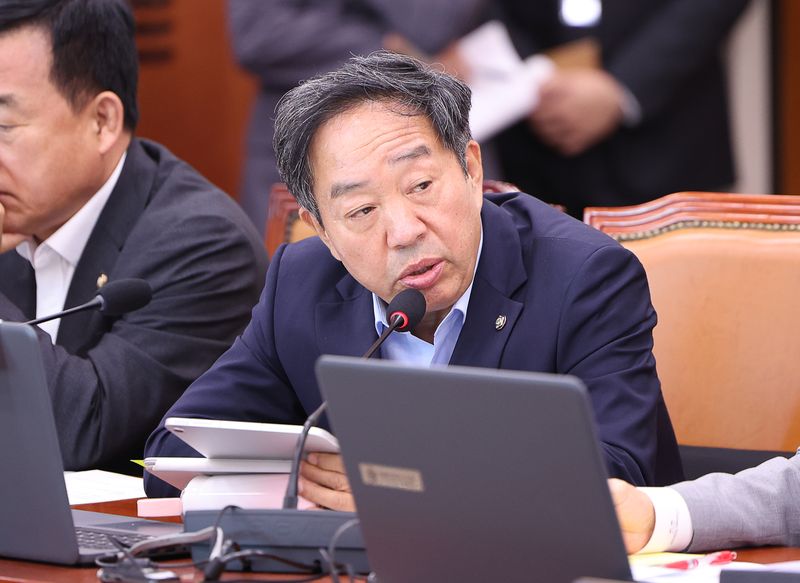
[Financial News] It was confirmed that the farmland owned by the mother of a senior official at the Ministry of Agriculture, Food and Rural Affairs (MAFRA), which oversees agricultural policy, and by newly appointed Korea Coast Guard (KCG) Commissioner Ha Man-sik was all in an "uncultivated" state. Political circles have criticized the current Farmland Act and uniform nationwide farmland surveys for failing to reflect the realities of rural areas facing aging and population decline, while producing only people who are unfairly branded as lawbreakers.
According to documents submitted on the 5th to Kang Seung-gyu, a member of the National Assembly Agriculture, Food, Rural Affairs, Oceans and Fisheries Committee, by the Jeonnam-Gwangju Integrated Special City, Wando County, and others, all three farmland parcels owned by the mother of Kim Jeong-wook, director of MAFRA's Agricultural Innovation Policy Office, in Dongbaek-ri, Geumil-eup, Wando County, South Jeolla Province, were found to be fallow in a local government survey. Kim's mother acquired the land through purchases and gifts in 2021 and 2022 and even submitted agricultural management plans, but she has not actually farmed it.
Kim explained, "It is true that my mother has been unable to cultivate the land because she is elderly and ill," but added, "Under the Farmland Act, farmland can legally be left fallow for reasons such as illness, so it cannot be definitively deemed a violation." He further stated, "I have also expressed the view in internal MAFRA meetings that supplementary measures are needed to take rural realities, such as the aging population, into account."
A similar controversy was also found involving newly appointed KCG Commissioner Ha Man-sik. Ha inherited three farmland parcels in Jinsang-myeon, Gwangyang-si, South Jeolla Province, in 2007 but has left them uncultivated. Graves for his parents, grandparents, and others have been established on the land. Ha's side explained, "We could not farm the land ourselves because we were unable to find anyone who wanted to cultivate it, and we were also unable to sign a lease-trust contract with the Korea Rural Community Corporation's Agricultural Land Bank."
However, Kang's office pointed out that placing graves on farmland constitutes illegal conversion of farmland and that leaving it uncultivated without entrusting it to the Agricultural Land Bank could make the owner subject to a farmland disposition order or an enforcement fine.
Kang criticized the cases, saying they illustrate the bleak reality of rural areas, particularly islands and mountainous regions, where even finding tenants or entrusting farmland to the Agricultural Land Bank can be extremely difficult.
Kang urged action, saying, "The current Farmland Act and nationwide survey system are so out of step with reality that even the families of senior MAFRA officials have to sweat to prove that their land is being left fallow legally. The government must immediately reconsider nationwide farmland surveys that treat law-abiding elderly farmers who are unavoidably unable to farm as lawbreakers and leave them trembling with anxiety, and revise the law to bring tenancy regulations in line with reality in response to the rural extinction crisis."
[email protected] Park Ji-hyun Reporter