The hormone released to help you grow taller becomes one that protects “youth” in your 60s to 80s [Professor Ahn Cheol-woo’s Encyclopedia of Hormones]
- Input
- 2026-10-10 07:00:00
- Updated
- 2026-10-10 07:00:00
People in their 60s to 80s are at a stage of life when they begin a new chapter alongside retirement. Since this stage is much longer than it used to be, they need to pursue new careers and hobbies, build relationships, and establish new routines.
Chronic conditions emerge one by one and energy wanes with each passing year, but healthy eating habits, appropriate exercise, and invigorating activities can make this a very happy time. At this stage of life, illness is no longer an enemy but an ally.
Important hormones include growth hormone, sex hormones, melatonin, and myokines. Growth hormone is essential throughout life. From infancy through adolescence, it drives the rapid growth of height and the skeleton; in adulthood, it helps maintain muscles, strengthens heart function, and boosts libido.
After age 60 in particular, bone density declines with aging, and brain, immune, and heart function, among others, all weaken. Even a little support from growth hormone can significantly slow the pace of these changes. It is a hormone whose value we may not notice while we have it, but miss when it is gone—one that becomes all the more precious and desperately needed when levels are low: growth hormone in old age.
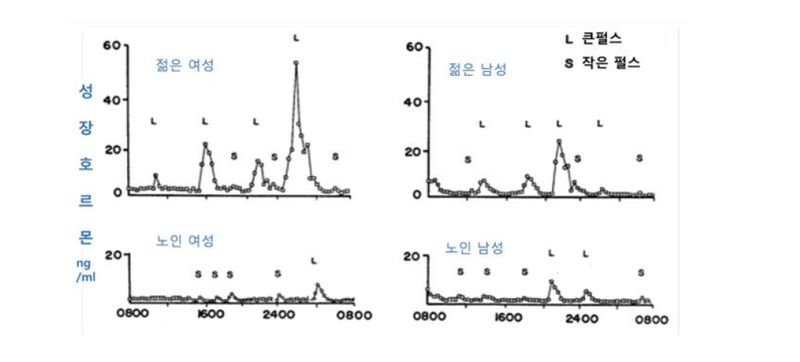
Growth hormone is secreted in pulses, rising suddenly and then falling in a rhythm like a heartbeat. It is also secreted on a daily cycle, following a similar pattern according to activity and sleep over the course of the day.
In youth, the difference in size between short and long pulses in the daily secretion pattern of growth hormone is pronounced. Short pulses amount to only a few nanograms per milliliter of blood, while large pulses can reach 20–60 nanograms. The largest pulses occur during sleep; medium-sized pulses occur during the day, when people are active, and in the afternoon, when they feel hungry. The remaining pulses are very small. Children secrete 200–600 micrograms a day, and this rises to as much as 1,000–1,800 micrograms during puberty. Adult men and women secrete 200–600 micrograms, with women believed to secrete somewhat more.
After age 30, however, growth hormone secretion declines by 1.5–2% each year. This means that by their 60s, people’s hormone secretion has dropped sharply to half or less of the level it was in their 30s. In particular, secretion during sleep falls to an almost insignificant level. Growth hormone that surges in large pulses during slow-wave sleep—that is, non-REM sleep—normally accounts for 50–70% of the total amount secreted in a day. But because this almost disappears, overall secretion falls to near rock-bottom levels, becoming nearly depleted.
/Professor Ahn Cheol-woo, Department of Endocrinology, Gangnam Severance Hospital
[email protected] Jung Myeong-jin, Medical Correspondent Reporter