President Lee Jae Myung's Approval Rating Slips Slightly to 37.4%; Democratic Party Rebounds to 42.5% [Realmeter]
- Input
- 2026-10-05 16:37:08
- Updated
- 2026-10-05 16:37:08
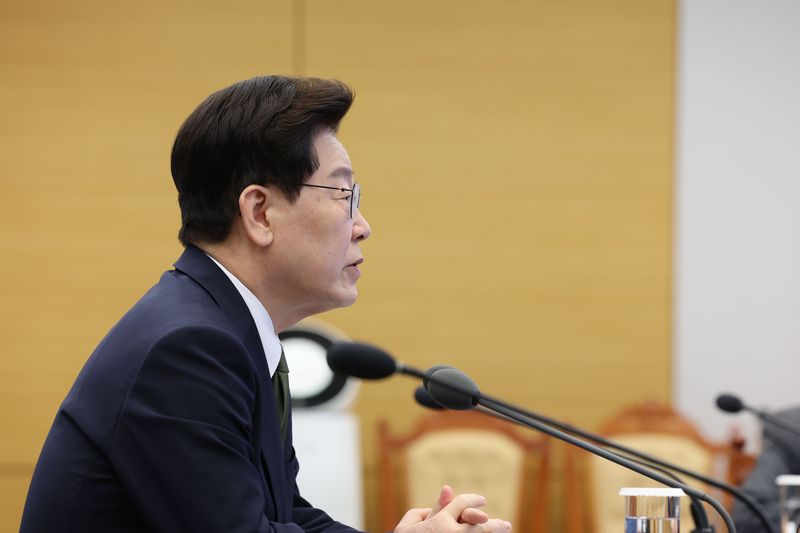
[Financial News] A poll released on the 5th found that President Lee Jae Myung's job-approval rating fell slightly to 37.4% after three weeks. Support for the Democratic Party of Korea rebounded to 42.5%, showing a different trend from the president's approval rating. The People Power Party edged down to 38.4%, while the gap between the two parties remained within the margin of error for the seventh consecutive week.
In a survey conducted by Realmeter at the request of Energy Economy Newspaper among 2,515 people aged 18 and older nationwide from the 28th of last month to the 2nd of this month, President Lee's positive job-performance rating was 37.4%, down 0.5 percentage points from the previous week. His negative rating also fell 0.3 percentage points to 59.8%, while 2.8% responded, "Don't know."
In a party-support survey conducted on the 1st and 2nd among 1,009 people aged 18 and older nationwide, support for the Democratic Party rose 3.8 percentage points from the previous week to 42.5%. Support for the People Power Party fell 1.0 percentage point to 38.4%. The gap between the two parties was 4.1 percentage points.
Realmeter analyzed that the announcement of livelihood and welfare policies financed with excess tax revenue was a positive factor for the president's approval rating. However, controversy surrounding the nomination of Kim Ji-yong as head of the Serious Crime Investigation Agency, a landmine explosion in the Korean Demilitarized Zone (DMZ), diplomatic friction with Ukraine, and housing instability involving monthly-rent and lease properties in the Seoul metropolitan area contributed to the decline.
For the Democratic Party, government support policies concerning housing, jobs, and finance for low-income households were viewed as positive factors. Realmeter explained that support from centrists and people in their 30s and 40s consolidated on the basis of favorable views of the government's livelihood and welfare policies. As for the People Power Party, Realmeter interpreted the loss of centrist support as a result of its hard-line response, including security offensives over the DMZ landmine incident and plans for street protests, which appeared to be partisan infighting.
By region, the president's approval rating fell the most in Honam. The positive rating for Gwangju and South Jeolla combined with North Jeolla was 57.4%, down 8.1 percentage points from the previous week. Busan, Ulsan, and South Gyeongsang recorded 35.1%, a decline of 1.3 percentage points. Daegu and North Gyeongsang rose 7.3 percentage points to 29.2%, while Daejeon, Sejong, and Chungcheong increased 2.4 percentage points to 42.4%.
By ideological orientation, the rating stood at 14.1% among conservatives, down 2.2 percentage points, and at 54.4% among progressives, down 1.1 percentage points. Among centrists, it rose 2.8 percentage points to 42.7%.
In party support, the Democratic Party rose 12.0 percentage points in Daegu and North Gyeongsang and 6.3 percentage points in Busan, Ulsan, and South Gyeongsang, recording 26.7% and 41.4%, respectively. In the same regions, support for the People Power Party fell 4.9 and 3.1 percentage points, respectively, to 50.4% and 41.2%.
Among people in their 30s, support for the Democratic Party rose 11.5 percentage points to 41.9%, while support for the People Power Party fell 7.5 percentage points to 37.5%. Among those in their 20s, Democratic Party support rose 7.2 percentage points to 28.1%, while People Power Party support fell 6.8 percentage points to 47.5%.
Support for the Rebuilding Korea Party (RKP) rose 1.2 percentage points from the previous week to 5.2%. The Reform Party stood at 1.5%, the Progressive Party at 1.3%, and other parties at 1.6%, while the unaffiliated accounted for 9.5%.
Both surveys were conducted using a 100% wireless automated-response method. The response rate for the presidential job-performance survey was 3.9%, with a margin of sampling error of plus or minus 2.0 percentage points at the 95% confidence level. The party-support survey had a response rate of 3.0% and a margin of sampling error of plus or minus 3.1 percentage points at the 95% confidence level. Further details are available on the website of the Central Election Poll Deliberation Commission.
[email protected] Seong Seok-woo Reporter