Visiting Yuk Young-soo’s birthplace, Jang Dong-hyuk declares a “war over history” and continues his offensive against ‘Assassin(s)’
- Input
- 2026-10-05 16:17:14
- Updated
- 2026-10-05 16:17:14
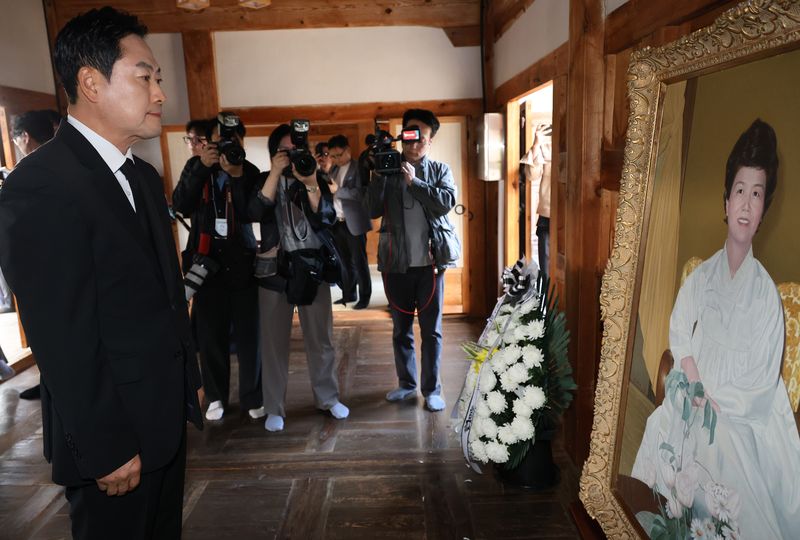
[Financial News] As controversy over alleged historical distortion in the film ‘Assassin(s)’ continues, People Power Party leader Jang Dong-hyuk visited the birthplace of the late Yuk Young-soo and declared a “war over history and culture.” He argued that the nation-building and industrialization narratives of former Presidents Syngman Rhee and Park Chung-hee represent the legitimacy of the Republic of Korea and warned that the film could pose “a threat to liberal democracy.” Kim Min-seok, leader of the Democratic Party of Korea, countered that “the place for politics to join the fight is people’s livelihoods,” saying politicians should not meddle in film criticism.
Jang visited Yuk Young-soo’s birthplace in Okcheon County, North Chungcheong Province, on the 5th. The visit came after controversy erupted over ‘Assassin(s),’ which deals with the attempted assassination of President Park Chung-hee and the shooting death of Yuk Young-soo on August 15, 1974. Jang called for the film’s screenings to be halted and for the filmmakers and others involved to apologize. Park Deok-heum, a deputy speaker of the National Assembly whose constituency is in Okcheon County, as well as policy committee chair Im Lee-ja and secretary-general Jeong Hee-yong, also attended.
Regarding the film, Jang cited a statement by Soviet dictator Joseph Stalin and criticized it as “a means of inciting the masses.” He continued, “Adding unverified allegations based on malicious intentions to the wounds of the deceased and their families, thereby distorting historical facts, goes beyond freedom of expression.” He added, “The people must fight back against attempts to gain political advantage by distorting history and threatening the liberal democratic system.”
Criticizing the Democratic Party of Korea, he said, “They are trying to sanctify certain people and certain events, refusing to allow any verification, gagging the public, and even threatening to punish them.” He added, “The people will not tolerate attempts to gag them in response to clear historical distortions.” Referring to what he called “Starbucks Tank Day” and the “Paichai High School incident,” he also accused the party of failing to address historical distortions by the same standard.
Park Deok-heum said, “Mrs. Yuk’s life and death were both the pain of one family and a tragedy in modern Korean history. Her family, who have lived with the grief of losing their beloved mother, are being wounded again by false fabrications.” He added, “Do not cowardly hide behind the claim of ‘artistic license.’ Apologize sincerely to the bereaved family and the people.”
Meanwhile, Kim Min-seok criticized the People Power Party’s continued attacks on ‘Assassin(s)’ as excessive political interference in the cultural and artistic fields. In a social media post that day, Kim said, “Respect for the bereaved, respect for creative work, and testimony about dictatorship are all valuable principles.” He continued, “Criticism of history belongs to records and verification, while criticism of films belongs to critics and audiences.” Kim went on to emphasize, “Should politicians really step in and even blame the actors?” and added, “Films belong to filmmakers, and evaluations belong to audiences. The place for politics to join the fight is people’s livelihoods.”
[email protected] Lee Hae-ram Reporter