"The More Places There Are to Stick, the More They Cluster—even with Weak Adhesion"...The Secret of Molecules Inside Cells [Health LAB]
- Input
- 2026-10-06 08:00:00
- Updated
- 2026-10-06 08:00:00
[Financial News] A clue has emerged to understanding how biomolecular condensates form—structures created when proteins, ribonucleic acids (RNA), and other molecules floating in the cytoplasm come together.
A research team led by Professor Dong Woog Lee of Ulsan National Institute of Science and Technology (UNIST), together with teams led by Professor Soo Hyung Choi of Hongik University and Professor Hur, Su-Mi of Daegu Gyeongbuk Institute of Science and Technology (DGIST), announced on the 6th that it had established that the more stickers—a molecule's binding sites—in a synthetic material modeled on proteins, the more readily condensates form with weaker bonds.
Biomolecular condensates are small liquid droplets formed when proteins, RNA, and other molecules floating inside cells gather in one place. Without a separate membrane, they collect the materials needed for reactions and regulate various processes within the cell. A representative example is a condensate formed when viral DNA and proteins that detect it come together. When enzymes and reactants gather inside, reactions that produce immune signaling molecules become more active.
The research team created an experimental model that makes it possible to examine the process by which complex biomolecules cluster in a simplified way. The model consists of long, chain-shaped synthetic molecules fitted with stickers that bind to one another and spacers that fill the gaps between them.
The stickers were modeled on the guanidinium group in the chemical structure of Arginine, an amino acid found in proteins. When the stickers' flat surfaces move close enough to overlap, an attractive force comes into play. The spacers were modeled on part of the structure of another amino acid, L-lysine.
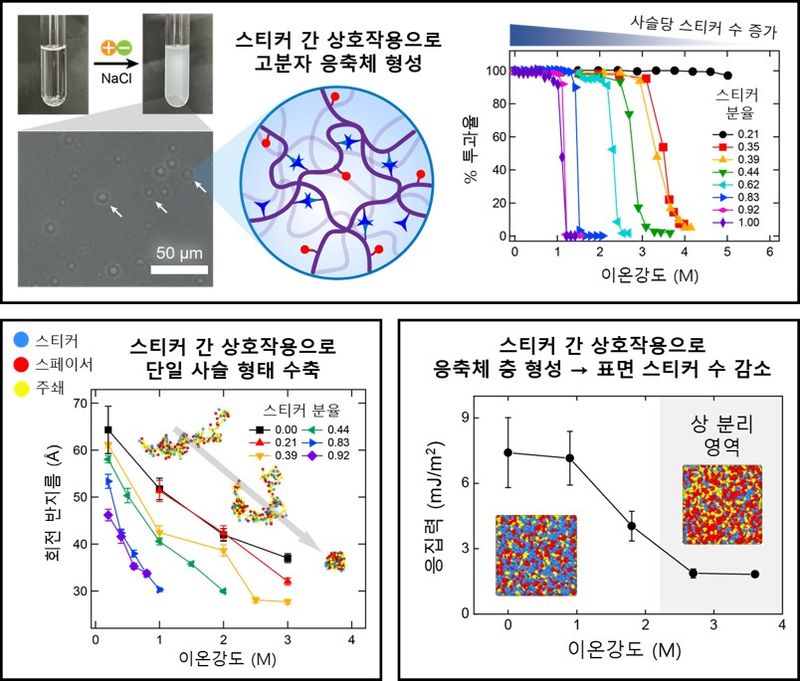
When stickers bind to one another, the chain contracts. When stickers on different chains bind, multiple chains become linked and cluster together. Keeping the chain length constant, the researchers varied the number of stickers and the salt concentration in water to compare changes in chain shape and the conditions under which molecules clustered.
The experiments showed that molecules gathered to form liquid droplets at lower salt concentrations when they had more stickers. In other words, liquid–liquid phase separation—the formation of liquid droplets with different compositions within a liquid—occurred more readily. The transition from an extended individual molecular chain to a contracted state also appeared at lower salt concentrations. This means that when there are more sites available for binding, chains can contract and multiple chains can gather even if each individual bond is relatively weak.
A counterintuitive result emerged when two surfaces coated with the same material were brought together underwater. In materials with more stickers, stronger sticker-to-sticker forces actually caused the two material layers to adhere less.
The research team interpreted this result as meaning that densely packed molecular chains within each layer first bonded with one another, reducing the number of stickers available to connect to the opposite layer. Molecular simulations also supported this interpretation, showing that stronger bonds reduced the number of stickers exposed on the outside.
The joint research team stated, "We developed a model that resembles the binding properties of proteins while allowing us to easily control the number of binding sites and the strength of adhesion. This model enables us to examine everything from changes in molecular shape to condensate formation and bonding between material layers. We expect it to be useful not only in basic research on biomolecular condensation, but also in developing stimuli-responsive soft materials, wet adhesives, and underwater coatings."
The study was published in the international academic journal Advanced Science on August 18.
[email protected] Yeon Ji-an Reporter